Institut für
BD Biodiversität
Dr. Wiebke Sickel

Institut für Biodiversität
Bundesallee 6538116 Braunschweig
- Telefon
- +49 531 596 2524
- Telefon
- +49 531 2570 2200
- wiebke.sickel@thuenen.de
Forschungsschwerpunkte
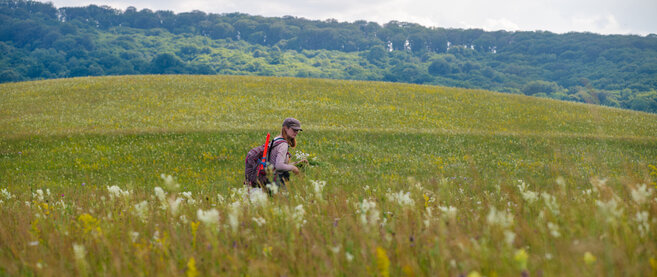
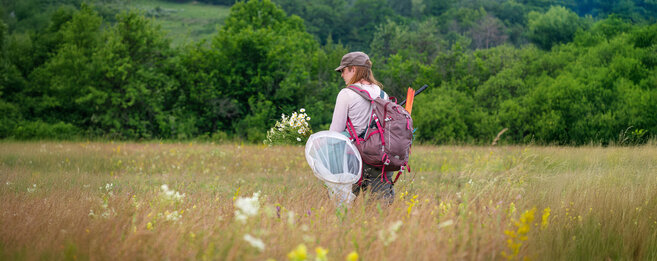
- DNA-basiertes Biodiversitätsmonitoring (Wildbienen-Monitoring in Agrarlandschaften)
- Erfassung genetischer Vielfalt […]
Methoden-Entwicklung eDNA
Projekte
Ansprechperson für
Beteiligt an
Laufende Projekte
Abgeschlossene Projekte
Mitgliedschaften und weitere Aktivitäten
- Gesellschaft für Ökologie
- British Ecology Society (BES)
- COST-Action GENOA[WS1]
- Reviewtätigkeit für wissenschaftliche Journale
- Reviewtätigkeit für BES Review College
Publikationen
- 0
Gornall L, Dauber J, Sickel W (2025) Population delimitation in bumble bees - strategies and research gaps. Front Bee Sci 3:1507903, DOI:10.3389/frbee.2025.1507903
- 1
Hellwig N, Sommerlandt FMJ, Grabener S, Lindermann L, Sickel W, Krüger L, Dieker P (2024) Six steps towards a spatial design for large-scale pollinator surveillance monitoring. Insects 15(4):229, DOI:10.3390/insects15040229
- 2
Weber C, Noel G, Sickel W, Monaghan MT, Bonn A, Lokatis S (2024) Urban pavements as a novel habitat for wild bees and other ground-nesting insects. Urban Ecosyst 27(6):2453-2467, DOI:10.1007/s11252-024-01569-3
- 3
Sickel W, Zizka V, Scherges A, Bourlat SJ, Dieker P (2023) Abundance estimation with DNA metabarcoding - recent advancements for terrestrial arthropods. Metabarcoding & Metagenomics 7:e112290, DOI:10.3897/mbmg.7.112290
- 4
Sickel W, Kulow J, Krüger L, Dieker P (2023) BEE-quest of the nest: A novel method for eDNA-based, nonlethal detection of cavity-nesting hymenopterans and other arthropods. Environmental DNA 5(6):1163-1176, DOI:10.1002/edn3.490
- 5
Hakobyan A, Velte S, Sickel W, Quandt D, Stoll A, Knief C (2023) Tillandsia landbeckii phyllosphere and laimosphere as refugia for bacterial life in a hyperarid desert environment. Microbiome 11:246, DOI:10.1186/s40168-023-01684-x
- 6
Hornick T, Richter A, Harpole WS, Bastl M, Bohlmann S, Bonn A, Bumberger J, Dietrich P, Gemeinholzer B, Grote R, Heinold B, Keller A, Luttkus ML, Mäder P, Motivans Svara E, Passonneau S, Punyasena SW, Rákosy D, Richter R, Sickel W, et al (2022) An integrative environmental pollen diversity assessment and its importance for the Sustainable Development Goals. Plants People Planet 4(2):110-121, DOI:10.1002/ppp3.10234
- 7
Wilson RS, Keller A, Shapcott A, Leonhardt SD, Sickel W, Hardwick JL, Heard TA, Kaluza BF, Wallace HM (2021) Many small rather than few large sources identified in long-term bee pollen diets in agroecosystems. Agric Ecosyst Environ 310:107296, DOI:10.1016/j.agee.2020.107296
- 8
Campos MG, Anjos O, Chica M, Campoy P, Nozkova J, Almaraz-Abarca N, Barreto LMRC, Nordi JC, Estevinho LM, Pascoal A, Branco Paula V, Chopina A, Dias LG, Tesic ZLj, Mosic MD, ZKostic A, Pesic MB, Milojkovic-Opsenica DM, Sickel W, Ankenbrand MJ, et al (2021) Standard methods for pollen research. J Apicult Res 60(4):1-109, DOI:10.1080/00218839.2021.1948240
- 9
Vaudo AD, Biddinger DJ, Sickel W, Keller A, López-Uribe MM (2020) Introduced bees (Osmia cornifrons) collect pollen from both coevolved and novel host-plant species within their family-level phylogenetic preferences. Royal Soc Open Sci 7(7):200225, DOI:10.1098/rsos.200225