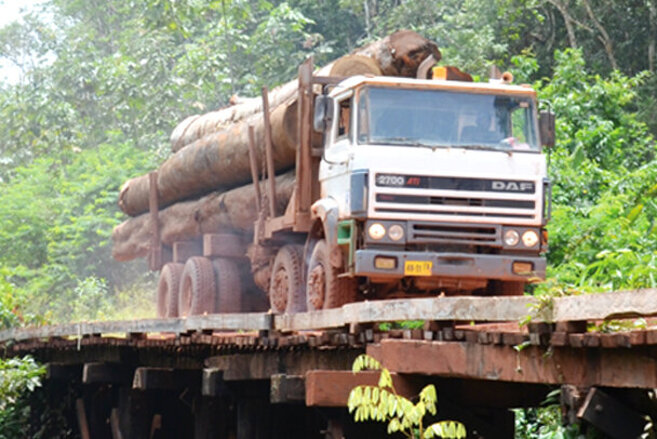
A timber truck fully loaded with logs drives over a very simple wooden bridge in a forest.
Institute of

WF Forestry

News

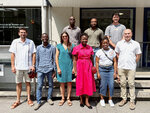
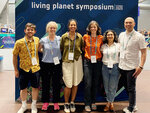
On July 21, nine participants from the Hamburg Adult Education Center visited the Thünen site in Hamburg-Bergedorf to learn about the work of the Thünen Institute.

group photo

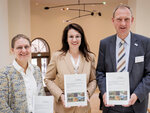
The Scientific Advisory Council on Forest Policy (WBW) has issued a current statement providing guidance on the climate protection benefits of forests and wood use. The document was presented to Parliamentary State Secretary Martina Englhardt-Kopf at the beginning of July.

Group picture with three people

The Thünen Institute of Forestry and the Amazon Environmental Research Institute (IPAM, Brazil) will collaborate in the new research project "EUDR Effects".

André Guimarães, executive director of IPAM; Caroline Salomão, IPAM consultant; Richard Fischer, senior scientist Thünen Institute

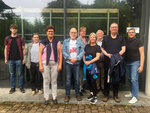
In collaboration with IUFRO, the global forest science network, the Thünen Institute of Forestry hosted the second ForMIP 2.0 workshop. On site in Hamburg-Bergedorf and worldwide via livestream, they discussed different models for the forestry sector.

A group of people are standing in front of some trees.


From May 13-17, 2025, Björn Seintsch, Cornelius Regelmann, and Lydia Rosenkranz participated in the International IUFRO Conference of Research Group 4.05 Managerial economics and accounting, entitled "Socioeconomic changes and challenges in the forest sector: acknowledging the role of managerial…

Group photo

On June 2, Paraguayan Vice Minister of Economy Andrés Gines visited our Institute WF to discuss status and challenges of the EUDR implementation process in Paraguay.

Foto (from left to right): Andrés Gines, Sven Günter, Matthias Dieter, Margret Köthke, Heiner von Lüpke (all four TI-WF).

The Anthropocene poses major challenges for the conservation and restoration of ecosystems in human-altered landscapes.

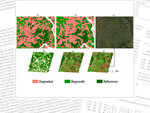
Transition classes for change between no FLR (forest landscape restoration) and potential FLR scenario for 2024

Participatory approaches involving stakeholders for the modeling of human-environmental interactions and social-ecological systems (SESs) have gained increased recognition in recent years.

Graph: Percentage of reviewed papers with participation of stakeholders at different stages of the modeling process (n: 79); no participation include studies with unclear status of participation.

Socio-Ecological System modelling projects are becoming increasingly complicated, with multiple actors and aspects being the norm.

Image of a chimera as an example of modelling socio-ecological systems, in which the different heads and limbs can point in different directions and pursue different goals.

Scroll to top