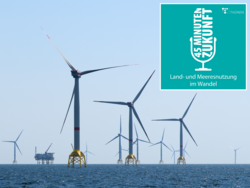
Podcast "45 minutes future"

45 minutes of the future. This is the Thünen Institute's podcast on the transformation of land and sea use. Together with our guests from science and practice, we look for ways to master current social challenges - in three quarters of an hour. We ask, for example, how the various interests on land and at sea can be reconciled in terms of sustainable use, how our forests can cope with climate change, why it is so difficult to ensure food prices are fair or to improve animal welfare. And we provide answers that are science-based and solution-oriented.

Our hosts

Lydia Heller studied political science and communications and, as a freelance radio author, produces mainly radio features for Deutschlandfunk and Deutschlandfunk Kultur - preferably on scientific topics.


Marko Pauli is a freelance radio author for Deutschlandfunk Kultur, BR and SWR. He primarily produces radio features dealing with environmental protection and species conservation. He also works as a presenter for ByteFM.

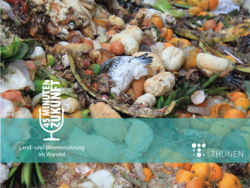
Episode 23, LIVE: Plate instead of bin I

Food waste is a burden on the environment, the economy and society. In conversation with our guests, we clarify where the waste is generated, how artificial intelligence can reduce it, and where politics and research should start.

More
Episode 23, LIVE: Plate instead of bin I

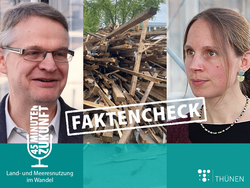
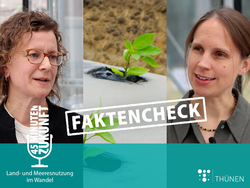
FACT CHECK: Microplastics – Are they a risk to our crops?

More and more microplastics are ending up in our soil – and we know very little about the consequences. A study from Nanjing, China, recently made headlines with claims such as "Microplastics threaten our entire food supply". Find out whether this alarming conclusion is justified and what steps are needed to advance microplastics research in the Thünen Fact Check.

More
FACT CHECK: Microplastics – Are they a risk to our crops?

Episode 22: The ailing Baltic Sea

The Baltic Sea is confronted with serious challenges. The sea has been utilised intensively by humans for centuries and is suffering from eutrophication, climate change, waste-pollution, traffic and declining fish stocks. Does the recipe for the recovery of the territorial sea lie on land?

More
Episode 22: The ailing Baltic Sea

Episode 21 – LIVE: More than hearth and farm

Women are an integral part of agriculture. But they usually work in the background. The balancing act between farm and family is difficult. What are the biggest challenges facing female farmers today and can politics help to support the women?

More
Episode 21 – LIVE: More than hearth and farm

Episode 20: The soil hangs onto the tree

Without forest soil, there is no forest. It provides trees with water, vital nutrients, and stability. However, nitrogen inputs and climate change are putting pressure on forest soils. In order to preserve it, we need long-term approaches that consider both the entire ecosystem and its utilisation.

More
Episode 20: The soil hangs onto the tree

Episode 19 – LIVE: There's a lot of wood in it

Wood from illegal logging remains a problem - even on the German timber market. Mislabelled wood ends up in building materials, furniture and paper. Genetic analyses can expose the wood products in question and find out where they actually come from

More
Episode 19 – LIVE: There's a lot of wood in it

Episode 18: All hands to the pump

Intact peatlands are efficient carbon reservoirs and therefore true climate protectors. If they are drained for agriculture and forestry, immense quantities of greenhouse gases escape into the atmosphere. Can paludiculture offer an alternative in the area of conflict between agriculture and climate policy?

More
Episode 18: All hands to the pump

Episode 17: Untapped resources II

Long droughts, massive floods – extreme weather events are increasing in our latitudes as well. New water management strategies are needed: water from heavy rainfall and floods, for example, could be captured and stored for later dry phases. Water utilisation must also become more efficient.

More
Episode 17: Untapped resources II

Episode 14: Can the eel still be saved?

The European eel is acutely threatened. Fishing is one of the reasons for this. While scientists have been calling for a complete ban on fishing for years as well as for the improvement of water quality and fish passage, politicians are struggling with it. What is the reason for this? And could the eel still be saved at all?

More
Episode 14: Can the eel still be saved?

Special episode: Ask your colleague!

15 institutes with almost 1,200 employees - the Thünen Institute has numerous experts on extensive, but also very specialised topics. One of them researches octopods, for example, even though they don't even exist in the Baltic Sea. Another knows when cows feel really good. During the Thünen Day in June 2023, four researchers put themselves to the questions of their colleagues. The result is the first special episode of "45 minutes future".

More
Special episode: Ask your colleague!

Episode 13: Outdated or attractive after all?

Does country life make you happy? It is not only since Corona and Lockdown that many a die-hard city dweller has discovered the advantages of country life. From a scientific point of view, however, the current wave of people moving to the countryside is nothing completely new. And yet, it is an opportunity for rural areas. Our guests Dr Annett Steinführer from the Thünen Institute in Braunschweig and Dr Thomas Dax from the Federal Institute of Agricultural Economics and Mining in Vienna explain how it can be used.

More
Episode 13: Outdated or attractive after all?

Episode 12: End storage of greenhouse gases?

About ten percent - that's how many greenhouse gas emissions will remain from the current ones if Germany is climate neutral by the middle of the century. This is because there will be unavoidable emissions that will have to be compensated. This works, for example, by removing carbon dioxide (CO₂) from the atmosphere and storing it permanently. But where should the CO₂ go? And which CO₂ extraction processes are at all promising?

More
Episode 12: End storage of greenhouse gases?

Episode 11: What kind of trees do we need in future?

Climate change is taking its toll on forests: Since 2018, almost 400,000 hectares of forest stands in Germany alone have died due to drought and pest infestation. There's no question about it: Forests need to be made fit for the challenges of the coming years. But what will the forest of the future look like? Will there still be beech, oak, pine and spruce? Or will species that are still considered exotic today take over the reigns?

More
Episode 11: What kind of trees do we need in future?

Episode 10: Strategic partnership in the field?

Pest or beneficial insect? When it comes to insects and agriculture, livelihoods are at stake. Crop losses due to insect pests here, species extinction and loss of biodiversity there. It is true that pest control is part and parcel of agriculture. But the efficiency of pest control also affects the large group of beneficial insects. Can agriculture and biodiversity still function together?

More
Episode 10: Strategic partnership in the field?

Episode 9: At the expense of others?

By 2045, Germany should be greenhouse gas neutral, at least on a net basis. However, if we stick to our consumption patterns and at the same time enforce high standards of nature conservation, climate protection and animal welfare, this will contribute to rising food prices and put strain on natural resources such as forests in other parts of the world. How can agriculture and forestry contribute to the transformation towards a climate-neutral economy and society? Where do leakage effects occur and does a CO2 emission tax help to mitigate them?

More
Episode 9: At the expense of others?

Episode 8: One label fits all?

More and more people in Germany and the EU are paying attention to sustainability when shopping. Various labels promise orientation. But they usually only provide information on individual aspects such as working conditions or the origin of a product. The idea is that a state label should cover all aspects of a sustainably produced product. Can this work?

More
Episode 8: One label fits all?

Episode 7: All organic, everything fine?

The German government has set a target of 30 per cent organic farming by 2030, but the outbreak of the war in Ukraine has once again prompted critics to claim that organic farming cannot guarantee food security. Organic farming is the only way to ensure food security in the future, the proponents counter. We ask: Is organic farming suitable for the masses?

More
Episode 7: All organic, everything fine?

Episode 6: Small is beautiful?

Agriculture, the timber industry, fishing, local supply - everywhere the extinction of small businesses is lamented. Trust in these enterprises is high. Yet, from a scientific point of view, there is no evidence that small farms are fundamentally better or more sustainable than large farms, neither from an environmental nor from an animal welfare point of view. Where does this emotional affection for small farms come from, when even organically managed farms are sometimes very large? Do large structures also have advantages?

More
Episode 6: Small is beautiful?

Episode 5: For the museum only?

Climate change, fishing closures, Brexit, red tape, competition for space, an outdated fleet and the image as destroyer of the environment pose an existential challenge to the fishing industry. On the other hand, coastal fishing is positively connotated as a sustainable, artisanal activity. Which path should be taken in order to give coastal fishing a future?

More
Episode 5: For the museum only?

Episode 4: Fair, true, cost-covering?

The prices producers receive for food should be fair and secure their livelihoods. This applies to both the German dairy farmer and the Latin American coffee picker. But what does that actually mean? And how can social and ecological demands be incorporated into pricing? What possibilities does the state have to influence pricing?

More
Episode 4: Fair, true, cost-covering?

Episode 3: To each animal its own pleasure?

German livestock farming is under pressure: international competition here, demands for higher animal welfare and environmental standards there. Every form of animal husbandry is associated with environmental impacts. Are there options for making animal welfare, environmental and climate protection an integral part of agriculture?

More
Episode 3: To each animal its own pleasure?

Episode 2: Is there still a place available?

In the North and Baltic Seas, every square metre is being fought over: Traditional users such as fisheries are increasingly competing with wind farm operators, ship owners, raw material producers, the military, environmental protection and nature conservation for the scarce marine space. With the argument of the necessary energy transition, offshore energy producers are currently asserting themselves against many other interests. What could a peaceful co-existence of all interest groups look like?

More
Episode 2: Is there still a place available?

Episode 1: My field - my power station?

80 percent - this is the share that renewable energies should have in electricity consumption by 2030. The Ukraine war has made the issue of energy transition even more urgent. Agricultural land is increasingly being considered as a location for energy production. Open space and agri-photovoltaics offer interesting options - also from the farmers' point of view.

More
Episode 1: My field - my power station?

Contact

Nadine Kraft


Portraitfoto von Nadine Kraft

Head of Communication, Spokesperson

Bundesallee 50
38116 Braunschweig
Telephone
+49 531 2570 1865
Telephone
+49 151 15290850
Email
nadine.kraft@thuenen.de


Our podcast is listed at www.wissenschaftspodcasts.de

Scroll to top