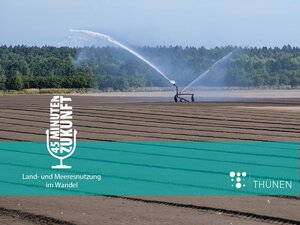
Long droughts, massive floods – extreme weather events are increasing in our latitudes as well. New water management strategies are needed: water from heavy rainfall and floods, for example, could be captured and stored for later dry phases. Water utilisation must also become more efficient.
In agriculture, and especially in horticulture, there is already a water shortage. Fruit and vegetables in particular, but also potatoes, require large quantities of water for cultivation. At the same time, there is a risk of crop losses due to heavy rainfall and flooding. Agriculture is one of the causes of anthropogenic climate change - and is a victim of the consequences.
The joint project LAWAMAD (‘Agricultural Water Management in Germany’) investigates where the greatest potential for water storage lies in German agricultural landscapes, how much water could be stored and how realistic its realisation is. After all, investments in irrigation systems must be economically viable for farmers.
‘An irrigated area is an area that is cultivated more efficiently’, says Dr. Daniel Heßdörfer from the Bavarian State Institute for Viticulture and Horticulture
Crops and arable land must also be adapted to the increasing drought, for example through new varieties and erosion control. The latter allows more water to seep into the soil instead of running off the surface.
In this episode, Dr. Nataliya Stupak and Dr. Daniel Heßdörfer discuss drought and competition over water in Germany. They also talk about which forms of water storage are already being used and which technologies could make irrigation more efficient.
Further links and literature:
- The Federal Environmental Agency answers the most important questions about drought in Germany on its website. (in German)
- The National Water Strategy of the Federal Ministry for the Environment, Nature Conservation, Nuclear Safety and Consumer Protection (BMUV) sets guidelines for dealing with water scarcity in Germany. The aim is to establish a modern water management system by 2050.
- A short explanatory video on the National Water Strategy by the Federal Ministry for the Environment, Nature Conservation, Nuclear Safety and Consumer Protection (BMUV)
- The articles ‘How aridity damages agriculture’ and ‘Adaptation to aridity in arable farming’ by the Federal Agricultural Information Centre explain what damage can be expected from drought and what helps agricultural actors in limiting it. (in German)
- In the Thünen Working Paper 227, scientists have assessed the potential of technical options for water storage and irrigation and their feasibility. (in German)
- You can find further articles on the challenges of increasing drought, flooding and threatened water quality on the homepage of the Thünen Topic Water.
- In its thematic focus #Our water, the TV channel Das Erste has collected contributions for the young and the old on the topic of water in Germany in 2022 (in German).
- The ‘planet wissen’ documentary presents the most important strategies of the National Water Strategy (in German).

Dr. Daniel Heßdörfer works at the Bavarian State Institute for Viticulture and Horticulture. Here he develops new strategies for climate adaptation in viticulture and horticulture as well as for new irrigation systems.

Dr. Nataliya Stupak is a scientist in the Climate, Soil, Biodiversity Unit at the Thünen Institute in Braunschweig. She is the contact person for the joint project ‘Agricultural Water Management in Germany (LAWAMAD)’ and thus sits at the interface between research, agriculture and politics.