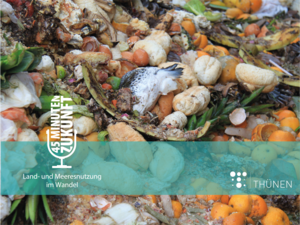
Millions of tons of food end up in the trash every year - at the expense of the environment, the economy, and society. In this episode, we talk about which social structures contribute to this and how we can achieve a more sustainable approach to food.
“We don't have too little food in the world overall, it's a question of distribution. We need to distribute food more fairly and sustainably.”
Prof. Dr. Okka Zimmermann is a social scientist at IU International University and TU Braunschweig.
Worldwide, food waste causes significant greenhouse gas emissions and leads to lost investments in agriculture and food processing. At the same time, it exacerbates social inequalities: edible food ends up in the trash, even though it is urgently needed elsewhere.
A lot of food is thrown away, especially in private households. Often, too much is bought or products spoil because they are stored incorrectly. In our society, it is also no longer common practice to share surplus food with neighbors or friends. In addition, more food is often produced than is actually needed. Strict shape and size standards mean that misshapen fruit or vegetables are sorted out before they reach supermarket shelves.
Initiatives such as foodsharing or the Braunschweig and Braunschweiger Land Food Council (ERBSL) show that there is another way: foodsharing volunteers rescue surplus food from supermarkets or bakeries that would otherwise end up in the trash. The ERBSL advocates for a regional and climate-friendly food policy and organizes events on the topic of nutrition.
Despite this commitment, the fundamental challenge remains: in order to solve the causes of waste in the long term, we as a society must rethink how we deal with food.
In this podcast episode, we discuss with Prof. Dr. Okka Zimmermann and Dr. Felicitas Schneider how social structures contribute to food waste, where we can start, and what we can learn from other countries.
“In my view, we need to solve the problem of food waste as a society. There are no individual culprits.”
Dr. Felicitas Schneider is a researcher at the Thünen Institute of Market Analysis.
Further links and literature:
• The podcast episode Plate Instead of Bin I – How Can AI Save Food? is available on our website and wherever good podcasts are available. The episode was recorded live at the KIDA conference in September 2025 at the Thünen Institute. Guests included Prof. Dr. Engel Arkenau, Digitalization Officer at the Federal Ministry of Food and Agriculture (BMLEH), and Thünen President Prof. Dr. Birgit Kleinschmit.
• The Global Initiative Against Food Loss and Waste was launched during the meeting of the chief agricultural scientists of the G20 countries (MACS-G20). At the Thünen Institute, Dr. Felicitas Schneider coordinates international activities aimed at reducing food loss and waste.
• The Thünen Institute's dossier Less is more: reducing food loss and waste outlines strategies for preventing food loss and waste and offers a wide range of articles on the topic.
• Too good for the bin is a campaign that was launched by the BMLEH in 2012. It offers numerous tips for everyday life, an app with recipes for leftover food, teaching materials, and much more.
• In 2023, the BMLEH joined forces with 14 wholesale and retail companies to sign the Pact Against Food Waste. In it, the companies commit to halving their food waste by 2030 and donating food that is still edible.


Dr. Felicitas Schneider is a researcher at the Thünen Institute of Market Analysis. She has been conducting research on food loss and waste since 2001 and coordinates the Global Initiative Against Food Loss and Waste. She is an active member of the board of the Braunschweig and Braunschweiger Land Food Policy Council (ERBSL).