

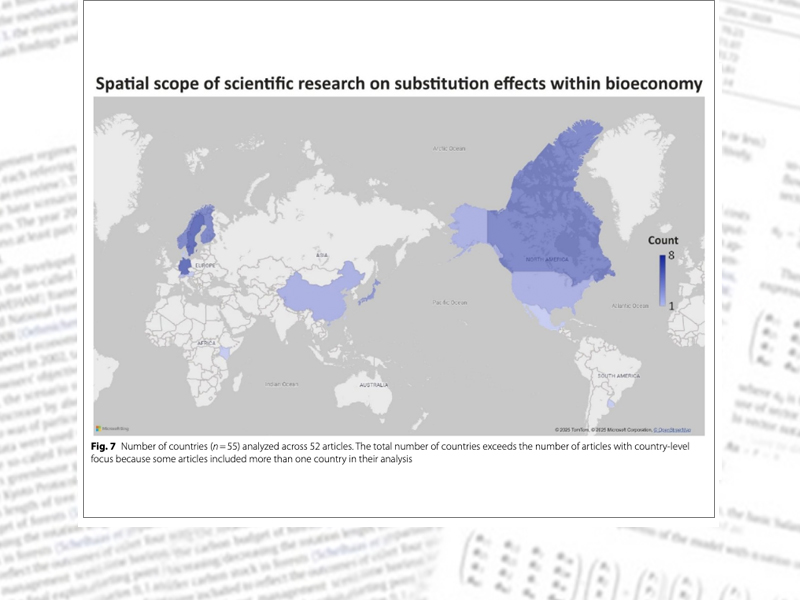
The aim of this scoping review is to examine how substitution effects are defined and assessed in the bioeconomy literature. The article identifies methodological trends, research gaps, and implications for monitoring biomass use. The review follows the PRISMA guidelines for scientific reviews.
Results show that the predominant literature focuses on material and energetic substitution, primarily woody biomass. Life Cycle Assessment (LCA) is the dominant methodology, with the displacement factor (DF, also: substitution factor) frequently used as the quantification metric. Reviewed research concentrates on sectors such as construction, energy, and other wood-based industries. It often emphasizes CO2-related mitigation indicators.
While LCA remains the dominant method, we can conclude, however, that robust interdisciplinary assessments require complementary approaches — such as e. g. behavioral economics and physical accounting— to fully capture substitution effects. In Addition, expanding the analytical scope beyond purely environmental concerns will enable a more comprehensive assessment of substitution effects.
- Gordillo Vera F, Weimar H (2025) How to define and quantify substitution effects in the bioeconomy : a scoping review. Ann Forest Sci 82:26, DOI:10.1186/s13595-025-01299-2
https://literatur.thuenen.de/digbib_extern/dn069890.pdf - Projectsite
Bioeconomy Monitoring II