[Translate to English:]
[Translate to English:]
Institute of

FG Forest Genetics

Current projects

Early flowering trees for forest genetics

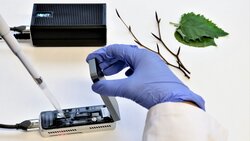
Induction of early flowering in different tree species for genetic analyses and breeding.

More
Early flowering trees for forest genetics

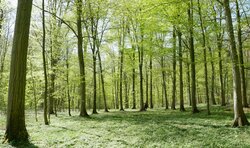
European hornbeam, from a nurse tree to a promising tree

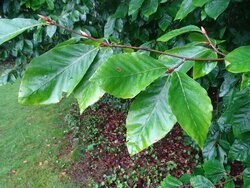
The potential of the hornbeam as an alternative tree species lies in its ecologically advantageous characteristics: its shade tolerance and thus its importance as a second stand layer for the forest interior climate, its suitability as a mixed tree species in deciduous as well as coniferous forests, a deep-reaching root system and an easily decomposable litter.

More
European hornbeam, from a nurse tree to a promising tree

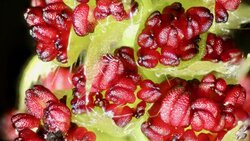
Evolution of monoecy and dioecy ("MonDio")

Resolving the molecular genetics of monoecy and dioecy in the Salicaceae family to explore the evolution of plant sexual systems.

More
Evolution of monoecy and dioecy ("MonDio")

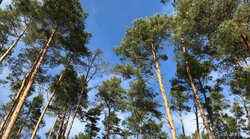
Genetic Diversity of Scots Pine in Germany

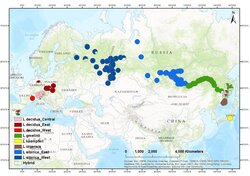
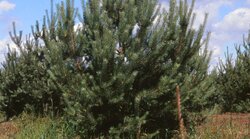
Based on an extensive, nationwide sampling, we study the genetic diversity and spatial-genetic structure in Scots pine throughout Germany. Knowledge of genetic variation and its patterns is a necessary basis for the sustainable use and conservation of forest genetic resources.

More
Genetic Diversity of Scots Pine in Germany

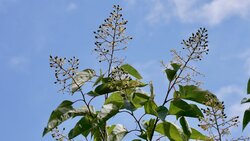
Genetics of black locust

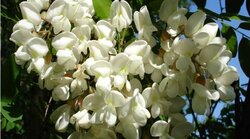
Black locust is a fast growing tree species with hard and durable wood. The tree is characterized by good growth on poor and nitrogen-deficient soils and is suitable for afforestation of arable land and devastated areas. There has been a remarkable increase in the interest in this multipurpose tree species not only aimed at the production of construction timber, but also for the use as biomass source in short rotation plantations.

More
Genetics of black locust

Genetische Referenzdaten und statistische Methoden zur Art- und Herkunftsbestimmung

Mit dem Inkrafttreten der EU Holzverordnung ist der Bedarf nach effektiven Kontrollverfahren zur genetischen Überprüfung von Holzart und Holzherkunft deutlich angestiegen. Wir ergänzen und verbessern die Referenzdaten zur Art- und Herkunftskontrolle von Holz.

More
Genetische Referenzdaten und statistische Methoden zur Art- und Herkunftsbestimmung

Genome analysis in trees

Structural and functional analysis of genomes in forest trees.

More
Genome analysis in trees

Genome Editing & Drought Stress (TreeEdit)

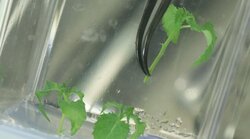
The aims of the project are to establish new methods of genome editing (CRISPR/Cas) in beech and poplar and to modify candidate genes to study their influence on drought stress tolerance of tree species. The project is being researched in the junior research group "Genetic Technologies".

More
Genome Editing & Drought Stress (TreeEdit)

Mikrobiomtherapie

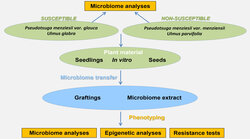
Climate change and globalization promote the spread of non-native pests in the EU, threatening forest ecosystems and biodiversity. The project investigates the promotion of resistance through microbiome transfer and epigenetic changes.

More
Mikrobiomtherapie

OptiSaat - Seed plantations of the future

The project builds on the Forest Climate Fund projects FitForClim and AdaptForClim, in which breeding zones were designated, plus trees selected and breeding populations established. In OptiSaat, seedlings are produced for the breeding zone north-east for the tree species Douglas fir and Scots pine for the establishment of seed orchards.

More
OptiSaat - Seed plantations of the future

OrientBuche

The Oriental beech is characterized by a higher drought tolerance than the related European beech and has otherwise comparable characteristics (site requirements, shade tolerance, wood use). In the project, we are investigating the genetic and phenotypic variation of this alternative tree species.

More
OrientBuche

PangenomeBeech

Pangenome analysis of European beech to elucidate the role of structural genetic variation in local adaptationand phenotypic differentiation under different environments.

More
PangenomeBeech

Phytopathogens in Forests

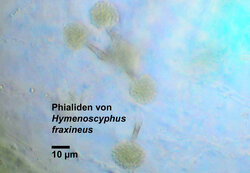
Diagnostics and species distinction of pyhtopathogenic fungi are needed to avoid or to reduce the impact of new diseases in forests.

More
Phytopathogens in Forests

ResVir

Genetic elements involved in sensibility, tolerance or resistance against pathogens are analysed with the aim to provide plant material for sustainable forests

More
ResVir

TaxGen

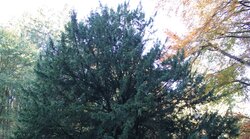
This project aims at the elucidation of the genetic basis of sex determination in the dioecious gymnosperm species Taxus baccata based on the assembly of chromosome-level reference genomes of a male and female individual and resequencing approaches.

More
TaxGen

Scroll to top