Expertise
More differences between the sexes in working life
Gesine Tuitjer | 06.03.2026
Over the past ten years, the differences between rural areas and cities have narrowed. The same is true for the differences between eastern and western Germany. At the same time, gender gaps have hardly changed – despite the increase in women's participation in the labour market.

Eastern and western Germany continue to converge: ten years ago, there was still a significant difference in the employment rates of women. In the east, more women worked in both rural and urban areas than in the west. Due to the increased participation of women in the labour market in western Germany, this gap has now virtually disappeared. At the same time, however, the employment rate among men has risen in both eastern and western Germany. As a result, the gender gaps in employment rates in eastern and western Germany have widened slightly in both rural and urban areas.
In general, men and women in rural areas participate in working life slightly more often than in urban areas. This applies to both eastern and western Germany. The differences in the employment rates of women in rural and urban areas have remained the same in western Germany over the past ten years. In eastern Germany, they have fallen slightly.
However, the corresponding gender gaps are greater than the urban-rural or east-west differences in women's labour force participation. These are particularly pronounced in western Germany . In 2015, the gap between women and men in rural areas of western Germany averaged around 7.5 percentage points, while in the east it was significantly lower at around 3.7 percentage points.
Women are more likely than men to work part-time. This applies to all regions. In 2015, the gender gap in rural areas of western Germany averaged 16.8 percentage points (38.8 per cent women compared to 22.0 per cent men). In western German cities, it was 17.5 percentage points (36.3 per cent to 18.8 per cent). In the east, the difference was even greater: in rural areas, it averaged 28.4 percentage points (39.7 per cent to 11.3 per cent), and in cities, 25.7 percentage points (36.6 per cent to 10.9 per cent). This means that the gender gap in part-time employment was significantly greater in the east than in the west.
These gaps will continue to widen until 2025. In the west, the proportion of women working part-time will increase significantly, while the proportion of men working part-time will fall sharply. As a result, the gender gap in part-time employment will grow to an average of 30.3 percentage points (46.1 per cent to 15.8 per cent) in rural areas of western Germany and 28.9 percentage points (42.3 per cent to 13.4 per cent) in cities. The difference is also increasing in the east: in rural areas, it will be 38.5 percentage points (47.8 per cent to 9.3 per cent) in 2025, and 35.9 percentage points (44.6 per cent to 8.7 per cent) in cities. The gap between women and men thus remains widest in the east and has increased since 2015.
In addition to gender differences, there are also differences between rural and urban regions. In 2015, the proportion of part-time workers in rural areas is slightly higher than in cities. In the west, the regional gap for women is 2.5 percentage points (38.8 per cent in rural areas compared to 36.3 per cent in urban areas) and for men 3.2 percentage points (22.0 per cent to 18.8 per cent). In the east, the difference is 3.1 percentage points for women (39.7 per cent to 36.6 per cent) and 0.4 percentage points for men (11.3 per cent to 10.9 per cent). The urban-rural difference is thus significantly smaller than the gender difference in part-time employment.
In 2025, part-time work will remain slightly more common in rural areas than in cities. In the west, the gap between rural and urban areas is 3.8 percentage points for women (46.1 per cent to 42.3 per cent) and 2.4 percentage points for men (15.8 per cent to 13.4 per cent). In the east, the regional gap is 3.2 percentage points for women (47.8 per cent to 44.6 per cent) and 0.6 percentage points for men (9.3 per cent to 8.7 per cent).
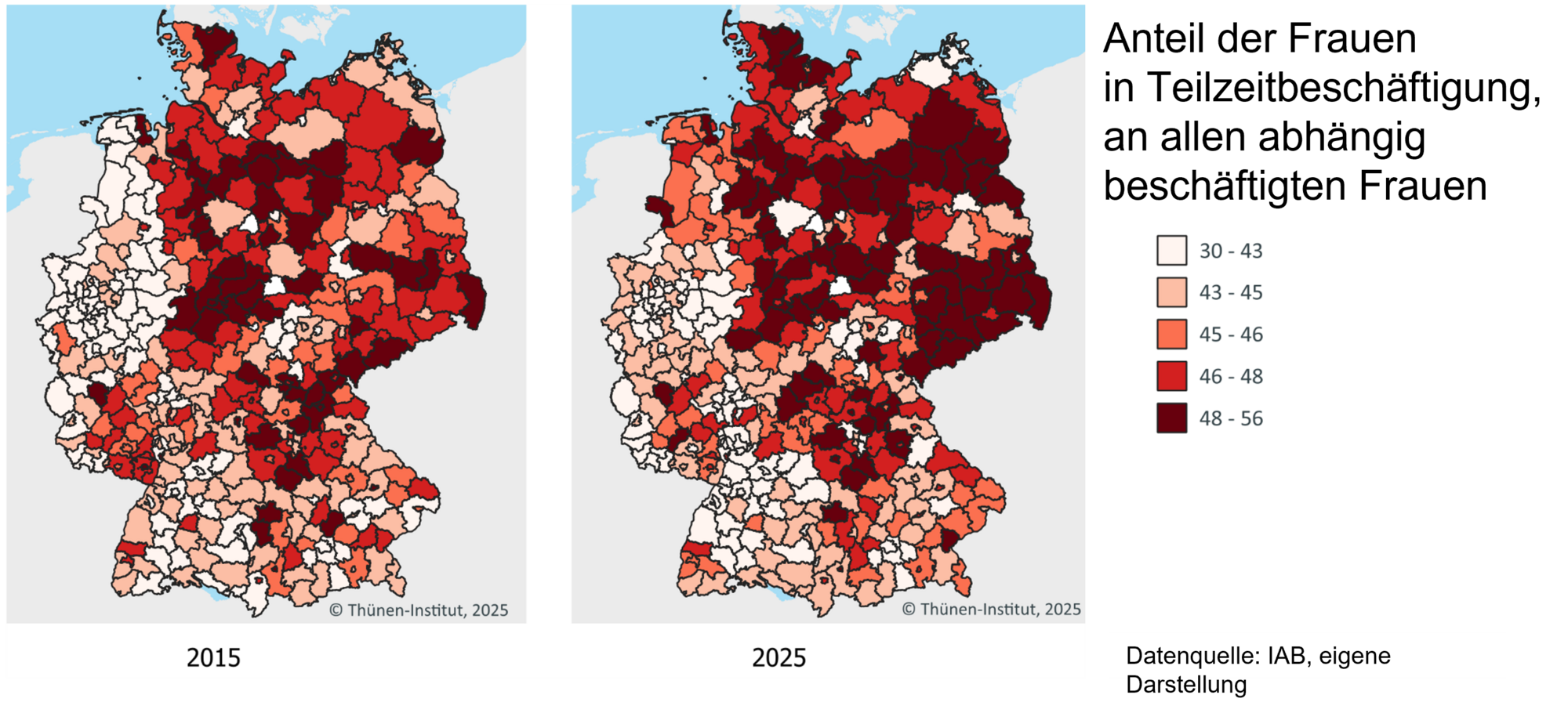
Overall, the differences between rural and urban areas are moderate, while gender differences – especially in the east – are very pronounced and have continued to increase over the years. In addition to the amount of working hours, there are significant differences in the industries and positions that women and men hold in working life. Most women work in a few sectors, such as health and social services, education and public administration. Few men are found in these areas. Women also continue to be underrepresented in management positions. Although almost half of all employed persons are female, only around one third of managers are women.