
Expertise
Between work and family life in rural areas
Sylvia Keim-Klärner , Stefan Neumeier | 06.03.2026
More and more women are in employment – even outside of large cities. However, long commutes and, in some cases, weak labour markets in rural areas make everyday life difficult and place a particular strain on working mothers. This expert article highlights the challenges women face and what supports them.
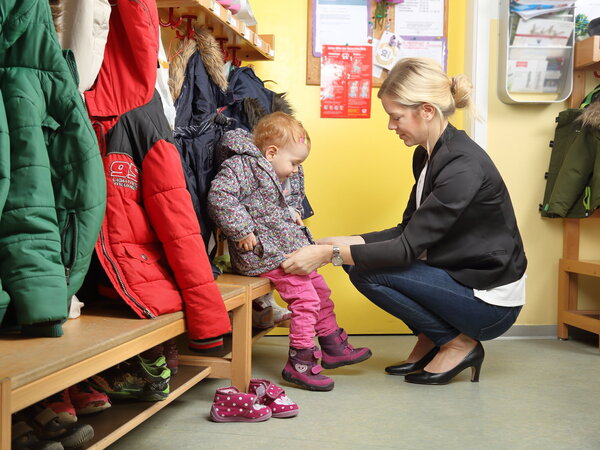
Whether it's a quick shop, a visit to the doctor or short-term childcare – what is usually just around the corner in the city often requires a longer journey in rural areas. At the same time, family-friendly working hours and childcare facilities that cover the required working hours are often not available nearby. It is therefore not always easy for working mothers to achieve a satisfactory work-life balance. Researchers at the Thünen Institute are investigating the challenges faced by women and families in rural areas and what support they need.
Many women face a double burden
The proportion of working women has risen significantly in recent years – in some cases even more so in rural areas than in large cities. While in 2001, 45 per cent of women in large cities and 46 per cent of women in rural communities were in employment subject to social insurance contributions, by 2023 the figure had risen to 58 per cent in large cities and as high as 65 per cent in rural communities. This is shown by data from the Federal Institute for Research on Building, Urban Affairs and Spatial Development. At the same time, women continue to bear the main responsibility for household and childcare. Working hours have to be coordinated with nursery opening hours, doctor's appointments organised and shopping planned on the side. Many mothers therefore experience a great deal of time pressure, especially when childcare facilities are lacking or unreliable.
The car makes the difference
How well gainful employment and caregiving responsibilities can be reconciled in rural areas often depends on whether families own a car. Larger purchases, for example, are usually made by car. On average, the journey to the nearest supermarket by car takes only one to two minutes longer than in non-rural areas. Without a car, however, even everyday errands can become a challenge. On foot, the journey to the nearest supermarket in the various types of rural areas takes between 31 and 46 minutes on average – almost twice as long as in non-rural areas. Buses and trains are often not an alternative, as the network is sparse and services are infrequent.
The distances become even longer if, for example, the nearest doctor's surgery is not accepting new patients or the nursery does not offer the required childcare hours. Often, the facilities are also located in opposite directions. Mobility thus becomes an important prerequisite for a functioning family life.
Conditions for a successful work-life balance
Despite the challenges they face, many families are satisfied with where they live because they are able to actively overcome structural limitations and long distances in their everyday lives. This is shown by a survey conducted by the Thünen Institute. Families make this possible by planning their journeys in advance, combining errands or doing them online. Reliable social networks are particularly helpful. When relatives, neighbours or clubs help with childcare or transport services, the burden on families is noticeably reduced.
Families in rural areas need suitable and reliable childcare services, flexible working time models and a functioning transport infrastructure, such as safe cycle paths or on-demand buses. It is equally important that various services are bundled at central contact points. This shortens the everyday journeys of families. The compatibility of work and care is therefore not only a question of individual organisation and the division of tasks between men and women, but also of the structural conditions in place locally.

Further information:
- The Thünen-Landatlas provides interactive maps showing the accessibility of supermarkets, nurseries and doctors' surgeries in Germany.
- In the research projects Families in Rural Areas and Social Disadvantage in Rural Peripheries in Eastern Germany and the Czech Republic, Thünen researchers are investigating the challenges faced by families in rural regions.
- In an article in the magazine Stimme der Familie, the Thünen researchers explain their findings. (only in German) The entire issue is available on the website of the Catholic Family Association.