FAQ
This is why the reduction targets for land use are not being met
Bernhard Osterburg, Roland Fuß | 14.03.2026
The latest projections for greenhouse gas emissions show that the land use, land-use change and forestry (LULUCF) sector will release carbon dioxide in the long term rather than acting as a sink. You can find questions and answers on this topic in our FAQ.
The Climate Action Act assigns a special role to the land use, land-use change and forestry (LULUCF) sector:
It is the only sector that contains not only sources but also sinks of greenhouse gases. Consequently, unavoidable emissions in other sectors are to be offset in future by a net sink in the LULUCF sector, which is enshrined as a target in law. Projections by the Thünen Institute on behalf of the German government have shown in recent years that this target is likely to be missed by a wide margin. Following successful legal action by Deutsche Umwelthilfe, the German government is obliged to introduce measures that will enable the target to be met.
In Germany, high emissions from drained organic-rich soils were previously offset by the sequestration of carbon dioxide in forest ecosystems. However, forests severely damaged by climate change are no longer able to do this, meaning that the LULUCF sector is also releasing large quantities of CO₂ overall, which contradicts the statutory targets.
The sector’s potential to act as a carbon sink is intended to offset emissions in other sectors, such as agriculture, where emissions are partly unavoidable. The Climate Protection Act stipulates for the LULUCF sector that, on average over the years 2027 to 2030, a net total of 25 million tonnes of carbon dioxide equivalent (CO₂ equivalent) per year should be sequestered. The target for net sequestration is 35 million tonnes of CO₂ equivalent per year on average for the years 2037 to 2040, and 40 million tonnes for the period from 2042 to 2045.
The 2026 projections show that, whilst the forest is currently recovering, the LULUCF sector will remain a significant source of greenhouse gases in the future. If the agreed measures are implemented, emissions of around 24.5 million tonnes of CO₂ equivalents per year are expected between 2027 and 2030. This falls dramatically short of the target of a net sequestration of 25 million tonnes of CO₂ equivalents.
Furthermore, the modelling results show that the uncertainties arising from climate change – and in particular the increasingly likely extreme weather events resulting from it – have a significant impact on the emissions balance of the LULUCF sector. These uncertainties are far greater than the combined effect of all mitigation measures introduced to date.
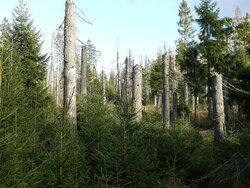
- The drought of recent years has caused widespread forest dieback. The results of the fourth National Forest Inventory have been available since October 2024. These quantify the forest damage caused by drought and bark beetle infestation from 2018 onwards, which meant that the forest was no longer a carbon sink, even though the forest soils offset part of the loss. Although recovery has now begun, the carbon sequestration capacity seen before the drought is unlikely to be regained.
- Emissions from drained peatlands remain high. The rewetting measures implemented and planned to date are far from sufficient to substantially reduce these emissions.
- Data and modelling results show that mineral soils used for arable farming lose carbon over the long term. However, this loss varies greatly depending on the weather. Under favourable weather conditions, arable soils can even act as a carbon sink in individual years.
Current trends in the LULUCF sector are at odds with climate targets. Even in the absence of extreme weather events, the 2030 targets will be significantly missed. Furthermore, some climate protection measures that have already been decided upon have not yet been implemented in practice. Even if these measures were to be implemented at an accelerated pace now, they would have only a minor impact by 2030. The reason: many measures in the land use and forestry sector only yield results in the long term. In the LULUCF sector, the focus must therefore be on long-term measures. However, their implementation must take place more quickly and on a larger scale than has been the case to date.
Such studies are potential studies that examine theoretically possible mitigation pathways. In other words, they show what would need to be done to achieve the targets. Unlike projection data, however, they do not take into account the real political, legal, economic and technical barriers to implementation. As a result, they include, for example, rewetting at an unrealistic rate: the CARESupreme scenario, developed on behalf of the Federal Environment Agency, assumes that 40% of drained peatlands will be fully rewetted by 2030. For forests, too, as in the study by Agora Agrar presented in early 2026, unrealistic assumptions are made regarding forest management and timber use. If made legally binding, this would constitute a significant encroachment on forest owners’ property rights and, in the long term, restrict the potential growth of forest trees – which in turn would make it even more difficult to achieve future climate targets.
- Re-wetting drained peatlands is the most effective measure for avoiding emissions. This is expected to save five million tonnes of CO₂ equivalent annually by 2030. This is set out in the Federal-State Target Agreement on Climate Protection through Peatland Conservation and the National Peatland Conservation Strategy. The rewetting of peatlands is a complex and lengthy task, yet the potential for carbon sequestration is significantly higher than the five million tonnes of CO₂ equivalent previously announced. The legal and economic framework for rewetting must be improved consistently and swiftly.
- Phasing out peat extraction and the use of peat in potting soils and growing media will prevent significant amounts of CO₂ emissions.
- Forests damaged by drought and the associated bark beetle infestation must be rapidly reforested. Fast-growing tree species that are suited to the local conditions and resilient to climate change should be used. This will improve the carbon sink capacity of forests in the long term.
- Where possible, additional woodland should be created. Newly planted hedges and other agroforestry crops can also rapidly sequester a significant amount of carbon from carbon dioxide.
- The potential for increasing wood product storage should be exploited, e.g. through the implementation of the timber construction initiative.
- Furthermore, further options for long-term carbon sequestration must be investigated and developed, for example through biochar.
- Even under a very optimistic scenario, the targets of the Climate Protection Act for the LULUCF sector cannot be met without drastically reducing existing benefits to society. It should therefore be considered whether the targets for the other sectors need to be adjusted in order to achieve the overall target.
Links
Greenhouse Gas Projections for 2025 – Key Findings | Umweltbundesamt (in German)
Press Release from the Umwelbundesamts dated 14 March 2026 (in German)