Expertise
Erosion protection – so that the soil remains fertile
Bastian Steinhoff-Knopp | 26.06.2025
Heavy rainfall or wind can erode fertile soils - with consequences for farming and surrounding water bodies. However, farmers can take countermeasures. For example, by keeping the soil covered as much as possible and by diverse land use patterns including small landscape features.
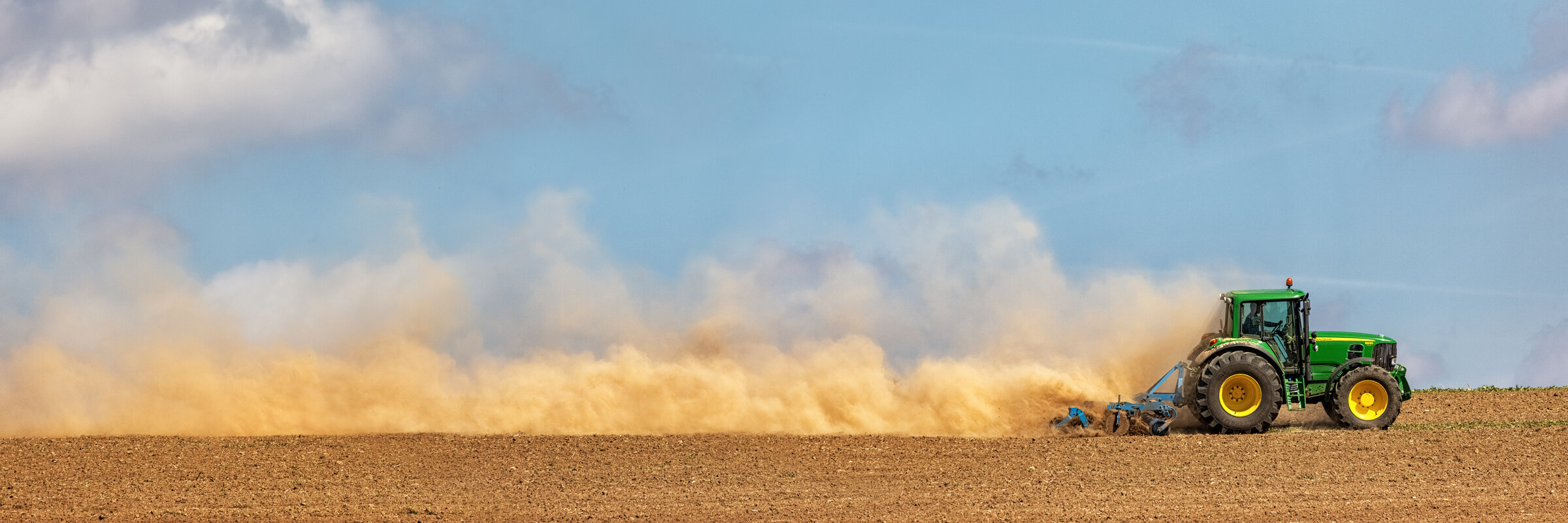
Agriculture goes hand in hand with phases in which the soil is covered only slightly or not at all. During this time, the soil is particularly at risk: heavy rainfall and surface run-off or strong winds can erode the nutrient-rich topsoil. The eroded soil particles, along nutrients, pollutants and pesticides, can contaminate neighbouring water bodies or protected biotopes. If the material is deposited on roads or in residential areas, this is a costly nuisance.
In addition to the short-term damages, soil erosion reduces the soil profile and thus the fertility of the fields in the long term. The soils can then only fulfil their ecosystem functions to a limited extent. On severely degraded soils, agriculture even has to be stopped. Farmers are therefore obliged to adapt their farming practices to the risk of erosion as a precautionary measure. The principle of site-appropriate cultivation under German soil protection law applies in order to safeguard soils in the long term.
Germany's soils are at varying degrees of risk
The extent to which a site is at risk of erosion determines which adaptations farmers should take as a precautionary measure in line with good professional practice. State authorities provide information on the erosion risk of each individual field. The risk depends on soil properties, topography, the intensity of rainfall or strong wind events, the layout of the fields (size of arable fields, number and location of structural elements such as hedges and field margins or buffer stripes along water bodies) and the crops grown. For example, loess soils on slopes are particularly vulnerable to water erosion. The risk of erosion is even greater with arable crops that start to cover the ground late in the year, such as maize. Winter crops, on the other hand, protect the soil better. Model estimations that take these factors into account are the foundation to identify regions with soils at risk from wind or water erosion.
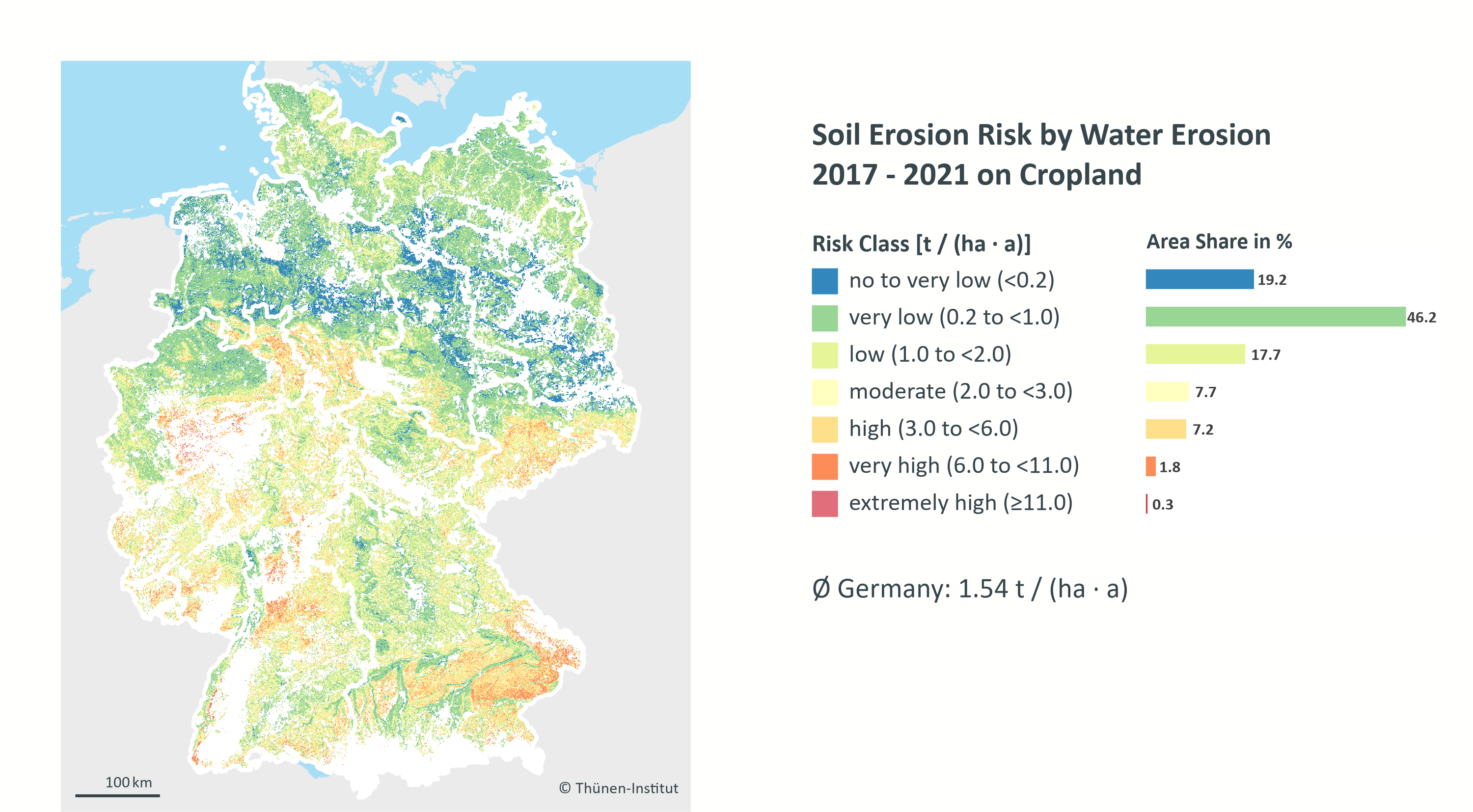
The map above shows the risk of soil erosion by water according to the Universal Soil Loss Equation (ULSE). In addition to soil properties, topography and field design, the model takes into account the amount, intensity and timing of precipitation and the arable crops grown in the period 2017 to 2021. The results are also based on information generated at the Thünen Institute: The soil properties integrate results from the Agricultural Soil Inventory. The information on arable crops was derived from earth observation data by the Thünen Earth Observation team.
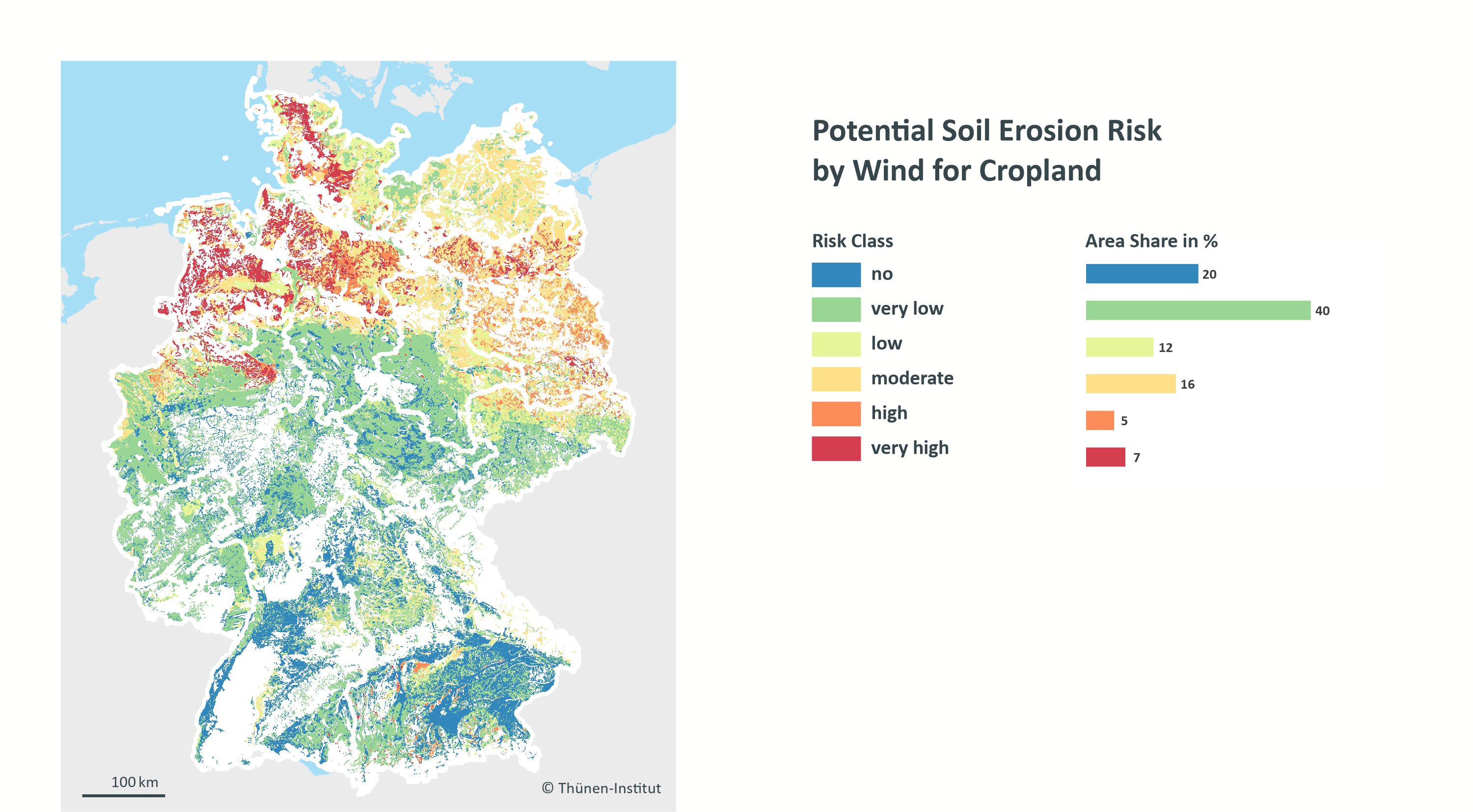
A Germany-wide risk assessment is also available for wind erosion. The map below shows a qualitative assessment of the natural risk of wind erosion. This is based on soil properties and the average wind speed.
Covering the soil mitigates erosion
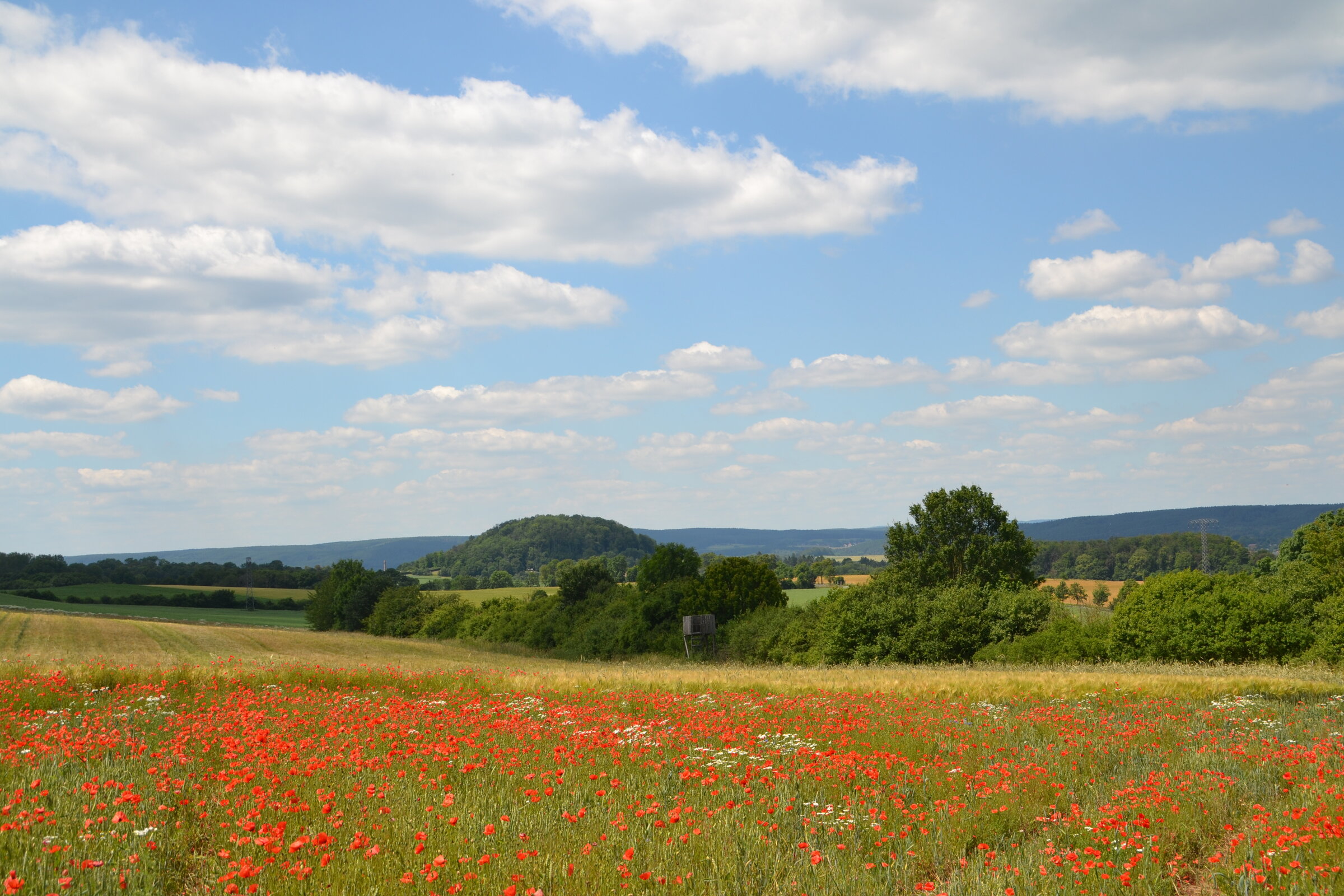
The most important principle in agricultural erosion control is to cover the soil as continuously as possible throughout the year. Plants or mulch protect the soil by breaking the energy of rainfall and surface runoff. Wind is also slowed down by plants and loses its erosive effect. Farmers achieve high levels of soil cover by selecting winter crops and growing catch crops. Even a reduced proportion of late-growing summer crops in the crop rotation – particularly maize, but also potatoes and sugar beet – can significantly reduce the soil erosion risk. The tillage method also makes a difference: with mulch and direct sowing, plant material remains on the surface and protects the soil. The ‘clean table’ approach used in the past, where the soil is not protected from water and wind, should be avoided. The mulch and no-till methods protect the soil from erosion in several ways: they allow rainwater to infiltrate into the ground more quickly. This increases the percolation capacity – or the ‘rain digestibility’ – of the soil and less water runs off on the surface. At the same time, the soil structure becomes more stable and better able to withstand water and wind with large, stable soil aggregates. A diverse soil life with many earthworms also promotes these properties.
Farmers can also take targeted action at the field level: Cultivation in line with the slope angle should be avoided. Surface runoff is slowed down by dividing fields or cultivating in strips. Intermittent planting on tramline tracks has the same effect, slowing down water collected in the tracks. Buffer strips prevent nutrients and pollutants from entering water bodies and are mandatory under the EU's common agricultural policy. In thalwegs, where erosion often occurs, permanent vegetation can significantly reduce erosion. Hedges and tree rows rectangular to the main wind direction slow down the wind and thus prevent wind erosion.
Erosion control is mandatory in high-risk areas
The EU's Common Agricultural Policy (CAP) obliges farmers who receive direct payments to provide erosion control on particularly high-risk areas. This includes requirements for crop rotation, soil cover and soil cultivation.
The German soil protection law works with the principles of good professional practice in accordance with the precautionary approach. If a major erosion event has occurred, farmers are required to protect their land from erosion in subsequent years. Specialised agricultural authorities offer advice accordingly. If a soil protection authority determines that an area has not been cultivated appropriately and that harmful a soil changes in line with the Federal Soil Protection Act have therefore occurred, it can oblige farmer to implement erosion protection measures.
To prevent this, farmers should use the detailed information available regarding soil erosion risk of their land, their own observations, and the advisory services, to adapt their management to the local characteristics in accordance with the principles of good professional practice.