Expertise
Remote sensing supports deforestation control
Margret Köthke, Melvin Lippe | 24.11.2025
The EUDR obliges companies to report the precise geocoordinates of their production sites. This information forms the basis for effectively monitoring deforestation and forest degradation using modern remote sensing technologies.
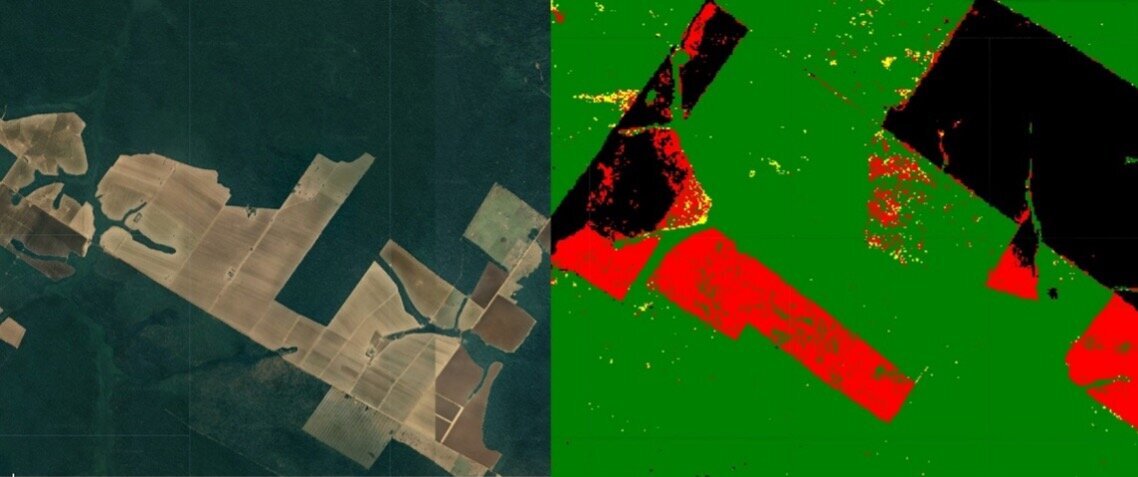
Products made from wood, soy, palm oil, rubber, beef, coffee, and cocoa often have something in common: their production frequently leads to the destruction or degradation of forests—not only in the tropics, but around the world. The European Union aims to counter global forest loss with its EU Regulation 2023/1115 on deforestation-free supply chains, better known as the EU Deforestation Regulation (EUDR). Geospatial data and remote sensing play an important role in monitoring compliance with the EUDR. At the Thünen Institute for Forestry, researchers are investigating how map and remote sensing data can be used effectively to verify the implementation of the EUDR and thereby strengthen forest protection.
What the EUDR requires
The EUDR prohibits the import, export, and trade of certain products on the EU market if forest has been destroyed for the cultivation of the commodities they contain. Only products that have been produced deforestation-free and are also legally compliant with the laws of the producing countries may be traded. Products are considered deforestation-free if the commodity production did not take place on land where deforestation or forest degradation has occurred since December 31, 2020.
Companies trading or producing products made from wood, soy, palm oil, rubber, beef, coffee, or cocoa must confirm in a due diligence statement that the commodities were produced without causing deforestation. They must also provide the geocoordinates of the production sites. These coordinates enable both the companies themselves and the authorities to verify, using remote sensing, whether forest was actually not destroyed for the respective product.
Why verifying deforestation-free production is difficult
The geocoordinates of a property can be recorded using mobile phones, portable GNSS devices (Global Navigation Satellite System), or geographic information systems (GIS). However, the coordinates are not always accurate: imprecise instruments, cloud cover, dense tree canopies, or incorrect use of GPS devices can lead to location inaccuracies and faulty data.
Reference maps that indicate forest and non-forest areas globally, nationally, or regionally can be used to verify deforestation-free production. However, inaccuracies can also arise when using reference maps, for example if the map data quality is low, if there are geographic data gaps, categorical conflicts, or if various tree-based land use types, such as agroforestry systems, are not sufficiently detected by remote sensing.
In addition to reference maps, high-resolution satellite images can also be used to check for deforestation-free production. Land use changes can be determined in much more detail through time series analyses of satellite images. The downside: these analyses are time-consuming and require large amounts of data. Moreover, they cannot be carried out independently by non-experts. Specialized knowledge is required to evaluate the data.
Detecting forest degradation is particularly challenging. Degradation processes usually occur slowly. They only become clearly visible in remote sensing images once a critical threshold has been exceeded. The difficulty here: the EUDR does not define binding thresholds. It is therefore unclear at which level of structural change the regulation’s requirements are considered violated.
Research and recommendations for action
At the Thünen Institute for Forestry, several projects compile reference maps, field data, satellite data, and more, and assess their applicability for monitoring the EUDR. The results support the Federal Office for Agriculture and Food (BLE), which is the control authority for the EUDR in Germany, as well as other relevant stakeholders in using geospatial data. All products are published as open source.