


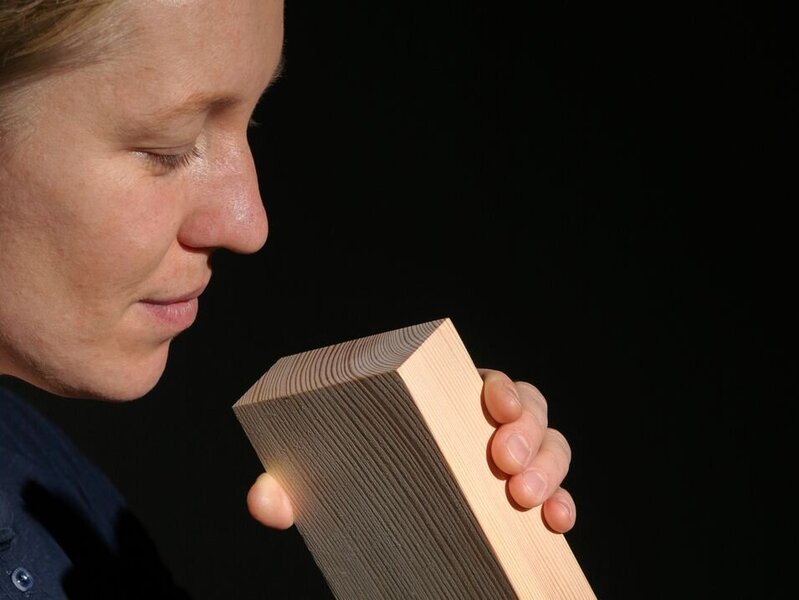
Sometimes, simple wood paneling is enough to change perceptions: people find the smell of wood more pleasant when they can see it at the same time. This was discovered by scientists at the Thünen Institute of Wood Research and the Leibniz Institute for Work Research in Dortmund (IfADo) in joint studies. Among other things, they conducted standardized smell tests. The results showed that wood smells are rated more positively when a matching image of the corresponding wood species is shown at the same time. The test subjects found the scent of pine wood, which has a high terpene content, to be the most pleasant. Without the image, the participants found it more difficult to classify the smell, which lowered their rating, at least for solid wood. “Smell evaluations depend very much on context. Visual impressions influence how the scent of wood is perceived. Even simply knowing the source of the smell changes perception,” explains Martin Ohlmeyer, who led the project at the Thünen Institute of Wood Research. These findings are particularly relevant for the evaluation and use of wood as a building material in living spaces.
Wood is a sustainable building material – with a smell
Wood is currently a popular building material. It is considered climate-friendly and creates a cozy atmosphere. However, wood always has its own smell, which is caused by volatile organic compounds (VOCs) contained in the material. Some of these substances can be harmful to health, at least in high concentrations, but many are not. A strong and unfamiliar smell does not automatically mean that a product is harmful to health. “Against this background, the question now arises as to how odors from wood products can be objectively evaluated, particularly in testing procedures,” says Martin Ohlmeyer.
Smell alone is not an objective measure of quality
Some standards or certifications, such as environmental labels, require odor testing. These tests are intended to assess the effect of building materials on indoor air quality. In view of the study results, the researchers advise caution: since odors are rarely processed correctly without simultaneous visual stimuli, such procedures are prone to interference, for example due to the design of the test setting. When assessing the quality of indoor air in terms of health, the actual measured concentration of VOCs is more relevant than the subjective perception of odor.
Design recommendation: Make wood visible
The studies by the Thünen Institute and IfADo therefore contain specific recommendations for planners and those responsible for construction. One example: if wood is used in a building, it makes sense to make it visible. This could be in the form of exposed ceiling beams or wood paneling. When people perceive the material positively, they also rate the indoor air quality more highly.