
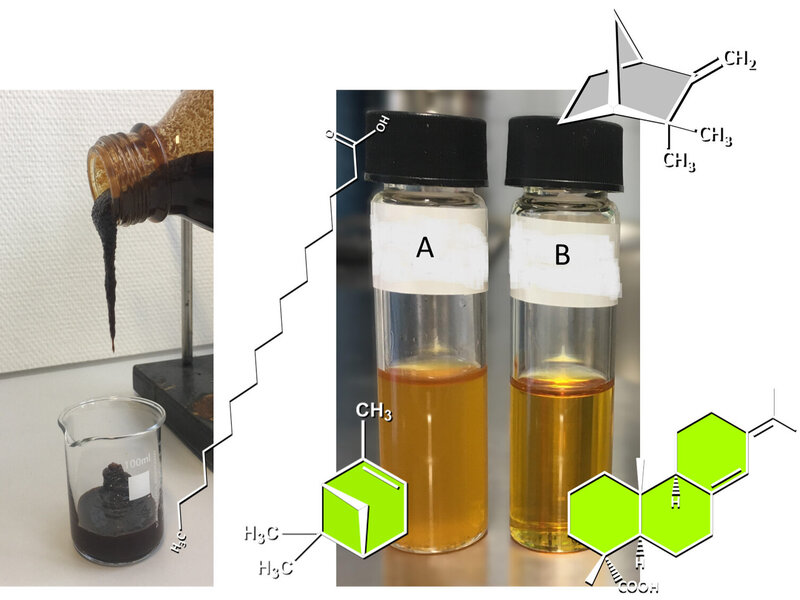
Tall oil is an important by-product in the production of pulp from soft wood and has a wide range of applications. Crude tall oil consists primarily of fatty and resin acids as well as neutral, unsaponifiable components. Industrially, these components are separated from each other in a complex process in order to achieve higher added value. It has now been possible to separate crude tall oil into different fractions using supercritical carbon dioxide. These fractions are significantly less viscous than crude tall oil and are almost transparent and yellow in colour. A selected extraction process can increase the proportion of fatty acids compared to the proportion of resin acids. With further optimisation, supercritical carbon dioxide extraction can establish itself as a serious alternative to vacuum distillation in the industrial upgrading of crude tall oil.
Contact:
More informations:
Link to Thuenenproject: “Putting more nature on paper”