

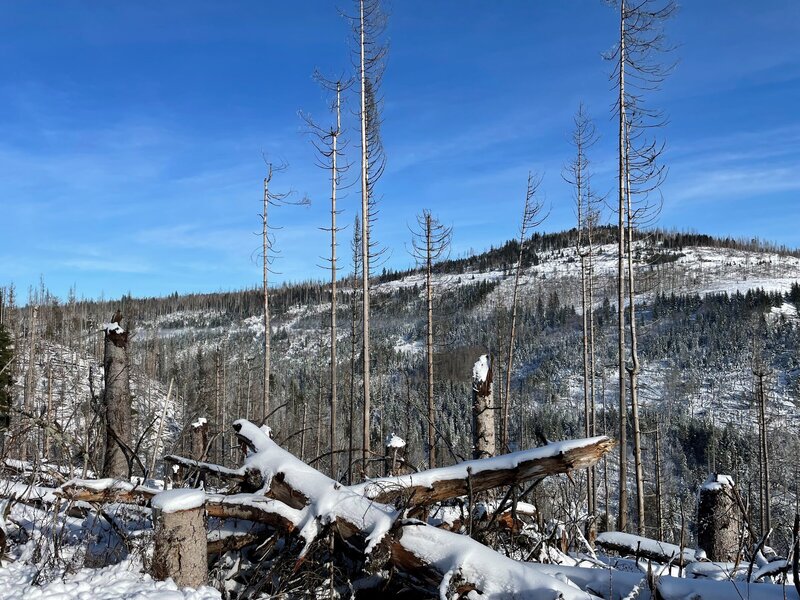
Norway spruce in the Harz Mountains National Park (Germany) has experienced widespread mortality (> 97% of trees in the study stands) due to infestation with the large spruce bark beetle (Ips typographus L.). The dead trees (snags) remain standing in the forest for 2–5 years before harvesting. It is important to identify trees that can still produce quality timber, which may be achieved by examining their outer appearance using selected characteristics. The aim of this study was to identify possible correlations between the standing storage duration and defined external characteristics of the snags. The majority of the snags were broken at least once. Windthrows were less likely compared to living spruce trees because of reduced resistance to the wind as a result of needle loss and breakage. The mean stem breakage proportion increased significantly with the duration of the standing storage; however, prolonged storage durations did not always lead to complete breakage. The condition of the crown, assessed by the presence of branchlets, was a good indicator of the duration of the standing storage.
Contact:
More informations: