


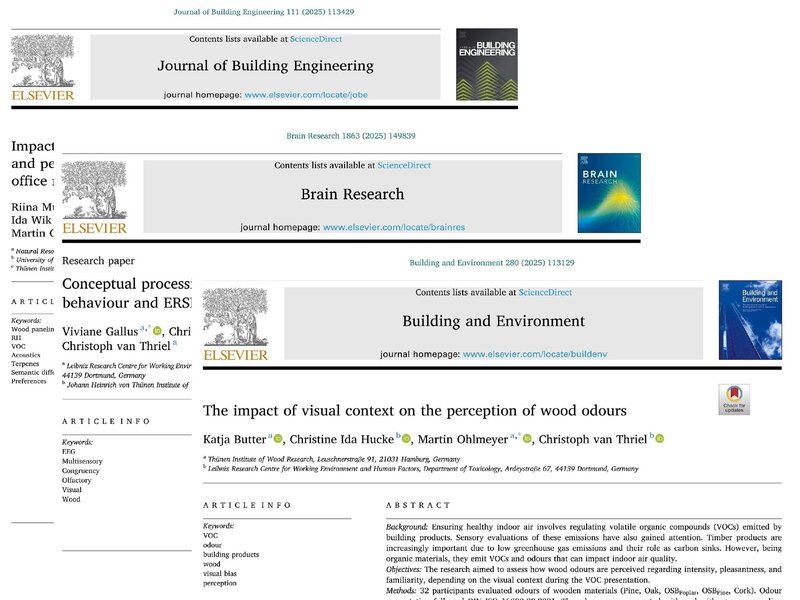
We perceive our environment through multiple senses simultaneously. However, how smell and visual impressions interact - especially in the case of wood odours - has hardly been studied. We investigated how these odours are perceived in terms of intensity, hedonic quality, and familiarity, both with and without a matching visual image of the material. In addition, researchers from the Leibniz Research Centre for Working Environment and Human Factors at TU Dortmund (IfADo) recorded the participants’ brain activity using EEG.
Both studies show: Wood odours are processed in a multisensory way. For example, the smell of pine was rated as more familiar and pleasant when presented together with a matching image, while the perceived intensity remained largely unchanged. Odour perception varies greatly between individuals, is highly context-dependent, and results from the interaction of multiple senses - often with visual stimuli dominating the experience. Thus, regulations for building products based on odour perception should be critically reviewed, especially since odours alone are not indicators of health risks.
One thing is clear, however: Interior spaces featuring pine wood surfaces are perceived as more pleasant, warmer, and more natural than those with conventional materials - and the smell is also positively received. This was demonstrated by another study conducted by the Natural Resources Institute Finland.
Link to articles:
Contact: