![[Translate to English:]](/media/_processed_/9/2/csm_Allgemein_Thueringen_Hainich_Mischwald_Bolte_2__19d9dab56a.jpg "[Translate to English:]")
![[Translate to English:]](/media/_processed_/d/2/csm_100_0001_0013_c05c63e7db.jpg "[Translate to English:]")
Collection and processing of litterfall
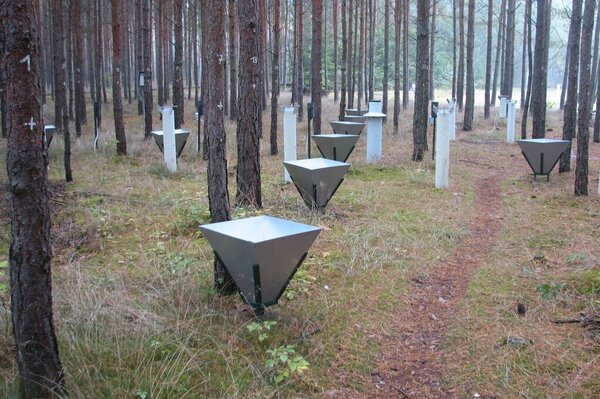
To collect the litter, litter catchers are set up on measuring areas and emptied regularly. The collected litter is then divided into different fractions by hand. During analysis, the weight and chemical composition of the falling fruit, leaves and twigs are determined. This is an important aspect in the investigation of the nutrient cycle and humus formation as well as for assessing the regeneration capacity of the tree species. Furthermore, regularly occurring mast years, i.e. years with a high occurrence of fruits of e.g. beech and oak, are recorded. These are required, for example, to assess the carbon balance of the trees. In addition, the surface area of the leaves and needles can be determined and used to calculate the leaf area index. We are currently collecting litterfall data as part of the ADAPT-Wald-Holz project (link to project page: ADAPT-Wald-Holz) and at the Britz intensive monitoring site (link to website: Britz intensive monitoring site) and the Neuglobsow ICP-IM site.
Information on the chemical composition of the litter based on data from intensive forest environmental monitoring (Level II) can be found on the Forest Environmental Monitoring website: link to the website Levell II / Composition of litter (only german).