![[Translate to English:]](/media/_processed_/2/9/csm_Embryo-Exp_Gelege_9F_dpf5-200513111619_c8534a8199.jpg "[Translate to English:]")
![[Translate to English:]](/media/_processed_/2/9/csm_Embryo-Exp_Gelege_9F_dpf5-200513111619_9027994d44.jpg "[Translate to English:]")
Project
Restoration of European oyster reef systems
Integrative measures to restore healthy reef systems of the European flat oyster
How can the production of oyster seeds be ensured, in sufficient quantity and quality, to sustainably support the restoration of the European oyster in Germany?
Background and Objective
The project aims to sustainably restore biogenic reefs of the European flat oyster (Ostrea edulis) in the German North Sea. These reefs, among the most endangered marine habitats in temperate regions, play a key ecological role by enhancing biodiversity, providing food, shelter, and spawning grounds for numerous species. Following the historical collapse of oyster stocks, these reef structures have almost completely disappeared, resulting in a significant loss of ecological functions and ecosystem services.
To address this challenge, the project adopts an integrative approach combining applied research, technical development, and institutional cooperation. Led by the Federal Agency for Nature Conservation, the Thünen Institute of Fisheries Ecology, and the Alfred Wegener Institute, it brings together the scientific and operational expertise required for long-term restoration. The Thünen Institute is responsible for hatchery-based seed oyster production, including broodstock conditioning, microalgae cultivation, larval rearing, settlement on natural substrates, and a pre-growth nursery phase. The Alfred Wegener Institute coordinates field-based restoration measures at sea.
The objective is to develop reliable, sustainable, and scalable production methods that can support the reintroduction of the European flat oyster and the re-establishment of its reef habitats. Applied research at the Thünen Institute contributes to optimizing production processes with regard to efficiency, animal health, and ecological impact. In addition, international collaborations and targeted knowledge exchange ensure the development of high-quality production suitable for large-scale restoration. Ultimately, the project seeks not only to restore an emblematic marine habitat but also to strengthen the resilience of coastal ecosystems and contribute to biodiversity conservation in the North Sea.
Approach
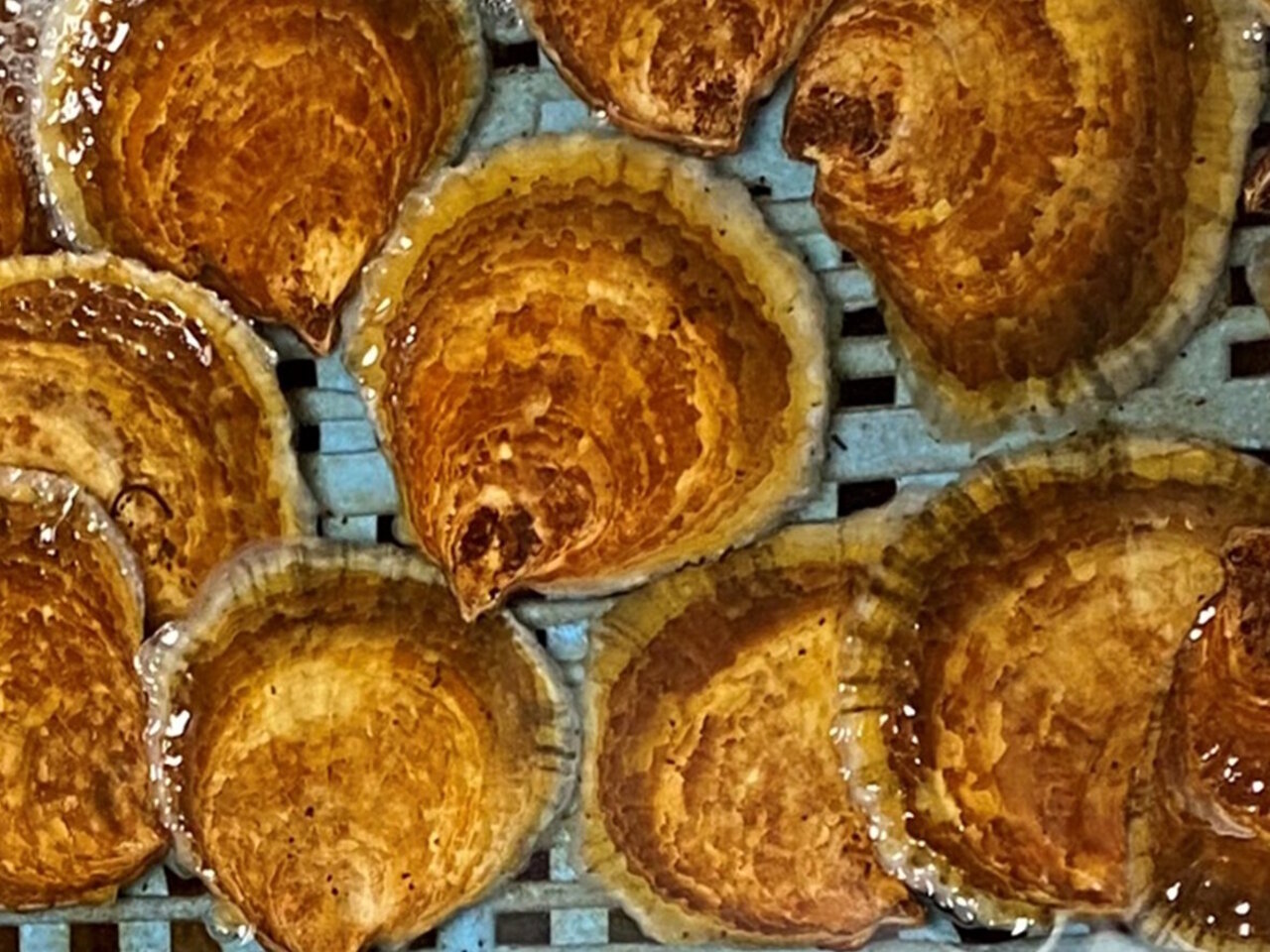
The production of European oysters (Ostrea edulis) for restoration follows all key stages of controlled reproduction: conditioning of broodstock from compatible populations, cultivation of microalgae tailored to each developmental stage, larval rearing, settlement on natural substrates (e.g. shells, wood, innovative materials), and a pre-growth phase in the micro-nursery.
Each step is accompanied by applied research to optimize existing protocols and adapt commercial aquaculture techniques to restoration needs (e.g. spat-on-shell, spat-on-reef). The focus lies on the quality, genetic diversity, and health of the juveniles produced, as well as on process efficiency, ecological sustainability, reduction of disease and pollutant risks, and the use of natural and low-carbon materials.
The approach also involves close cooperation with European networks and hatchery partners to foster knowledge exchange, harmonize practices, and establish a scalable production system capable of meeting the growing demand of oyster restoration projects in Germany.
Involved Thünen-Partners
Involved external Thünen-Partners
- Alfred Wegener Institut (AWI) - Helmholtz -Zentrum für Polar und Meeresforschung
(Bremerhaven, List (Sylt), Deutschland) - Bundesamt für Naturschutz BfN
(Bonn/Vilm, Deutschland)
Funding Body
-
Federal Ministry for the Environment, Nature Conservation, Nuclear Safety and Consumer Protection
(national, öffentlich)
Duration
6.2025 - 12.2034
More Information
Project status:
ongoing