![[Translate to English:]](/media/_processed_/e/3/csm_Demetra2_c8a192c0f8.jpg "[Translate to English:]")
![[Translate to English:]](/media/_processed_/e/2/csm_Demetra1_Panorama_8557ee3b13.jpg "[Translate to English:]")
Project
Archetypes of agricultural land systems in support of policy tailoring (ARC-SPOT)
Archetypes of agricultural land systems in support of policy tailoring (ARC-SPOT)
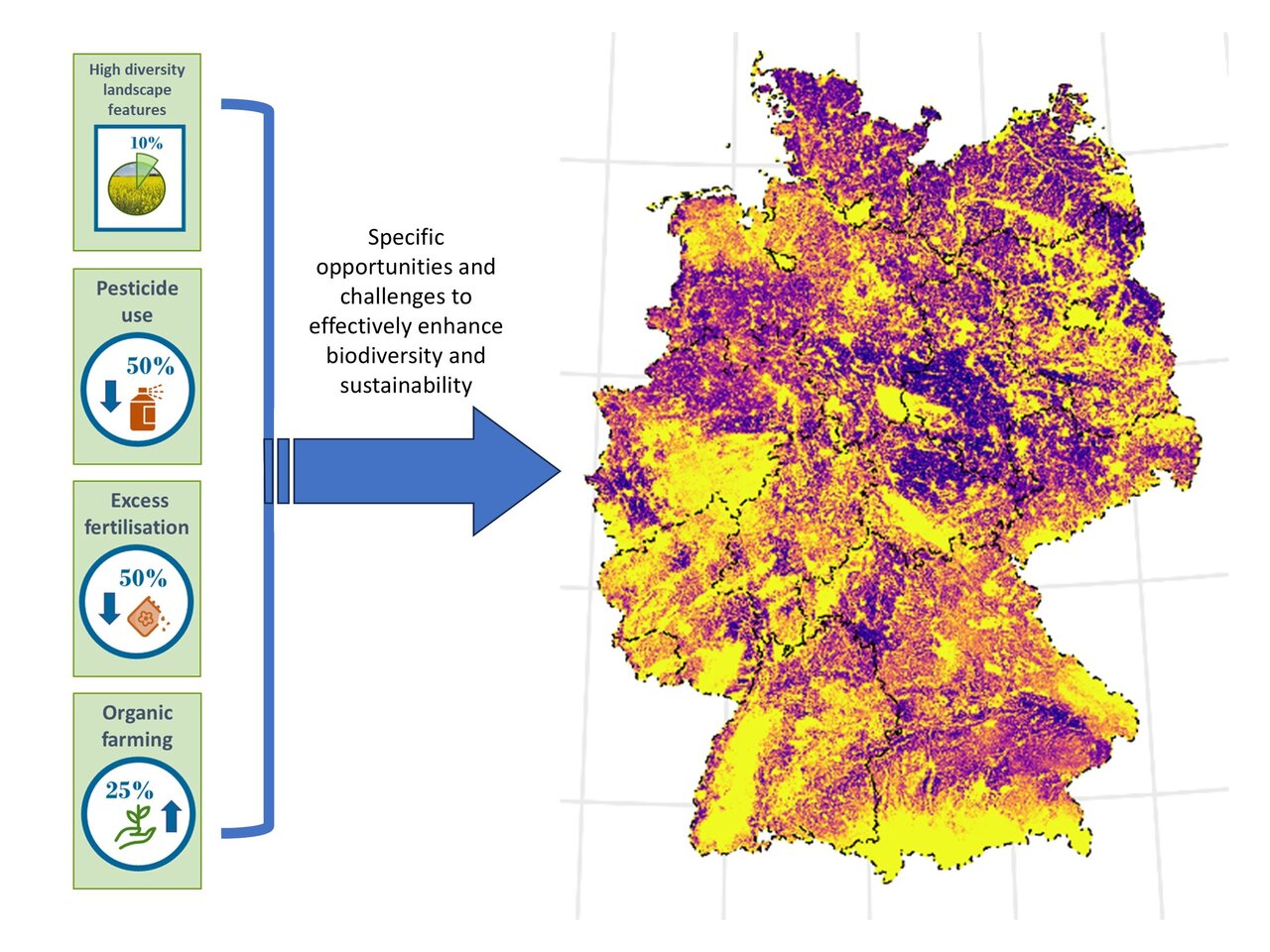
The uniform implementation of agricultural and biodiversity policies weakens chances to effectively enhance farmland biodiversity, such as carabids and wild bees and associated biocontrol and pollination services. Agriculture and farmland biodiversity interact in diverse ways depending in the local context. Yet, distinct interactions recur in agricultural land systems offering opportunities to tailor policy measures to those conditions where they can effectively halt and reverse the biodiversity decline and support the achievement of other sustainability goals. We apply archetype analysis to reveal recurrent patterns in the interactions between biodiversity, agriculture, resource use decisions and governance, among others. Archetypes enable the tailoring, i.e. fitting of policy measures to typical cause-effect relationships and direct actions to the most promising regions. This can significantly increase the effectiveness of policy measures.
Background and Objective
We aim to provide insights to answer the following research questions:
- Which archetypical interactions between agriculture, biodiversity, resource use decisions and governance, among others, differentiate agricultural land systems in Germany?
- How do the demands to maintain, enhance and restore functional interactions between agriculture and farmland biodiversity differ across archetypes?
- Which archetype-specific opportunities and challenges do agricultural and biodiversity policy measures offer to effectively achieve biodiversity and other sustainability goals?
Thünen-Contact

Duration
Permanent task 1.2023
More Information
Project status:
ongoing
Publications
- 0
Sietz D (2025) Mapping human-nature archetypes to guide global biodiversity, food security and land use policy : data layer underlying Figure 1 - Human-nature archetypes [Datenpublikation]. Genève: Zenodo, DOI:10.5281/zenodo.10851971
- 1
Sietz D, Niamir A, Müller D, Hickler T, Kanemoto K, Moran DD, Thonicke K (2025) Mapping human-nature archetypes to guide global biodiversity, food security, and land-use policy. One Earth 8(8):101416, DOI:10.1016/j.oneear.2025.101416
- 2
Orozco R, Meyer-Jürshof M, Vergara-Rodríguez K, Václavík T, Sietz D (2024) Dynamic archetypes of agricultural land systems in Germany from 1992 to 2019. Land Use Pol 145:107281, DOI:10.1016/j.landusepol.2024.107281
- 3
Oberlack C, Pedde S, Piemontese L, Václavík T, Sietz D (2023) Archetypes in support of tailoring land-use policies. Environ Res Lett 18(6):060202, DOI:10.1088/1748-9326/acd802
- 4
Sietz D, Neudert R (2022) Taking stock of and advancing knowledge on interaction archetypes at the nexus between land, biodiversity, food and climate [online]. Environ Res Lett 17(11):113004, zu finden in <https://iopscience.iop.org/article/10.1088/1748-9326/ac9a5c> [zitiert am 25.10.2022], DOI:10.1088/1748-9326/ac9a5c
- 5
Piemontese L, Neudert R, Oberlack C, Pedde S, Roggero M, Buchadas A, Martin DA, Orozco R, Pellowe K, Segnon AC, Zarbá L, Sietz D (2022) Validity and validation in archetype analysis: practical assessment framework and guidelines. Environ Res Lett 17(2):025010, DOI:10.1088/1748-9326/ac4f12
- 6
Eisenack K, Oberlack C, Sietz D (2021) Avenues of archetype analysis: roots, achievements, and next steps in sustainability research. Ecol Soc 26(2):31, DOI:10.5751/ES-12484-260231