See blog
On board the Walter Herwig III: In the eels’ spawning grounds
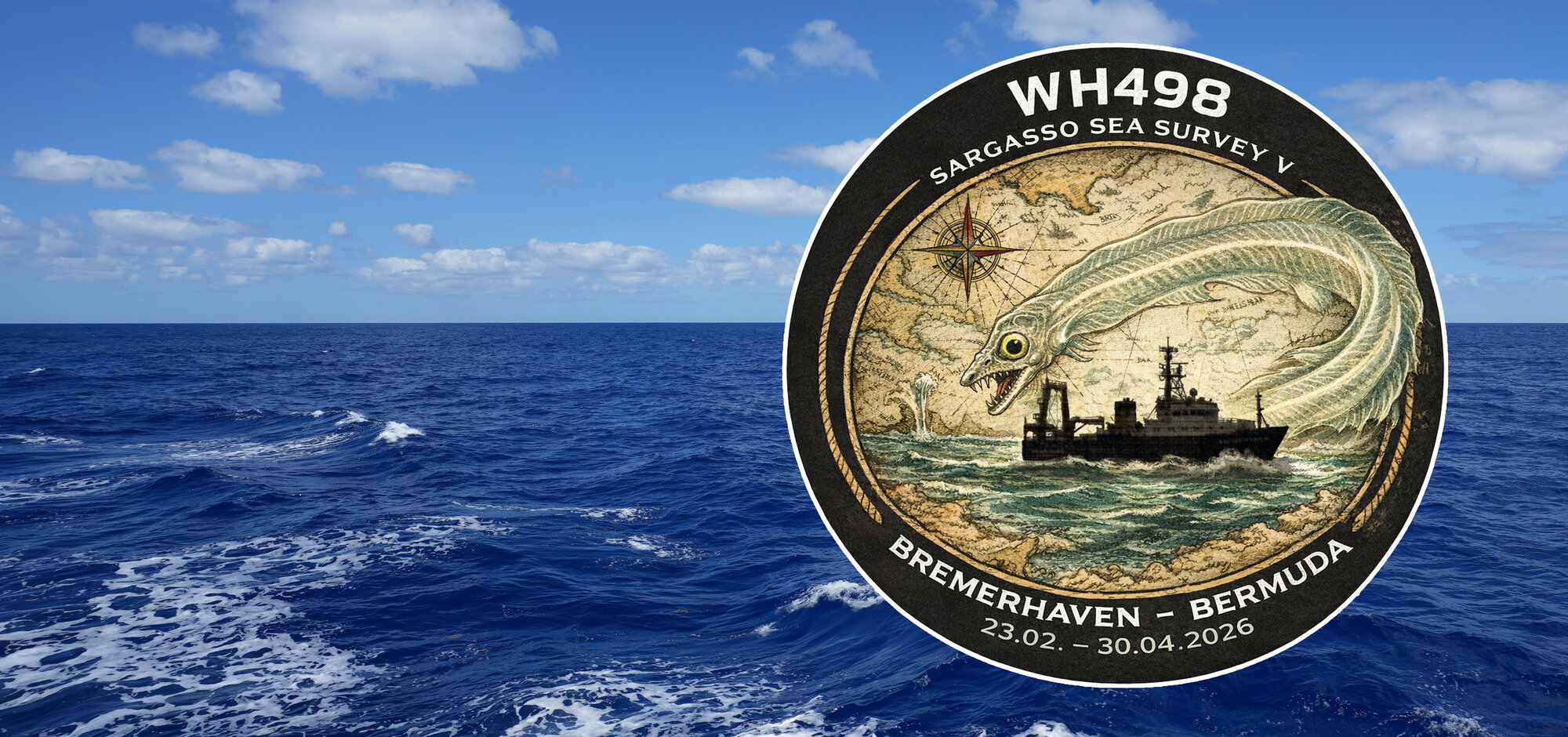
Walther Herwig III, Cruise 498
Cruise leader: Reinhold Hanel
Thünen Team: Marko Freese, Reinhold Hanel, Lasse Marohn, Jan-Dag Pohlmann, Tina Blancke, Ulrike Wypler
Duration of the expedition in the research area: 17.03.-14.04.2026
Cruise area: Sargasso Sea
Purpose of the expedition
This regular research expedition focuses on the distribution and abundance of the willow leaf and leptocephalus larvae of the European eel in its spawning grounds – the Sargasso Sea in the western North Atlantic.
To date, the recruitment time series of arriving glass eels and young yellow eels on the coasts of Europe and North Africa following their transatlantic migration have been regarded as the key indicator of the species’ population trends. However, supplementary information on the numbers and spatial distribution of the youngest larvae directly in their area of origin can provide further insights.
This enables us to better understand oceanic changes and identify potential impacts on recruitment trends at an early stage. The captured eel larvae are therefore being studied with regard to a wide range of biological and ecological parameters. The aim is to gain new insights into their ecology, diet and development.
++25.03.2026++International guest scientists on board


As part of this research expedition, we welcome several international guest scientists on board the Walther Herwig III. They contribute their own research approaches and questions, which closely complement the main objective of the cruise – investigating the distribution and abundance of European eel larvae in the Sargasso Sea. These additional perspectives create a collaborative research environment, providing further insights into ecological processes and enhancing the overall scientific value of the expedition.
My name is Giaele Benetti, I am 27 years old and a PhD student from Italy, currently enrolled at Wageningen University. My research focuses on the early-life microbial colonization of the fish gut and its effects on development and later life performance. I was introduced to Professor Hanel last October through my supervisor, Professor Kokou, and was immediately excited about the opportunity to join this expedition. During the cruise, I will collect water samples to analyse the bacterial communities present in the Sargasso Sea. This will help us better understand the microbial environment in which European eel larvae begin their life and oceanic journey.
I expect this expedition to provide valuable insights into eel larval ecology and to offer hands-on experience in conducting research at sea. I am also looking forward to exchanging ideas with the scientists on board and to experiencing the Sargasso Sea firsthand.
The Czech FishEvo research group studies the evolution of fishes using genetic methods, with a particular focus on sensory systems such as vision. During this expedition, the aim is to collect deep-sea fishes to better understand how their sensory organs have adapted to extreme environmental conditions.
The focus includes species such as the silver spinyfin (Diretmus argenteus) and the tube-eye fish (Stylephorus chordatus), which possess the highest known number of genes related to night vision among vertebrates. Analysing their retina can provide insights into the evolutionary mechanisms behind this exceptional genetic diversity and whether it offers an adaptive advantage. The samples will also provide data to better decode the genomes of deep-sea fishes and to determine which genes are active and what functions they have.
Camilla Kidmose
My name is Camilla, I am from Denmark and currently a PhD student in the FishEvo group in Prague. This is my first time on a research vessel, and I am especially looking forward to the practical work at sea.
In my PhD, I study the identity of photoreceptors in deep-sea pearleyes (Scopelarchidae). Most deep-sea fishes rely mainly on light-sensitive cells that are specialised for very low light conditions. However, some species show unusual features where characteristics of different types of visual cells are combined. To better understand this, I study which genes are active in individual cells of the retina.
During the expedition, I aim to collect deep-sea fishes from a specific group (Aulopiformes), especially scopelarchids. We will likely catch mostly larvae, but adult specimens would be particularly valuable, as their visual system is probably more strongly adapted to deep-sea conditions.
Vit Kaufman
My name is Vít Kaufman, I am a PhD student from the Czech Republic and have been working with fishes for many years. In my PhD, I study the evolution of bioluminescence (light production) in dragonfishes (Stomiiformes).
By comparing which genes are active (transcriptomics), I aim to identify genes involved in light production. During the cruise, I hope to collect samples of light organs as well as eye tissue, especially from species such as dragonfishes and viperfishes.
These samples will help to better understand the molecular mechanisms and evolutionary development of bioluminescence in deep-sea fishes.
Hello, my name is Florian Lüskow, I am 36 years old and work as a postdoctoral researcher at Uppsala University in Sweden. After 2017 and 2023, this is my third expedition to the Sargasso Sea with the Thünen team. I am very much looking forward to exploring this unique open-ocean ecosystem once again.
During the 2023 expedition, we found large numbers of so-called doliolids throughout the Sargasso Sea. These are tunicates (Tunicata) – gelatinous, filter-feeding animals that belong to the more complex invertebrate marine organisms. At that time, they made up the majority of the collected gelatinous organisms. It is still unclear whether such mass occurrences happen regularly or are rather rare events. On this expedition, I aim to find out under which conditions doliolids can proliferate in such large numbers and whether this represents a recurring phenomenon or an anomaly.
A second focus of my work is the Sargasso Sea itself. In addition to being the spawning area of the European and American eel, it is known for its seasonal abundance of floating Sargassum algae at the ocean surface. I investigate how these algae are distributed and which invertebrate communities are associated with them. For this, we use, among other approaches, a method known as the Essential Ocean Variables framework, which combines visual observations with satellite data to quantitatively analyse distribution patterns.
Hello, my name is Coline Rey, I am 23 years old and I am starting my PhD in population genetics at the Centre national de la recherche scientifique (CNRS). My work focuses on whether and how genetic structuring may occur in the European eel (Anguilla anguilla), a critically endangered migratory species.
In my project, I explore different possible explanations for possible genetic structuring of the eel, such as random reproductive success, the influence of ocean currents, or adaptation to local environmental conditions. To do this, I combine modern and historical genomic data with modelling and spatial analyses. This expedition is a great opportunity for me to gain hands-on experience as part of my PhD. By taking part in the sampling of eel larvae, I will be able to collect essential data for my research. It is also my first practical experience at sea – and likely my only chance to be directly involved in collecting the data I will later analyse. I am therefore very much looking forward to making the most of this opportunity.
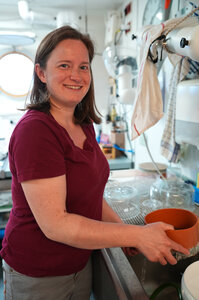
Hello, my name is Ulrike and I work as a technician at the Thünen Institute of Fisheries Ecology. This is also where I developed my fascination for eels. Joining this expedition is a dream come true for me. It is my first journey to the Sargasso Sea, and I approach it with a mix of curiosity, excitement, and a bit of nervousness. Before the trip, I had many questions: How will life and work in shifts function over such a long period? Will I be able to spot eel larvae in the plankton? What will the food be like? Will I get seasick? And will I perhaps even see whales?
Due to a necessary repair of the vessel in Bermuda, we had a few extra days to get to know each other, the crew, and the ship more easily from the harbour, and to explore Bermuda a bit. We also used this time to prepare and set up the laboratories. That was a pleasant start to the expedition for me.
On board, I take on several tasks. Like everyone else, I am involved in carefully sorting plankton samples as well as packing and labelling them. In addition, I am responsible for oxygen titration, which is used to calibrate the sensors. I am especially looking forward to working with the other scientists on board and learning more about their work.
++20.03.2026++Once again, we are setting off on a voyage to the Sargasso Sea.


On 17 March, the Walther Herwig III leaves the port of St. George’s with a total of 36 people on board – 24 seafarers and 12 scientists – and sets course for the Atlantic. Following the mandatory safety briefings, the first work in the planned station operations is scheduled to begin after approximately 16 hours’ sailing in the western Sargasso Sea.
A few words from the expedition leader, Prof. Dr Reinhold Hanel:
“This is my seventh voyage to this sea area, and yet my expectations are almost the same as they were in 2007, when I began my research into the early life stages of Atlantic eels as a member of the Danish Galathea expedition. Now, my crew and I are drawing on the experience gained from previous voyages and hope this will lead to further important insights into the distribution and frequency of occurrence of European and American eel larvae.
As on previous voyages, we have supplemented our core team of staff from the Thünen Institute of Fisheries Ecology with international guests who will assist us with sampling and investigate additional aspects of the samples taken. PhD students and postdocs from Sweden, the Netherlands, France and the Czech Republic will carry out genetic and genomic analyses on eel larvae and will also examine by-catches of deep-sea fish and drifting brown algae.
“After a slightly delayed departure from Bermuda, we are now all delighted to have reached our first sampling station at 67°W, 30°N and to be analysing our first catches. Let’s see what lies ahead...”