Dossier
Material efficiency and circular economy
Jan Lüdtke | 06.01.2026
Wood is an important building block on the path to a bioeconomy. And yet sustainable forestry production cannot be increased indefinitely – even though demand for wood is constantly rising.
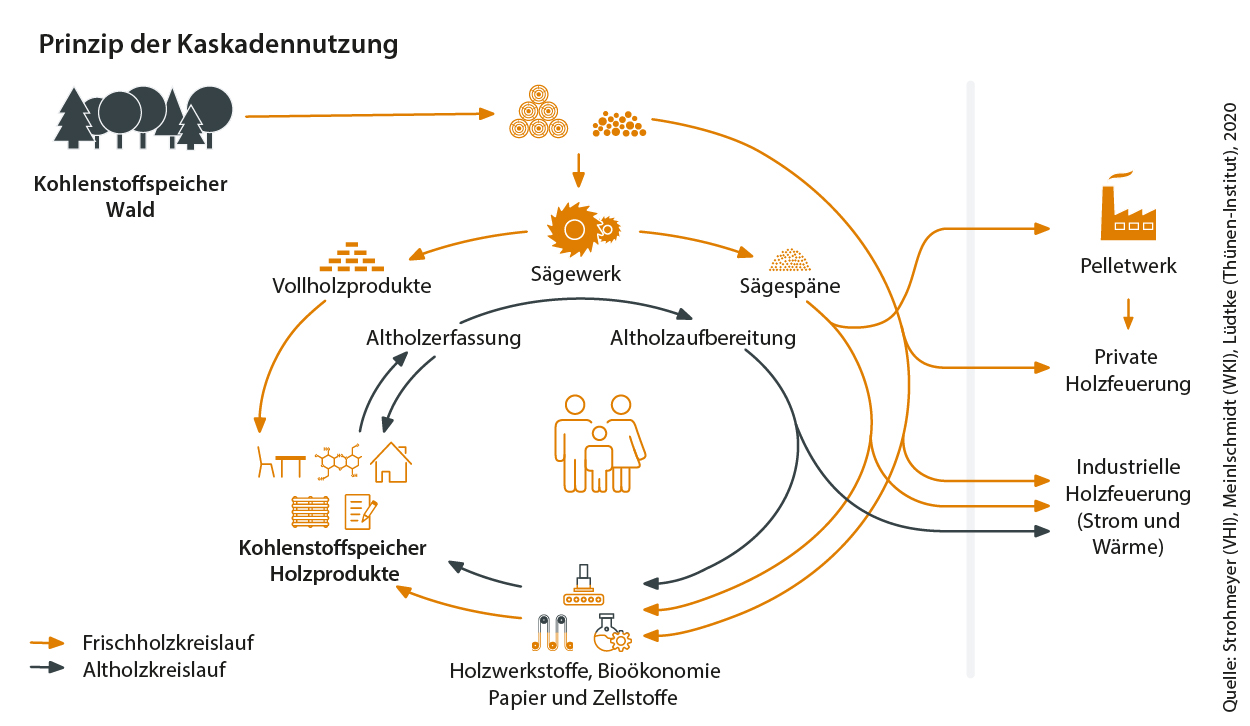
Our current linear economic model (take – make – waste) requires a high level of resource use because raw materials must be extracted from the environment in order to produce something. Once they have been used, most of these raw materials are incinerated directly as waste or end up in landfill.
Forward-looking approaches envisage circular value creation, in which resources are converted into smart products so efficiently that they create broad added value during use through innovative business models. At the end of their useful life, such multi-component products can be easily separated, with the raw materials remaining in the cycle and ready for reuse.
For the timber sector, the circular economy approach has another advantage: the carbon bound in the tree during growth remains stored in the wood during its use. The longer the wood remains in the material cycle, the longer the carbon is removed from the atmosphere. However, only about 20 percent of waste wood is currently reused as material, primarily in chipboard.
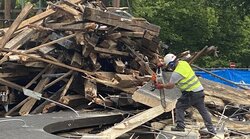
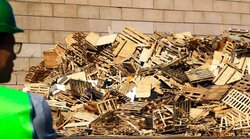
According to the current Waste Wood Ordinance, waste wood classes I and II are permitted for material use. These include single-type waste wood without contaminants, e.g. boards or pallets, and coated wood-based materials. Some coatings fall into waste wood class III and may not be used (see table). However, waste wood is currently collected largely in mixed assortments. Almost half of the waste wood that has already been sorted consists of mixed assortments A I/A II and A I/A II/A III, which may not be used as material in chipboard.
Waste wood categories | explanation |
|---|---|
A I | Natural or merely mechanically processed waste wood that has not been contaminated with non-wood substances to any significant degree during its use. |
A II | Glued, painted, coated, varnished or otherwise treated waste wood, without halogenated organic compounds in the coating and without wood preservatives. |
A III | Waste wood as A II, but with halogenated organic compounds in the coating, without wood preservatives. |
A IV | Waste wood treated with wood preservatives, such as railway sleepers, utility poles, hop poles, vine stakes and other waste wood that cannot be classified as waste wood categories A I, A II or A III due to its pollutant content. Excludes PCB waste wood. |
PCB-Altöl | Waste wood that is PCB within the meaning of the PCB/PCT Waste Ordinance and must be disposed of in accordance with its provisions. In particular, insulation and soundproofing panels that have been treated with substances containing polychlorinated biphenyls. |
We are researching how contaminants affect the manufacture and properties of products in order to evaluate options for greater reuse of the material. Together with the Material and Energy Efficiency Working Group, we have developed recommendations for establishing a resource-efficient circular economy for wood in the areas of
- Product development,
- Process and processing chain,
- Reuse and recycling, and
- Research, training and communication
can contribute.
Publikationen
- 0
Cakaj A, Hesse L, Krause A, Speth H, Lüdtke J (2025) Barriers and potentials for circular use of waste wood in construction and demolition sector with special focus on Germany. Urban Sci 9(9):367, DOI:10.3390/urbansci9090367
- 1
Iost S, Lüdtke J (2025) Transformation der Holzwirtschaft zu einer zirkulären Bioökonomie : Auswertung eines Workshops im Rahmen der Charta für Holz 2.0 im Dialog 2024 „Holz im Kreislauf - Treiber für Innovation!“. Braunschweig: Johann Heinrich von Thünen-Institut, 40 p, Thünen Working Paper 264, DOI:10.3220/253-2025-9
- 2
Cakaj A, Lüdtke J (2024) Efficient utilization of waste wood in a Circular Bioeconomy: Potentials and barriers. In: Forests & society towards 2050 : 26th IUFRO World Congress, Stockholm, Sweden, 23-29 June 2024 ; Book of abstracts. p 1860
- 3
Lüdtke J, Krause A (2024) Zirkuläre Bioökonomie - Relevanz und Anwendung in der Holzwirtschaft. Forsttechn Inf 76(6):10-12
- 4
Schmitz N, Krause A, Lüdtke J (2023) Critical review on a sustainable circular bio-economy for the forestry sector = Zirkuläre Bioökonomie in der Forst- und Holzwirtschaft für eine nachhaltige Entwicklung - Eine wissenschaftliche Einordnung. Braunschweig: Johann Heinrich von Thünen-Institut, 88 p, Thünen Rep 109, DOI:10.3220/REP1684154771000
- 5
Nguyen DL, Lüdtke J, Nopens M, Krause A (2023) Production of wood-based panel from recycled wood resource: a literature review. Eur J Wood Prod 81(3):557-570, DOI:10.1007/s00107-023-01937-4
- 6
Schmitz N, Lüdtke J (2022) Collective action in Germany’s forestry sector illustrating the potential impact of the transformation towards a forest-based circular economy. In: International Union of Forest Research Organizations (ed) Book of abstracts : ALL IUFRO Conference 2022 : forests in a volatile world - global collaboration in sustain forests and their societal benefits : ALL-IUFRO Conference, 21-23 September 2022, Vienna, Austria. pp 15-16