Facts & Figures
Emissions of greenhouse gases from land use, land-use change and forestry (LULUCF)
Andreas Gensior, Roland Fuß, Wolfgang Stümer, Joachim Rock, Sebastian Rüter | 05.02.2026
In 2024, Germany's land use sector remained a significant source of greenhouse gases (GHG), with net emissions of 57.8 million tonnes of CO₂ equivalents (million tonnes CO₂-eq.). By way of comparison, net emissions from land use, land-use change and forestry (LULUCF) amounted to 68.7 million t CO₂-eq in the previous year.
The main sources of these emissions in 2024 were again organic soils, followed by forest biomass. The droughts of 2018 to 2022 and the subsequent damage caused by bark beetles, among other things, have transformed forests from carbon sinks into carbon sources.
The results of the latest calculations on Germany's greenhouse gas emissions show that
- the LULUCF sector has been a net source of greenhouse gases since 2000,
- the targets of the Climate Protection Act (KSG) are currently being missed by a wide margin and are unlikely to be achieved by 2030,
- the carbon sinks of the various ecosystems and their ability to absorb greenhouse gases are sensitive to extreme weather events,
- the introduction of new methods has led to more accurate recording of the dynamics and spatial resolution of emissions in the LULUCF sector.
Background LULUCF
Greenhouse gas reporting for Germany is divided into various sectors. These include transport, industry, agriculture and LULUCF. The LULUCF sector reports on anthropogenic emissions resulting from land use, land-use change and forestry (LULUCF). In the LULUCF sector, carbon pools can either release greenhouse gases and thus cause emissions (source or positive emissions) or absorb CO₂ and thereby reduce emissions (sink or negative emissions).
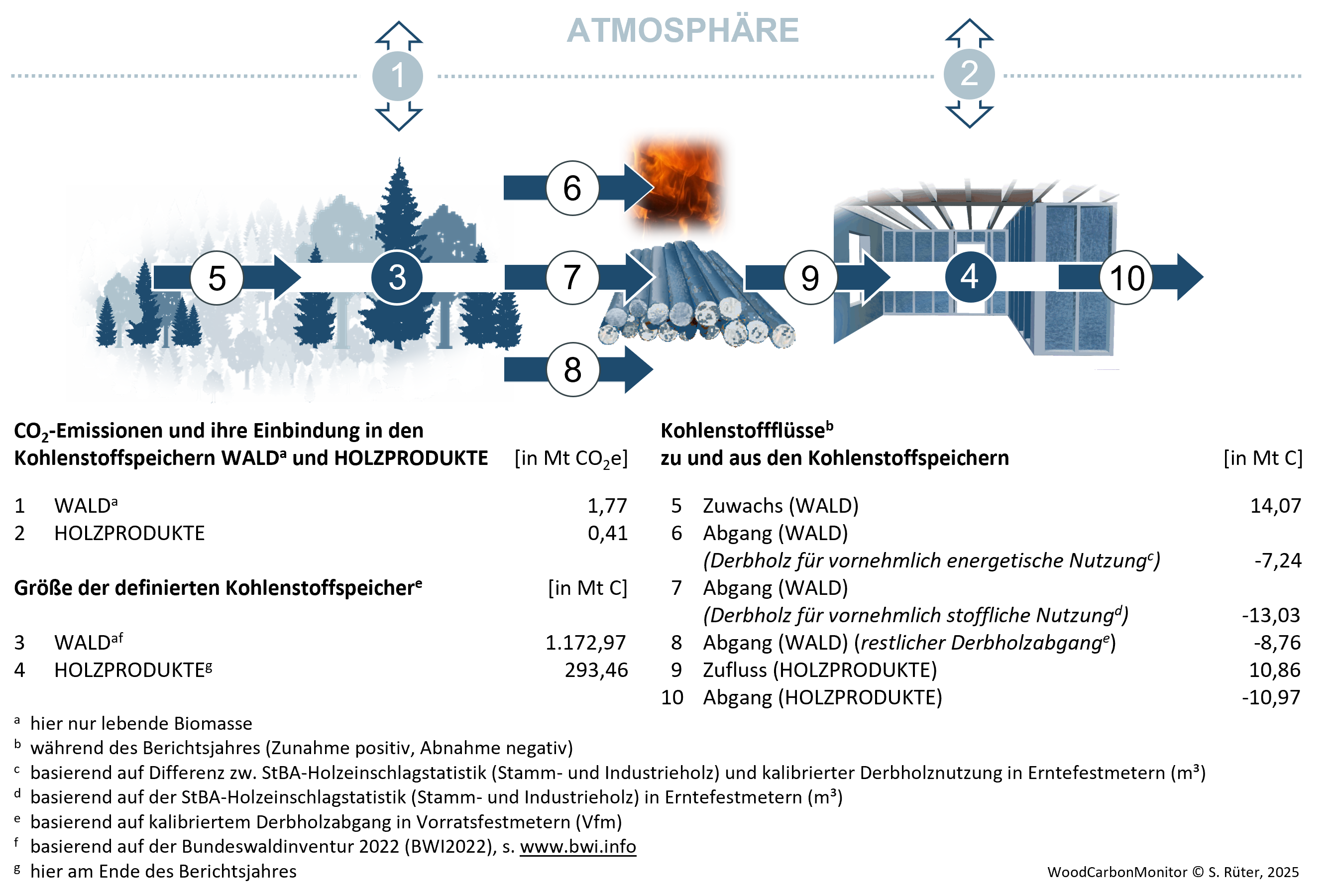
Emissions of carbon dioxide (CO₂), methane (CH₄) and nitrous oxide (N₂O) are recorded in the land use categories of forest, cropland, grassland, wetlands, settlements and other land. To this end, changes in the carbon pools of soils, biomass, dead wood and litter are examined. Added to this is the carbon storage provided by wood products. This wood product storage captures the delayed release of biogenic CO₂ emissions. Greenhouse gas emissions from artificial water bodies, e.g. reservoirs, fish ponds and drainage ditches, from forest and peatland fires and from industrial peat extraction are also included in the balance.
The emissions inventories always cover the period from the base year of reporting in 1990 to two years before the current reporting year. This means that the inventory published in 2026 covers emissions from 1990 to 2024 inclusive.
The LULUCF sector is currently falling well short of its reduction targets.
The Federal Climate Protection Act expects the LULUCF sector to achieve an increasing net sink capacity over time. Section 3a specifies absolute net emission quantities for the LULUCF sector as a contribution to climate protection targets: minus 25 million tonnes of CO₂ equivalent by 2030, minus 35 million tonnes of CO₂ equivalent by 2040 and minus 40 million tonnes of CO₂ equivalent by 2045. There is no specific target path for each year. The net emissions from the LULUCF sector to be accounted for compliance represent the average of emissions from the respective target year and the three preceding years.
If we compare the net emissions totals for the LULUCF sector with the targets specified in the KSG, it becomes clear that the required emission targets are already being missed by a considerable margin. In the entire reporting period since 1990, the sink capacity required for 2030 was only achieved in 1991 and 1993, but never as a four-year average.
Results of emission calculations for the year 2024
Since 2000, Germany's LULUCF sector has been predominantly a more or less significant net source of greenhouse gases. This source effect was particularly pronounced in the drought year of 2003 and again in the dry years since 2018. In 2024, net emissions amounted to 57.8 million tonnes of CO2 equivalent. All land use categories released greenhouse gases. Net emissions were highest in grassland, at 24.2 million tonnes of CO2 equivalent, and in arable land, at 17.5 million tonnes of CO2 equivalent. This was followed by wetlands with 9.0 million tonnes of CO2 equivalent and settlements with 4.6 million tonnes of CO2 equivalent. Forests and wood products were also minor sources, with 2.1 million tonnes of CO2 equivalent and 0.4 million tonnes of CO2 equivalent respectively.
How emissions from individual carbon pools have developed
In the 2024 observation period, net emissions from the LULUCF sector were primarily influenced by forest biomass, related wood product storage and mineral soils. Due to the forest damage since 2018 and its consequences, forest biomass was no longer able to compensate for the consistently high emissions from organic soils and water bodies and has itself become a significant source of emissions.
Biomass, especially that of forests, has a significant impact on the overall balance. In addition to trees, shrubs and their roots, annual plants such as grasses, herbs and arable crops are also taken into account. Dead wood, i.e. dead trees and branches, as well as the so-called litter layer of fallen leaves, needles and twigs are recorded as separate pools.
Despite storms and drought, the forest was a sink for greenhouse gases for most of the time. In 2018, the tide turned: storm damage, drought and related calamities (such as bark beetle infestation) led to increased tree mortality, which particularly affected spruce trees. As a result, a large amount of additional wood had to be removed from the forests. The loss of reserves and lower growth rates of wood led to annual emissions of more than 30 million tonnes of CO₂ equivalent from forest biomass between 2018 and 2023.
Since 2023, emissions from forest biomass have decreased significantly again due to a decline in forced harvesting caused by natural disasters. However, growth rates remained lower than before the disruption. At 1.8 million tonnes of CO₂ equivalent, forest biomass contributed significantly to the net emissions of the biomass pool in 2024. Together with the 1.7 million tonnes of CO₂ equivalent from biomass in the settlements category, these two areas accounted for the majority of total emissions from biomass, amounting to 3.9 million tonnes of CO₂ equivalent. Biomass from arable land was also a source, while biomass on grassland and wetlands acted as a sink overall.
Between 2018 and 2022, severe drought and the resulting damage to forests led to increased use of domestic raw timber. More wood was processed into semi-finished wood products. This also resulted in more carbon being sequestered in what is known as the harvested wood products pool. Since 2023, however, the damage to forests has been largely processed. Accordingly, the sequestration of carbon in the wood products pool is also declining. In 2024, this, together with the losses from the pool, led to the loss of the sink function of the harvested wood products category.
The largest part of greenhouse gas emissions in the LULUCF sector originate from organic soils. In 2024, the mostly drained peatlands caused net emissions of 49 million tonnes of CO₂ equivalent. The hydrological model for this sector in order incorporates weather data to calculate the groundwater level in organic soilswhich controls emissions. As a result, emissions fluctuate significantly from year to year and extreme hydrological events such as dry years have particularly strong impact. Due to the significantly lowered groundwater levels, emissions in the dry year of 2018 were 13.1 million tonnes of CO₂ equivalent or 28.1 per cent higher than in 2017.
In times of increased emissions from biomass, especially from forests, dry periods directly and indirectly intensify the release of greenhouse gases. At the same time, emissions from organic soils are rising, which significantly increases the overall level of emissions (e.g. 2003, 2018, 2022). The resulting interactions, some of which overlap and reinforce each other, show how sensitive land-based ecosystems and wetlands are to extreme weather events, particularly in their role as sources and sinks for greenhouse gases.
Mineral soils have also developed from a sink to a source in recent years. Net emissions amounted to 5.4 million tonnes of CO₂ equivalent in 2024. In the previous year, the figure was 5.0 million tonnes of CO₂ equivalent. Within the various carbon pools, mineral soils, and in particular arable and forest soils, show the greatest fluctuations between comparison periods. This is mainly due to the influence of changing weather conditions. For mineral soils under grassland, it is not yet possible to model carbon dynamics at individual locations with hectare-level accuracy.
While mineral arable soils were predominantly a net source of greenhouse gases, forest soils were almost exclusively a net sink. This sink function is temporarily enhanced in the years following storms, droughts or pest infestations. After such calamities, more organic material is introduced and, after decomposition, stored in the soil to a greater extent.
Over the long observation period of 35 years, mineral soils were predominantly a net sink for greenhouse gases. In most years, arable and settlement soils released fewer net emissions than forest, grassland and wetland soils absorbed carbon.
Changes compared to the 2025 report
Numerous methods were updated to reflect the latest scientific findings for the preparation of the current German greenhouse gas inventory. This led to a complete recalculation of emissions from the LULUCF sector over the entire reporting period. In particular, mineral soils and biomass now show significantly higher net emissions and greater fluctuations in values in the annual comparisons.
- CO₂ and N₂O emissions from mineral arable soils were determined for the first time on a per-hectare basis. The calculation was carried out on a site-specific basis using the Roth-C process model.
- For the forest soils pool, the input factors of the YASSO 15 model were adjusted to better account for the effects of calamities.
- A new model is now used to determine the development of biomass from perennial plants in settlement areas. It also includes new distribution coefficients for different plant types and updated factors for land sealing.
- A new method has been introduced to determine land use before 2010. Furthermore, the map base has been updated in terms of content, areas and time.
The previous year's estimate (VJS) according to the Federal Climate Protection Act (KSG)
According to the Federal Climate Protection Act (KSG), emissions from the previous year must be determined and reported by 15 March (previous year's estimate). These inventories are based in part on preliminary data and estimates. In the LULUCF sector, this applies to wood product storage, forest biomass, crop and grass biomass, and emissions from peat extraction. This data is then updated in the following inventory report. The KSG aims to "ensure the fulfilment of national climate protection targets and compliance with European targets in order to protect against the effects of global climate change" (Section 1 KSG). Among other things, the Expert Council for Climate Issues evaluates the data from the previous year's estimate with regard to compliance with these climate targets.
The results of the previous year's estimate for 2026, which are based on emissions for 2025, will be available from 15 March and will be added here.
Carbon sequestration: mitigation options
In the LULUCF sector, we humans can influence carbon sequestration and greenhouse gas emission reduction in two ways.
- Protecting existing stocks: Draining wetlands or converting grassland releases carbon that is permanently bound. Such land use changes should be avoided.
- Permanent carbon enrichment:
- The controlled rewetting of organic soils is, on the one hand, a very effective measure for significantly reducing greenhouse gas emissions and, on the other hand, for removing CO2 from the atmosphere and storing it in the soil for centuries. This is associated with further positive environmental effects, for example on biodiversity, the water balance in the landscape and the microclimate. If renewable raw materials such as reeds, peat mosses and woody plants are cultivated on rewetted areas, this creates additional potential for reducing greenhouse gases. These materials can, for example, replace insulation or fuel materials that have higher greenhouse gas emissions.
- The cultivation of woody plants in agricultural landscapes, for example in agroforestry systems, short rotation plantations or as hedges, leads to carbon storage in the woody biomass and in the humus, which is often formed in greater quantities. Woody plants also have positive effects on biodiversity, protect against excessive erosion and can replace fossil fuels.
- New forests and sustainable forest use can lead to an increase in the carbon stock in forest biomass. The sustainable use of forests and the associated use of harvested products also contribute to climate protection, for example when more carbon is stored in wood products.
- In mineral soils used for agriculture, the cultivation of catch crops and flower strips, humus-increasing crop rotations or optimised organic fertilisation provide additional carbon storage. However, these measures are reversible in the short term and are therefore only suitable to a limited extent for the long-term development of carbon stores. Technical solutions such as the application of biochar still need to be researched further.