Sharon Mada
Tracking down lost food
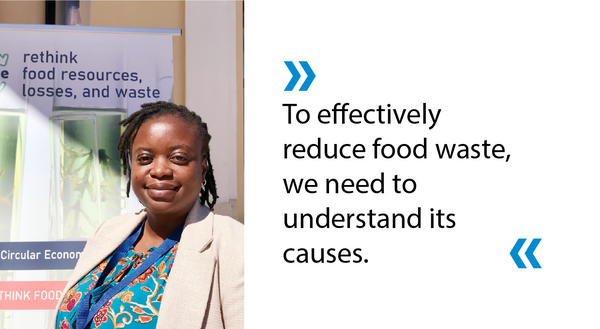
A strawberry yoghurt that is past its best-before date in the far corner of the fridge, or crooked cucumbers that don't meet the standard and never reach the vegetable section: These are the kinds of images many people have in mind when they think of food waste. Many also think that food waste is primarily a problem of affluence. However, food waste does not only occur in high-income households and countries. People also throw away food in low-income communities where hunger and food insecurity prevail. Sharon Mada is researching why this happens. She is a PhD student at the Thünen Institute for Market Analysis working in the Sustainability and Food Loss and Waste working group.
For her research at the Thünen Institute, the scientist examines street markets and households in Zimbabwe. At street markets, for example, she measures the amount of discarded bananas, cucumbers and leafy vegetables. She also conducts surveys and field observations. Within households,local residents also document their household waste in kitchen diaries. Using these analyses, she gathers new insights into why people in low-income communities waste food. Sharon Mada shows that food is not only disposed of because of abundance. Her findings make it clear that socio-cultural norms and values also play a significant role. Other reasons are that, people often cook and serve too much food and throw away leftovers. There is also a lack of refrigeration facilities ‒ both for private households and for the street market vendors. In Africa in particular, there is a lack of reliable data on where, why and how much food is thrown away. ‘However, we need this knowledge to act effectively, so that there is sufficient food for everyone, water and energy are used more efficiently, and climate protection is improved,’ says the researcher.
Even as a child, family and nature played an important role for the scientist, who grew up in Zimbabwe's capital, Harare. It was during high school that she discovered her enthusiasm for research. She explains: ‘I was fascinated by how, for example, climate change and human activities are connected.’ This led her to study geography at university, complete a master's degree in ecology and nature management and work as a university lecturer in Zimbabwe. Now Sharon Mada is pursuing a PhD at the Thünen Institute in the field of agricultural sciences ‒ and is thus pursuing the topics that have been close to her heart since childhood. Her outstanding scientific work is reflected in her two scholarships. For her doctoral studies, she received a three-year doctoral scholarship from the Catholic Academic Exchange Service (KAAD). In 2024, she was awarded the Herman Weber Scholarship, which is given to KAAD scholarship holders who distingush themselves in academic research and their commitment to their home country and the KAAD community.
Even after completing her dissertation, Sharon Mada intends to continue her research into food loss and waste in the Global South. She knows: ‘To reduce food waste, we need to understand its causes.’ Through her research, she aims to develop effective solutions. One initial approach would be to collaborate with local communities and develop materials for public awareness. For the future, she hopes her research findings will inform policy, so that even in low-income communities, less food is wasted.