Prof. Dr. Maraja Riechers
Expert for human-nature relationships
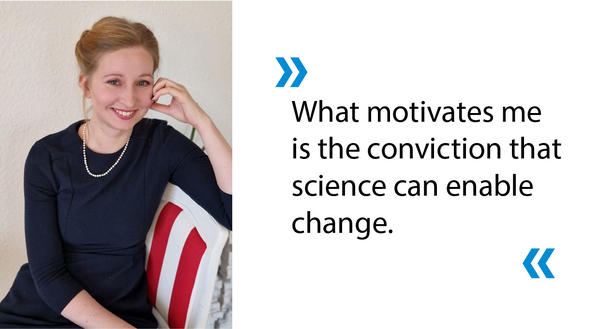
She grew up in a small town in Wedemark near Hanover - far away from the sea. Her constant curiosity about the world eventually led Maraja Riechers to the Baltic Sea and marine research. Today, she heads the ‘Fisheries and Society’ working group at the Thünen Institute of Baltic Sea Fisheries and has been an honorary professor at Leuphana University in Lüneburg since June.
Maraja Riechers' academic career began with a degree in social sciences in Hanover. This was followed by a Master's degree in Global Studies with a focus on human ecology in Sweden, her doctorate in Göttingen and later her habilitation at Leuphana University. Her research has taken her from the green spaces of Berlin to agricultural regions in Lower Saxony and Transylvania to islands in the South Pacific.
Maraja Riechers focusses on questions such as: What does nature mean to people - as a basis for life, as an emotional place, as a source of knowledge?
"We often live in and with nature and only realise how much it shapes us when something changes dramatically. The landscape becomes more homogenised, more built-up, more deserted. Suddenly we no longer feel as at home as we used to," explains the scientist.
Together with her team, she is researching how we can use the understanding of human-nature relationships to achieve a just transformation towards more sustainability in marine socio-ecological systems.
At the Thünen Institute of Baltic Sea Fisheries, Maraja Riechers is investigating how different population groups use the Baltic Sea region for the national fisheries data collection programme (DCF). A large-scale survey is currently being conducted among residents and tourists on the Baltic Sea coast. In this programme, the researchers are creating a data basis that takes into account the values and perspectives of different population groups as well as economics and ecology. The programme focuses on current issues: How do we deal with conflicting goals between nature conservation and use? How do we organise fair joint use?
Being a scientist has not always been easy for Maraja Riechers: temporary contracts, relocations, the difficulty of balancing work and private life. Nevertheless, she is sticking to her path. "The issues that move me are worth it. What motivates me is the conviction that science can enable change if it is anchored in society." Her vision is clear: a future in which healthy oceans and a good life for all are considered together - socially, ecologically and politically.