![[Translate to English:]](/media/_processed_/7/1/csm_IMG_7977_large_1defaf5de1.jpg "[Translate to English:]")

Project
Dead or alive? Bycatch mortality of the worlds longest living vertebrate?
At-vessel and post-release mortality of Greenland shark bycatch in commercial trawl fisheries
Sharks are one of the most endangered groups of vertebrates. According to current estimates, a third of all known shark species are threatened with extinction, and the proportion of affected species is steadily increasing. The main reason for the drastic decline in many shark populations is fishing. Many sharks are very susceptible to overfishing due to their slow growth, late sexual maturity and low number of offspring. This is particularly true of the Greenland shark. Centuries of fishing have caused the population of this Arctic predator to shrink considerably. Even though it is now largely prohibited to retain and land these sharks, even low bycatch rates in commercial fisheries can have a negative impact on the population trend. Knowledge of Greenland shark mortality from unintentional bycatch, which we want to determine as part of this project, is crucial here.
Background and Objective
Greenland sharks (Somniosus microcephalus) are very large sharks that live near the bottom or in deep open water and are mainly found in cold, arctic areas of the North Atlantic. Biological characteristics of Greenland sharks are their enormous size - up to 640 cm -, their very slow growth and an exceptionally high maximum lifespan (presumably up to over 400 years). The reproduction of Greenland sharks is also - as far as is known - remarkable: females only reach sexual maturity at around 150 years of age and then presumably give birth to between two and ten offspring every two years.
Due to their biology and enormously long generation times, many sharks are currently considered to be threatened with extinction by fishing - including Greenland sharks. However, there are no absolute and global figures on the population size of Greenland sharks. Trends from various data sources show a continuing decline in the population since the early 17th century, due to decades of intensive and targeted fishing. Greenland sharks are no longer targeted by commercial fisheries, but are caught as bycatch in various fisheries. Such fisheries include bottom trawling for Greenland halibut (Reinhardtius hippoglossus) and Arctic shrimp (Pandalus borealis). The animals must be released in accordance with new regulations and may not be kept on board. However, based on the estimated population growth rate of the Greenland shark, the currently assumed total bycatch of around 3,500 individuals per year would still be sufficient to cause a further decline in the overall population.
It should be noted here that the assumed bycatch level is based on the one hand on possibly insufficient observer data and on the other hand on a 100% discard mortality, i.e. it is assumed that the individuals thrown overboard/released after capture are all dead or die shortly after. However, the species may have a moderate - currently unknown - discard survival probability. There are very few studies on post-release survival rates for Greenland sharks. According to observers, some Greenland sharks caught in bottom trawl and longline fisheries are released alive. However, based on the limited data available, it is assumed that bycatch mortality of Greenland sharks is generally very high, especially in trawl fisheries. No data is available on possible subsequent mortality due to stress or injury after the release of live animals (post-release mortality). However, knowledge of this mortality of Greenland sharks after bycatch in commercial trawling is necessary in order to be able to better evaluate the population trend in the future by improving the assessment of fisheries induced mortality. Furthermore, it may be possible to derive measures that could reduce the level of bycatch or increase the probability of post-release survival.
Target Group
Policy-makers in marine environmental as well as common fisheries policy; Fisheries scientists; interested community
Approach
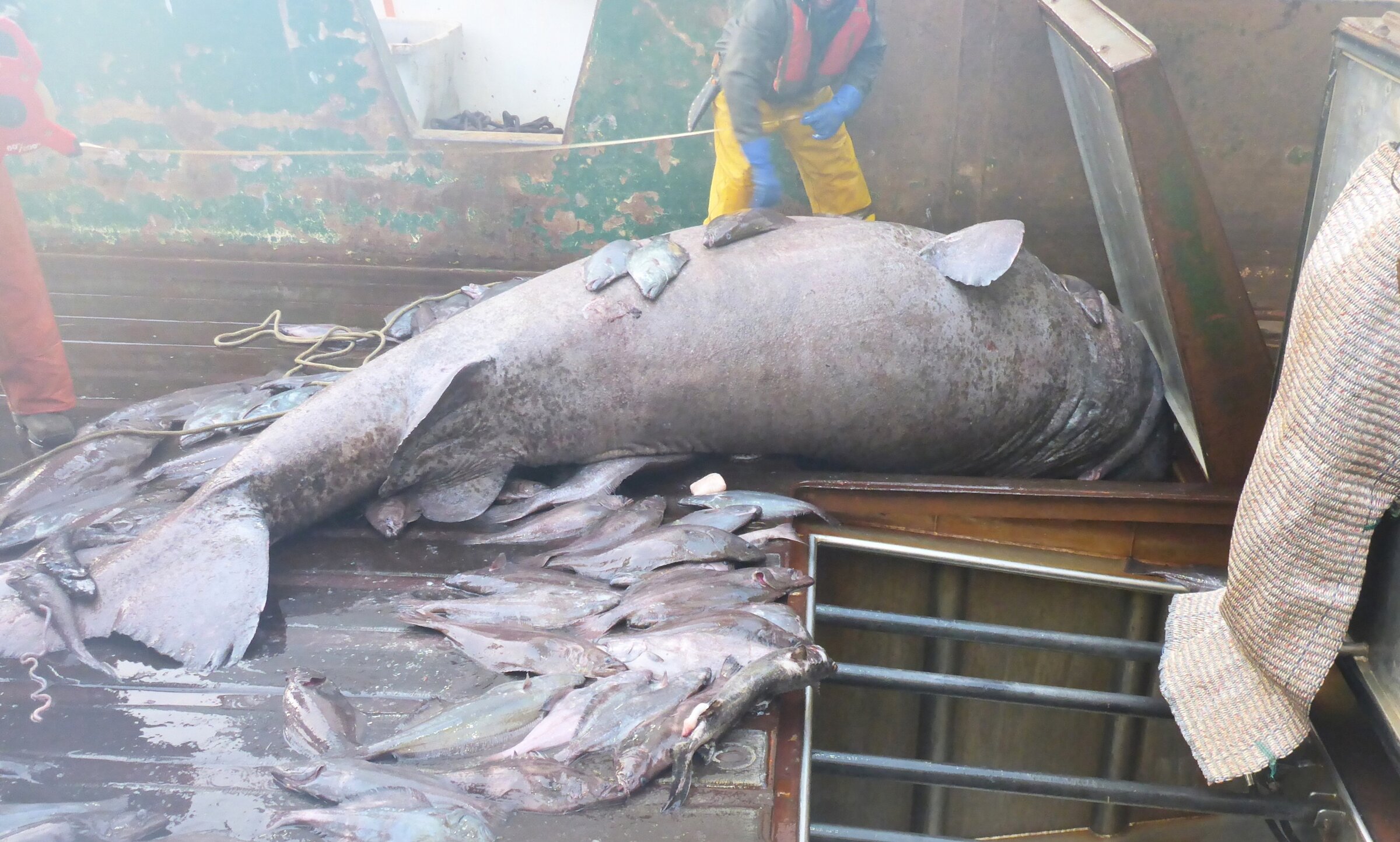
We accompany fishing activities of commercial bottom trawlers in the waters around Greenland. If a Greenland shark is unintentionally caught and brought on deck, we document the condition of the animal based on an assessment system and some tests and record various parameters - size, injuries, liveliness, reflexes, etc. Animals that are according to the assessment scheme suitable for further investigations are then marked with a satellite transmitter before being released. The transmitter/tag records the animal's movement patterns over a period of 30 days. From these data, we can deduce whether the respective individuals have survived the catch and subsequent release.
Data and Methods
We use so-called “survivor Pop-Up Archival Transmitting Tags” (sPAT) for tagging the sharks. The tags are anchored below the dorsal fin in the muscles of the animals. After a Greenland shark suitable for this procedure has been tagged and released, the tags are activated on contact with seawater and begin recording data. Over the pre-programmed period of 30 days, the transmitters record the movement patterns of the sharks and the daily minimum and maximum depths of the animals. During this phase, there is no “contact” with the tagged shark, i.e. we do not know where the shark is or what the animal is doing while the data is being recorded. At the end of the deployment, the transmitter detaches from the animal and surfaces. There, the archived data is then transmitted via ARGOS satellites.
From the movement patterns, we can deduce whether the shark survived the capture and release, whereby “survival” is assumed if the shark is still actively swimming after 30 days, i.e. at the end of the deployment period and at the time the tag is detached.
Additional application of a so-called “spaghetti tag” - a type of ear tag - serves to record further data in the event that the shark is caught again at a later date after the satellite tag has detached.
Our Research Questions
- Can we quantify bycatch mortality of unintentionally caught Greenland sharks in the commercial bottom trawl fishery for Greenland halibut (here: “haulback mortality” or ‘at-vessel mortality’ - i.e. how many of the sharks caught are already dead when the net is hauled in or die while they are on deck)?
- How high is the post-release mortality of unintentionally caught Greenland sharks in the commercial bottom trawl fishery for Greenland halibut - i.e. how many of the sharks that are released alive survive capture and subsequent release?
- Can new data on bycatch mortality be used to derive improved input parameters for population assessments and best practices to avoid high bycatch mortalities?
Preliminary Results
Currently, we carry out preliminary investigations of the condition of bycaught Greenland sharks and the suitability of the respective individuals for tagging before release following the assessment scheme.
Duration
7.2024 - 12.2027
More Information
Project status:
ongoing