
![[Translate to English:]](/media/_processed_/8/e/csm_Bildschirmfoto_2021-03-03_bearb_fc48ac88bf.jpeg "[Translate to English:]")
![[Translate to English:]](/media/_processed_/8/e/csm_Bildschirmfoto_2021-03-03_bearb_ba3ec0e9d7.jpeg "[Translate to English:]")
Project
Winter vetch as preceding crop to maize and as silage for pigs
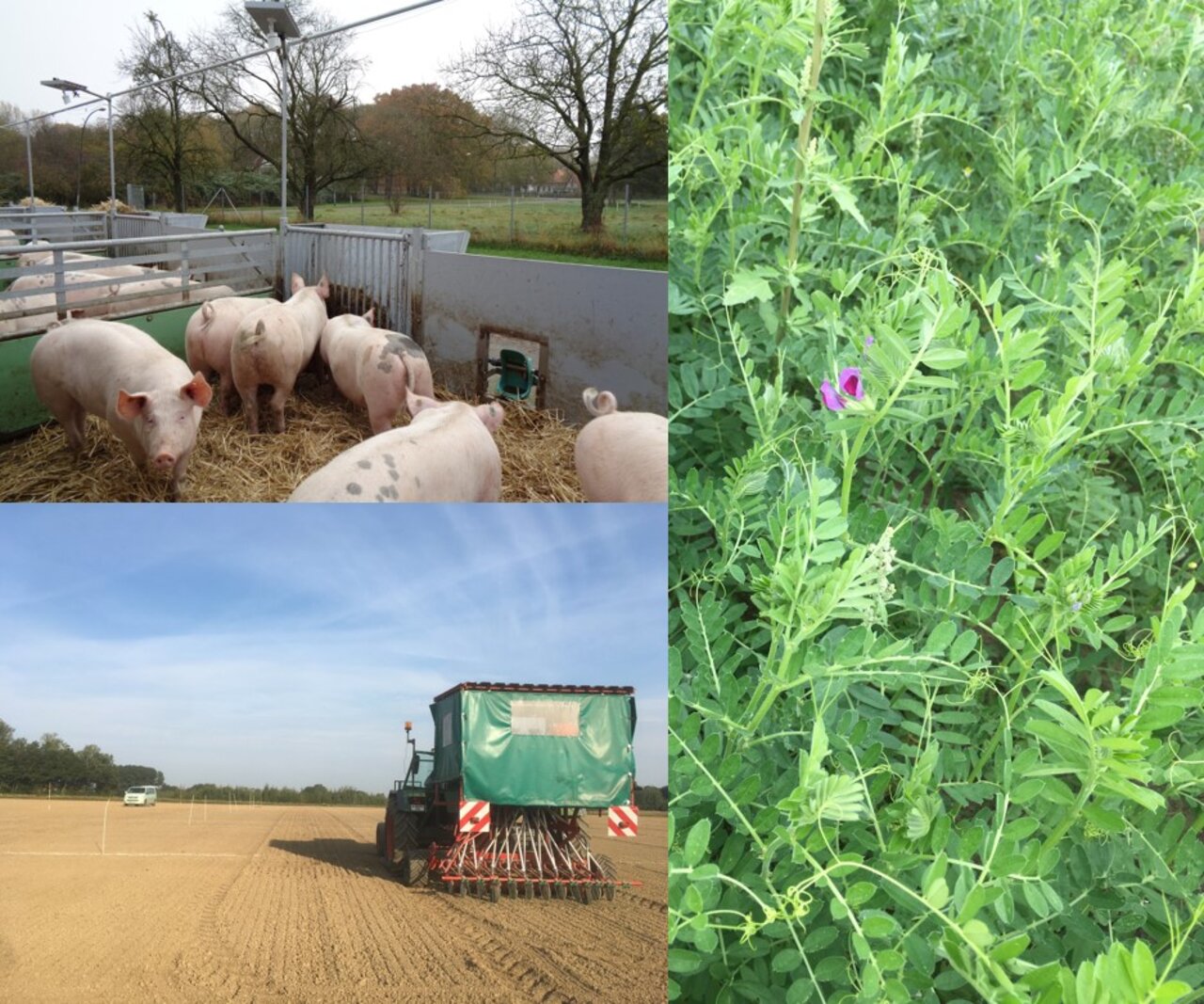
Winter vetch as whole plant: Potential as preceding crop to maize and in the feeding of fattening pigs (WickGanz)
The objective of the project is to test different varieties of the downy vetch (Vicia villosa), the Pannonian vetch (Vicia pannonica) and the Narbonne vetch (Vicia narbonensis) for their suitability for winter intercrop cultivation in Northern Germany, their preceding crop effect on maize and their suitability as high-protein, riboflavin-supplying feed for fattening pigs.
The object of the project was to test the hairy vetch (Vicia villosa), the Pannonian vetch (Vicia pannonica) and the common vetch (Vicia sativa) for their suitability as winter catch crop in Northern Germany, their preceding crop effect on maize and their suitability as high-protein, riboflavin-supplying feed for fattening pigs.
Background and Objective
The aim of the project was to evaluate different vetch species for arable farming and feeding as a whole plant in Northern Germany.
There is a wide range of different species of vetches, which grow as cultivated and wild plants worldwide under different conditions and can be found both as a valuable crop rotation element in pure seed and in mixtures and as a component of grassland. They are used as green manure, for obtaining the seeds as fodder or food, as hay, silage or pasture, and also as a whole plant in the feeding of various types of livestock. Vetches have a high arable value due to, among other things, the possibility of nitrogen fixation and the good rooting ability. They are good preceding crops and catch crops and are able to increase biodiversity. Therefore they are not only of interest in organic farming. The use of winter vetches as a winter catch crop with use as green manure or fodder is attractive from an agronomic point of view because the location requirements of the vetch are low, the soil cover over winter protects the field from erosion and the N2 fixation of winter vetches can significantly improve the preceding crop value. With the integration of leguminous winter catch crops into the crop rotation an optimization of the crop rotation can be achieved. The nitrogen fixed by leguminous winter catch crops can already be reused to a high degree by the following crop. At the same time, the danger of nitrogen being displaced into the groundwater is avoided, as the succeeding crops can absorb the released nitrogen very well. In addition, the establishment of winter catch crops is usually very successful. After the harvest of the main crop, a sufficient margin remains for soil cultivation and the resulting later date of cultivation ensures a good water supply, so that winter catch crops can be established much better than summer catch crops grown as stubble crops. On the other hand, since the legume winter catch crops provide additional forage area, the cultivation period could be reduced from a perennial to an over-year clover-grass cultivation. Thus, a legume preceding crop can be cultivated several times in the crop rotation, from which the subsequent crop benefits. In such a cultivation system, the overall N utilization in the entire crop rotation can be increased.
Due to their high protein content, vetches are not only interesting as seeds for feeding livestock, but also as a whole plant they provide a lot of crude protein. The negative effects of feeding the seeds to monogastric animals, which result from the antinutritive ingredients (ANF), could take a back seat when using the whole plant, as these are primarily localized in the seeds. In addition, silage of whole winter vetch plants could reduce possibly existing ANF. The use of whole plant products from vetches can therefore contribute to improving the protein supply of monogastric farm animals. However, both the protein quality (amino acid composition and digestibility) and the secondary plant constituents must be considered in order to assess the value of these feeds in feeding. Another advantage of using vetches as a whole plant is the expected increased riboflavin content. Since riboflavin is in short supply in most cereal-based rations for monogastric animals and green growths of legumes are known to have high riboflavin contents, it should be examined whether green cuttings or silages from different types of vetches can contribute to the riboflavin supply of monogastric farm animals.
In the project, various vetch species were tested for their suitability for cultivation in northern Germany, their preceding crop effect in maize and their suitability as a protein-rich, riboflavin-supplying feedstuff.
Approach
In a three-year field trial, the effect of different vetch species and varieties in pure seed and in mixtures with cereals on the yield performance of silage maize was investigated. In a further trial, it was determined how the content of valuable and anti-nutritional substances in vetches in pure seed changes over the course of growth. At the same time, these growths were used to test the ensiling ability of the whole plant on a laboratory scale. Recommendations for the choice of vetch species and cutting times with regard to the use of the whole plant as feed for monogastric animals were developed based on the results of the agronomic evaluation and the analyses of the feed value (valuable and antinutritive ingredients, energy and digestibility) of the whole plant as green cuttings and silage. With the help of feeding trials with fattening pigs, the acceptance and the achievable animal performance were also tested in an acceptance trial in the first year and a performance trial in the second and third year at the Thünen Institute. In addition, the precaecal digestibility of the nutrients from the silage was determined in fattening pigs at the Martin Luther University Halle-Wittenberg.
Results
Pre-crop effect
All three tested vetch species can be grown in northern Germany. However, the tested varieties of V. sativa, although advertised as particularly winter-hardy, had the highest risk of overwintering. The highest biomass yields were produced by V. pannonica, which, however, had the lowest N content. V. sativa achieved the highest N contents and thus had a good preceding crop value despite lower biomass yields. Although the preceding crop value was higher in the pure sowing variants than in the mixture variants, cultivation in the mixture is recommended due to the better weed suppression and the lower risk of frost damage. Both green manuring and harvesting for use as roughage should be carried out early enough so as not to jeopardize maize sowing.
Ingredients and ensiling
When using vetch plants for forage, early harvesting is recommended in terms of feed quality, as the total amino acid content decreases with increasing crude fiber content in all species during the course of growth. V. sativa shows only a very slight increase in crude fiber content over the course of growth, which is advantageous for the feed value of plant material harvested later. The levels of antinutritive secondary plant constituents, which increase in this species at the beginning of pod development, are very low compared to the levels in the mature seeds and can be successfully reduced by ensiling. Ensiling all three types of vetch is possible and leads to successful preservation of amino acids and riboflavin, especially in the early stages of development (up to flowering). Harvesting before flowering and ensiling with an ensiling aid are recommended.
Vetch whole plant silage in feeding
In the feeding trials, whole plant silages from the three vetch species were tested, which were harvested in flower or at the beginning of pod development. In general, the vetch silages proved to be an attractive amino acid-supplying roughage for feeding to fattening pigs, the presentation of which leads to a shortening of the fattening period when fed an N-reduced ration and an associated reduction in concentrates. No negative effects on the quality of the carcasses and meat were observed.
The total tract digestibilities of the crude nutrients, amino acids and energy of the three whole plant vetch silages were determined. The crude protein was 55 % digestible in the V. pannonica, 65 % in the V. villosa and 70 % in the V. sativa. A similar gradation was determined for the digestibility of lysine: 59 % in the V. pannonica, 62 % in the V. villosa and 76 % in the V. sativa. For an improved feed value determination, the determination of the precaecal nutrient digestibility would be relevant, especially for the amino acids, which was not successful in this project due to methodological problems, so that further work in the field of digestibility determination in animal experiments and in the laboratory is important here.
It was also shown that the provision of wrap silage as roughage in the outdoor area led to increased use of the outdoor area and increased natural foraging behavior. The opportunity to act out natural behaviors is part of animal welfare, which can therefore be increased here.
Conclusion
Depending on the species used, vetch is suitable as a freezing or harvestable winter catch crop and the growth can be processed as whole crop silage and used in the feeding of fattening pigs, especially before legume development.
Thünen-Contact

Involved Thünen-Partners
Involved external Thünen-Partners
-
Martin-Luther-Universität Halle-Wittenberg
(Halle (Saale), Deutschland)
Funding Body
-
Federal Office for Agriculture and Food (BLE)
(national, öffentlich)
Duration
9.2020 - 1.2026
More Information
Project funding number: 2818EPS019
Funding program: Bundesprogramm Ökologischer Landbau und andere Formen nachhaltiger Landwirtschaft (BÖLN)
Project status:
finished
Publications
- 0
Stepczynski S, Aulrich K, Böhm H, Witten S (2025) Effect of harvest stage and ensiling on contents of crude nutrients, amino acids, riboflavin and secondary plant metabolites of winter catch-crops Vicia sativa, Vicia villosa and Vicia pannonica. Grass Forage Sci 80(4):e70025, DOI:10.1111/gfs.70025
- 1
Stepczynski S, Aulrich K (2025) Formic acid addition to legume silages : methods of dry matter correction. Proc Soc Nutr Physiol 34: 42
- 2
Machner M-T, Aulrich K, Bussemas R, Wiskandt J, Witten S (2025) Usage of outdoor run and health aspects of fattening pigs fed whole plant vetch silage or straw as roughage. Appl Anim Behav Sci 292:106742, DOI:10.1016/j.applanim.2025.106742
- 3
Wiskandt J, Aulrich K, Bochnia M, Bussemas R, Kluth H, Machner M-T, Zeyner A, Witten S (2025) Whole plant silage of vetch in growing-finishing pigs : effect on growth performance and carcass characteristics, and determination of its apparent total tract digestibility. Livestock Sci 302:105830, DOI:10.1016/j.livsci.2025.105830
- 4
Stepczynski S, Böhm H, Witten S, Aulrich K (2024) "Veni, Vidi: Vicia" (Enneking 1994). In: 2. Nationaler Leguminosen-Kongress : Perspektiven für Landwirtschaft und Ernährung, 7.-10. Oktober 2024, Leipzig ; Programm und Beiträge, Stand 1. Oktober 2024. p 45
- 5
Stepczynski S, Witten S, Aulrich K (2024) Ameisensäurezusatz bei Leguminosensilagen: Methoden der Trockensubstanzkorrektur. In: 2. Nationaler Leguminosen-Kongress : Perspektiven für Landwirtschaft und Ernährung, 7.-10. Oktober 2024, Leipzig ; Programm und Beiträge, Stand 1. Oktober 2024. p 53
- 6
Witten S, Machner M-T, Wiskandt J, Stepczynski S, Bussemas R, Aulrich K (2024) Effects of feeding vetch whole plant silage to fattening pigs on fattening performance and slaughter characteristics. Proc Soc Nutr Physiol 33: 96
- 7
Wiskandt J, Witten S, Bussemas R, Stepczynski S, Machner M-T, Aulrich K (2024) Einfluss der Fütterung von Wickenganzpflanzensilage auf die Schlachtkörperqualität und Fleischqualitätsparameter beim Mastschwein. In: Bruder V, Röder-Dreher U, Breuer L, Herzig C, Gattinger A (eds) Landwirtschaft und Ernährung - Transformation macht nur gemeinsam Sinn : 17. Wissenschaftstagung Ökologischer Landbau, 5.-8. März 2024, Justus-Liebig-Universität Gießen ; Tagungsband. 1. Auflage. Frankfurt am Main: FiBL Deutschland eV, pp 304-306, DOI:10.5281/zenodo.11204339
- 8
Baldinger L, Witten S (2024) Noch unterschätzter Proteinlieferant. BW agrar Landwirtschaftl Wochenbl 191(38):24-25
- 9
Machner M-T, Witten S, Bussemas R, Stepczynski S, Wiskandt J, Aulrich K (2024) Silage aus verschiedenen Wickenarten als proteinreiches Raufutter in der Schweinemast. In: Bruder V, Röder-Dreher U, Breuer L, Herzig C, Gattinger A (eds) Landwirtschaft und Ernährung - Transformation macht nur gemeinsam Sinn : 17. Wissenschaftstagung Ökologischer Landbau, 5.-8. März 2024, Justus-Liebig-Universität Gießen ; Tagungsband. 1. Auflage. Frankfurt am Main: FiBL Deutschland eV, pp 309-311, DOI:10.5281/zenodo.11204339
- 10
Baldinger L, Witten S (2024) Wicken an Schweine verfüttern? Ja gerne, aber Achtung! Landwirt Bio(2):71-73
- 11
Wiskandt J, Machner M-T, Bussemas R, Witten S, Aulrich K (2024) Wickensilage in der Mastschweinefütterung - eine Zwischenfrucht als proteinreiches Raufutter. In: 2. Nationaler Leguminosen-Kongress : Perspektiven für Landwirtschaft und Ernährung, 7.-10. Oktober 2024, Leipzig ; Programm und Beiträge, Stand 1. Oktober 2024. p 27
- 12
Aulrich K, Böhm H (2023) Chemical composition (main ingredients and anti-nutritional factors) of common vetch (Vicia sativa L.) varieties. In: Fourth International Legume Society Conference ILS4 2023, 19-22 September, Granada, Spain : Book of abstracts. p 78
- 13
Stepczynski S, Witten S, Böhm H, Machner M-T, Wiskandt J, Aulrich K (2023) Effect of cutting stage on biomass yield, protein yield and protein content of different vetch species as winter catch crop in Northern Germany. In: Fourth International Legume Society Conference ILS4 2023, 19-22 September, Granada, Spain : Book of abstracts. pp 45-47
- 14
Witten S, Machner M-T, Wiskandt J, Stepczynski S, Böhm H, Bussemas R, Aulrich K (2023) Pannonian (Vicia pannonica) and hairy vetch (Vicia villosa) as pig feed. In: Fourth International Legume Society Conference ILS4 2023, 19-22 September, Granada, Spain : Book of abstracts. pp 72-73
- 15
Witten S, Bussemas R, Stepczynski S, Aulrich K (2023) Silage aus pannonischen Wicken (Vicia pannonica L.) und Zottelwicken (Vicia villosa L.) in der Schweinemast? In: Bibic V, Schmidtke K (eds) One step ahead - einen Schritt voraus! : Beiträge zur 16. Wissenschaftstagung Ökologischer Landbau, 07.-10. März 2023, Frick (CH), FiBL Campus. 1. Auflage. Berlin: Verlag Dr Köster, pp 546-547
- 16
Wiskandt J, Machner M-T, Witten S, Bussemas R, Stepczynski S, Aulrich K (2023) Silage aus verschiedenen Wickenarten als proteinreiches Raufutter in der Schweinemast: Auswirkung auf Mastleistung und Schlachtkörperqualität. In: Zeyner A, Kluth H (eds) 16. Tagung Schweine- und Geflügelernährung : 14.-16. November 2023, Lutherstadt Wittenberg ; Tagungsband. Halle (Saale): Institut für Agrar- und Ernährungswissenschaften, Universität Halle-Wittenberg, pp 51-53
- 17
Stepczynski S, Böhm H, Witten S, Wiskandt J, Machner M-T, Aulrich K (2023) Winterzwischenfruchtanbau mit Ganzpflanzennutzung als Vorfrucht zu Mais: Wickenarten in Reinsaat und im Gemenge mit Grünschnittroggen im Vergleich. Mitt Gesellsch Pflanzenbauwiss 33:105-106
- 18
Stepczynski S, Witten S, Böhm H, Aulrich K (2023) Winterzwischenfruchtanbau unterschiedlicher Wickenarten in Reinsaat und im Gemenge mit Grünschnittrogen. In: Bibic V, Schmidtke K (eds) One step ahead - einen Schritt voraus! : Beiträge zur 16. Wissenschaftstagung Ökologischer Landbau, 07.-10. März 2023, Frick (CH), FiBL Campus. 1. Auflage. Berlin: Verlag Dr Köster, pp 236-237
- 19
Stepczynski S, Witten S, Böhm H, Aulrich K (2023) Winterzwischenfruchteignung verschiedener Wickenarten mit dem Anbauziel der Ganzpflanzensilage. In: Bibic V, Schmidtke K (eds) One step ahead - einen Schritt voraus! : Beiträge zur 16. Wissenschaftstagung Ökologischer Landbau, 07.-10. März 2023, Frick (CH), FiBL Campus. 1. Auflage. Berlin: Verlag Dr Köster, pp 248-251