
![[Translate to English:]](/media/_processed_/8/e/csm_Bildschirmfoto_2021-03-03_bearb_fc48ac88bf.jpeg "[Translate to English:]")
![[Translate to English:]](/media/_processed_/8/e/csm_Bildschirmfoto_2021-03-03_bearb_ba3ec0e9d7.jpeg "[Translate to English:]")
Project
Common vetch: variety testing for agronomy and feeding of fattening pigs
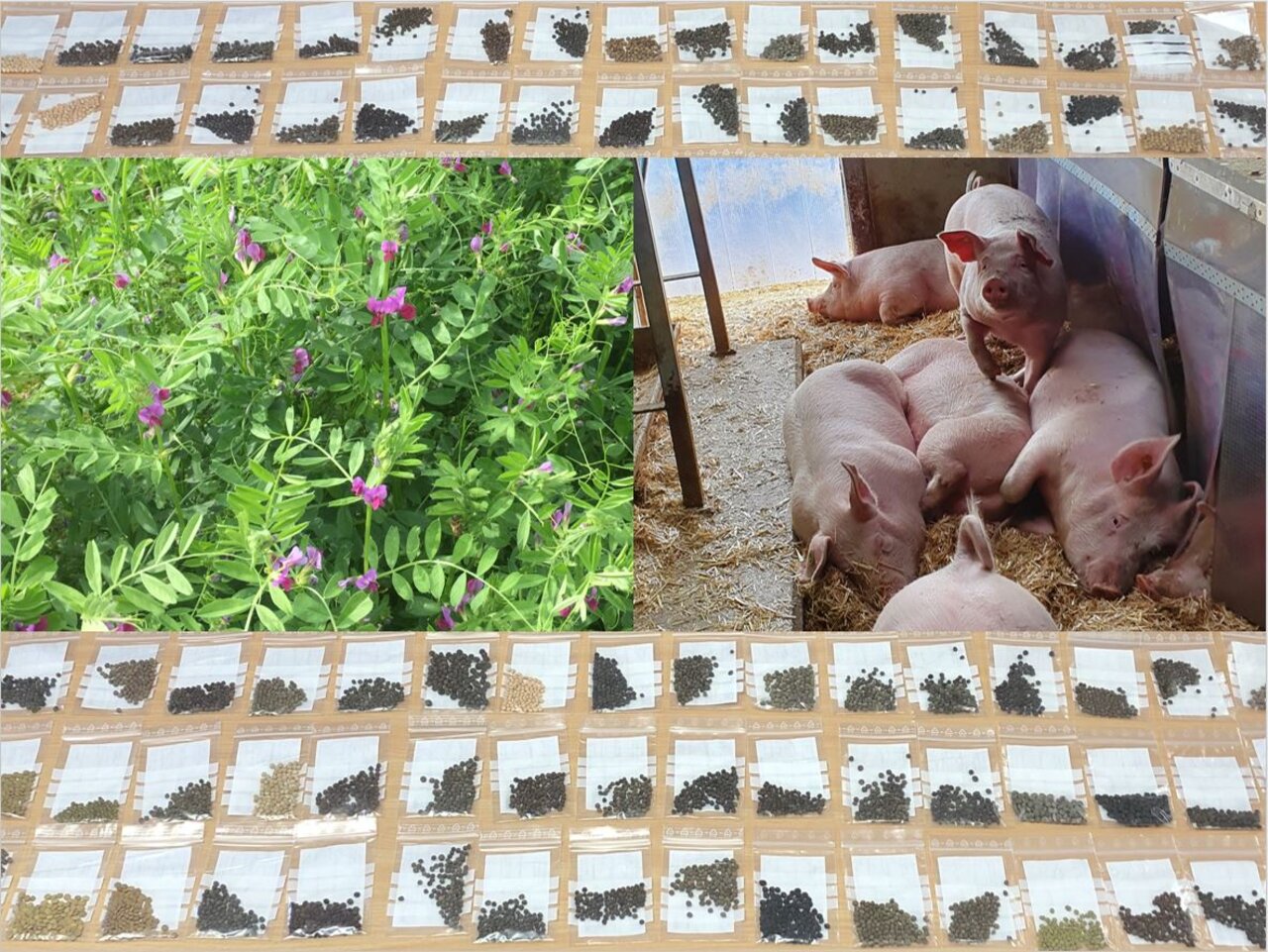
Vetch seeds (Vicia sativa L.) as an alternative, protein-rich feed for fattening pigs under changing climatic conditions (Wick4Pig)
In the planned project, we aim to identify varieties of common vetch (Vicia sativa L.), which can be cultivated under changing climatic conditions and used as valuable feedstuff for monogastric animals.
Background and Objective
Legumes perform a variety of functions in the agricultural ecosystem. One less well-regarded legume is common vetch (Vicia sativa L.). Its low habitat requirements allow it to grow even on acidic soils and in dry regions. Due to its robustness, common vetch has a high potential to produce good yields with high crude protein contents, even under changing climatic conditions. Common vetch is also an interesting feed crop, providing livestock with high-quality protein. However, its content of secondary plant metabolites can limit its use.
The following questions were derived from our own preliminary work, particularly from the WickEiweiss project, and the current state of knowledge:
Crop Production:
- Which common vetch varieties are suitable for protein production in Germany under organic farming conditions when grown intercropped with cereals?
- Which common vetch varieties or accessions have the highest grain, crude protein, and amino acid yields in different environments and under drought stress?
- Which common vetch varieties show the lowest concentrations of secondary plant compounds (vicine, convicine, cyanoalanine toxins, tannins) in different environments and under drought stress?
Treatment (ensiling):
- What effect does the common vetch variety have on the ensilability of the grains and the quality of the silage?
- What effect does ensiling have on the contents of secondary plant compounds in the grains of different common vetch varieties?
Feeding:
- Can high proportions of common vetch grains be used in the feed rations of fattening pigs without negatively impacting fattening and slaughter performance?
- Do two common vetch varieties with different nutrient profiles differ in their impact on fattening and slaughter performance?
- What proportion of the crude protein and amino acids in raw and ensiled vetch grains is precaecally digestible in fattening pigs?
Approach
In the project, agronomic trials with different varieties and gene bank accessions are planned in cooperation with the IPK. Furthermore, the ensilability is going to be tested under laboratory conditions. The digestability of vetch seeds by fattening pigs will be tested at the MLU Halle-Wittenberg and feeding trials with fattening pigs will be conducted.
Thünen-Contact

Involved Thünen-Partners
Involved external Thünen-Partners
- Martin-Luther-Universität Halle-Wittenberg
(Halle (Saale), Deutschland) - Leibniz-Institut für Pflanzengenetik und Kulturpflanzenforschung (IPK)
(Stadt Seefeld, OT Gatersleben, Deutschland)
Duration
2.2025 - 1.2028
More Information
Project funding number: 2822OE004
Project status:
ongoing
Publications
- 0
Honsdorf N, Al-Muttwaki M, Witten S, Lohwasser U, Aulrich K (2025) Wick4Pig : Anbau von Saatwicken als proteinreiches Futtermittel für Mastschweine. Mitt Gesellsch Pflanzenbauwiss 34:337-338