![[Translate to English:]](/media/_processed_/3/e/csm_AdobeStock_249730128_92f14d3a63.jpeg "[Translate to English:]")
![[Translate to English:]](/media/_processed_/3/e/csm_AdobeStock_249730128_a6fcf4c893.jpeg "[Translate to English:]")
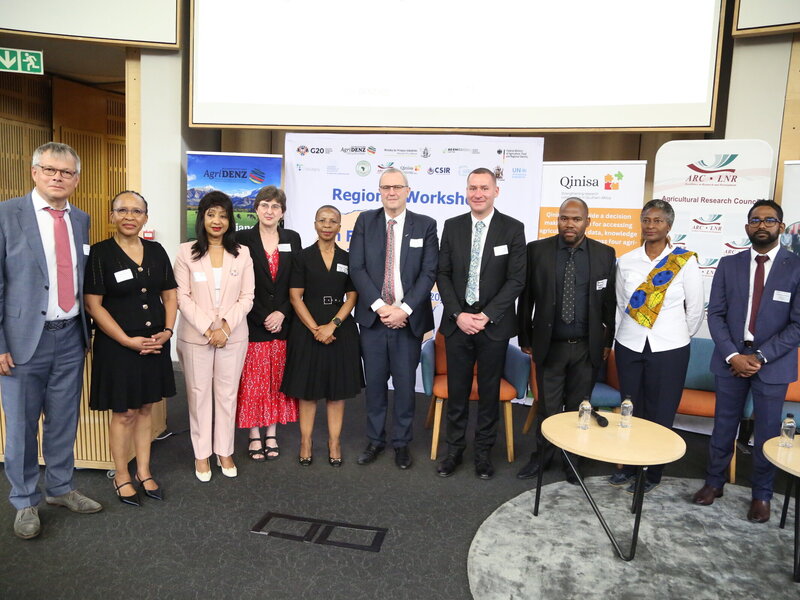
The workshop is part of the Collaboration Initiative on Food Loss and Wastecoordinated by the Thünen Institute, which emerged from a recommendation of the G20 meeting of agricultural science advisers (MACS-G20). The workshop is financially supported by the Federal Ministry of Agriculture, Food and Rural Affairs (BMLEH) and the New Zealand Ministry for Primary Industries as part of the Bilateral Alliance for the Climate (AgriDENZ). It contributes to the achievement of UN Sustainable Development Goal 12.3, which aims to halve food waste in retail and private consumption and reduce losses along the supply chain.
Over the three days of the workshop, we welcomed around 150 participants from 17 countries, including Botswana, Ghana, Kenya, Mauritius, Nigeria, Zambia, Senegal, Zimbabwe, Tanzania and South Africa. The participants from research, politics, business, international organisations and civil society exchanged views on topics such as losses in the production of animal products, the implementation of sustainable production systems in an urban context, the links between losses and waste and climate and sustainability, and the political framework for implementing measures. The intensive discussions were complemented by an exhibition with stands and posters, in which theoretical concepts were integrated into practical food waste reduction.
A particular focus was on the participation of young scientists in all phases of the workshop. As a result, this workshop has led to the establishment of a new network that supports young scientists in sub-Saharan Africa in their activities to reduce food waste and exploits synergies to carry out joint research projects.
The excursion on the last day took us to a farm that uses aquaponics to produce both trout and vegetables. The purchased fish feed nourishes the trout, whose excrement provides the nutrients needed for the vegetables in a recirculating system. This allows fish and vegetables to be produced year-round as needed with minimal use of water and other resources.
A summary of the workshop, presentations and posters will be available here from around the end of November.
We would like to express our sincere thanks to our participants and the fantastic organisation team from the Sustainable Development Solutions Network, our New Zealand colleagues and our South African partners on site!