![[Translate to English:]](/media/_processed_/3/e/csm_AdobeStock_249730128_92f14d3a63.jpeg "[Translate to English:]")
![[Translate to English:]](/media/_processed_/3/e/csm_AdobeStock_249730128_a6fcf4c893.jpeg "[Translate to English:]")
Project
Preventing stored product pests in Germany
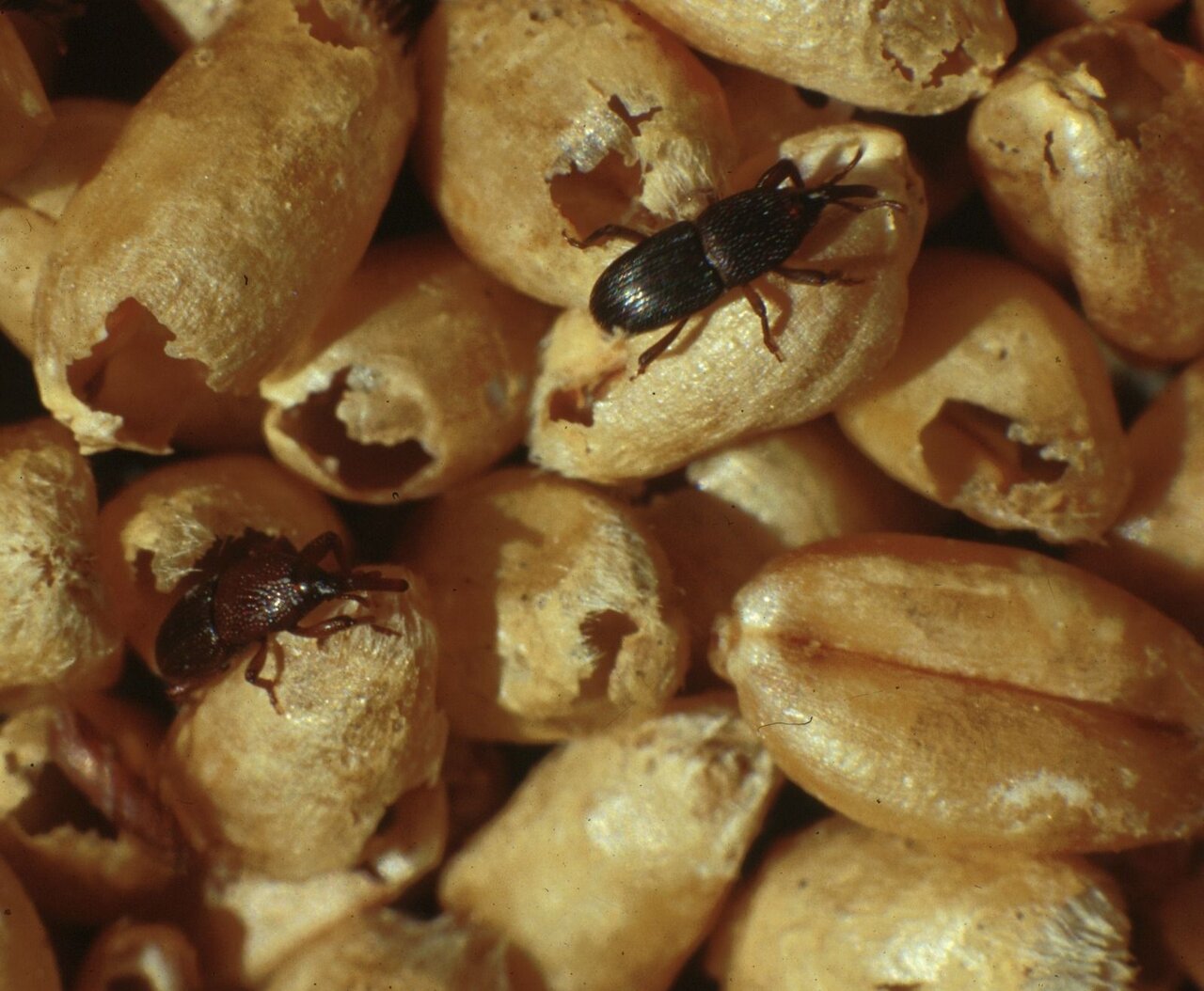
Climate-optimised storage technology for bulk grains and early detection of established and newly emerging insects harmful to stocks in the field and storage due to climate changes to reduce post-harvest losses and plant protection products
We develop optimised storage structures that combine product-specific advantages of underground hermetic storage and aspects of sustainability. The optimised early detection of insects that damage storage is also a topic.
Background and Objective
Due to climate change, the environment for the growth of arthropods that are harmful to food supplies is improving in Germany. They survive the mild winters and infestation of agricultural products is already becoming more frequent in the field. At present, little information is available on the occurrence of storage pests.
The storage structures currently used in Germany allow insect pests access to the stored goods, which results in the use of plant protection products and losses of stored agricultural products.
The aim of AVoiD was to develop optimised under- and above-ground storage structures that can also be equipped with solar cooling if necessary. In doing so, we would like to achieve the following:
- Reduction of post-harvest losses as the annual mean temperature rises.
- Reduction of greenhouse gas emissions through reduction of perishable stocks
- Reduction of pesticide application in stock protection
- Evaluation of pest resistance and cooling performance in hermetic storage
- Determination of the most economically, ecologically and socially sustainable storage technology for bulk grain goods
- Early detection of changing pest fauna due to climate change and of infestations in the field
- Determination of dispersal paths and mechanisms of insects harmful to stocks (e.g. along river courses and/or motorways from south to north with wind, active flight, or predominantly passively via transport)
Target Group
Our findings are relevant to both research and practice and should support future policy advice.
Approach
Under the leadership of the Julius Kühn Institute, a consortium of research and practice partners is working on the aforementioned issues.
Data and Methods
The occurrence of post-harvest losses due to pest infestation can be reduced by a series of measures: After thorough cleaning and drying before storage, a gas-tight (hermetic) storage can make it more difficult for pests to invade from the surrounding environment during storage. Additionally, the gas-tightness creates an oxygen-poor atmosphere in the stored grain over time, which helps to preserve the grain quality and germination capacity, while suppressing the occurrence of pests and fungi.
In the first work package, selected storage forms were compared and optimization potentials were identified. To this end, the various project partner organizations conducted an economic impact assessment, monitored grain quality (sensory, microbiological, and technical quality) during the storage process, performed a life cycle assessment, and evaluated social criteria for the different scenarios. Practical trials with various hermetic storage systems were conducted at the JKI on a laboratory scale and also on a pilot scale (hermetic above-ground and underground silos).
Due to the expertise at the Thünen Institute of Market Analysis, we were responsible for creating the ecological and social sustainability assessment of the different storage variants. We were able to incorporate both knowledge from our project partner organizations and literature data into our evaluation.
In the second part of the project, the Institute for Ecological Chemistry, Plant Analysis, and Stored Product Protection (JKI) developed optimized early detection methods for stored product pests inside and outside of storage facilities. These methods will be tested at selected locations in Germany.
Our Research Questions
What are the advantages and disadvantages of different existing storage structures in terms of stored goods and sustainability (economic, ecological and social) and how can they be improved?
Which storage pests exist in Germany and how can they be controlled as effectively as possible?
Results
At this point, only the results of our project part are presented. For the ecological and social evaluation, the following storage scenarios were compared: flat storage hall, round silo, hermetic film bag, hermetic underground silo, and hermetic above-ground silo. In the ecological evaluation, the hermetic storage variants showed partially significantly lower values in the considered impact categories of greenhouse potential and human toxicity. In terms of land use, the hermetic silos currently have higher values than conventional, non-hermetic storage forms, while the hermetic film bag has the lowest value.
In the social evaluation, factors related to health and occupational safety, qualification requirements, and qualitative workload were used as a basis. Non-hermetic storage scenarios generally require increased attention to occupational safety, particularly when it comes to climbing work or exposure to pesticides.
Limitations arise from partial gaps in the available databases for life cycle assessment (LCA). Additionally, there are currently hardly any practical data available for above-ground and underground hermetic silos, so numerous assumptions had to be made in these scenarios.
Overall, hermetic storage has the potential to reduce environmental impacts, health protection, and occupational safety in grain storage. Especially when considering the remaining project packages, advantages become apparent, which will likely be strengthened in the future due to increasing pest pressure. Pilot projects in practice could provide the currently still incomplete data in the future, allowing for detailed ecological and social calculations to be performed and concrete recommendations to be made.
A brief overview of the results of the overall AVoiD project can be found in the final report (in German only) of all 27 research projects funded under the German Climate Protection Programme 2022 of the Federal Ministry of Agriculture, Food and Regional Identity. An overview of all research projects can be found on the RessortForschtKlima website. An assessment of the potential to reduce greenhouse gas emissions of the funded projects was published in a separate report (in German only).
Links and Downloads
Dr. Cornel Adler (Project coordination, JKI Institute for ecological chemistry, plant analysis and stored product protection, ÖPV, Berlin)
Dr. Benjamin Fürstenau (JKI-ÖPV, Berlin)
Dr. Christina Müller (JKI-ÖPV, Berlin)
Camilla Albrecht (JKI-ÖPV, Berlin)
MSc. Jovanka Saltzmann (JKI Institute for strategies and technology assessment, SF, Kleinmachnow)
Julia Büchner (JKI-SF, Kleinmachnow)
Dr. Jens Begemann (MRI Department of Safety and Quality of Cereals, Detmold)
Thünen-Contact

Involved Thünen-Partners
Involved external Thünen-Partners
- Julius Kühn-Institut - Bundesforschungsinstitut für Kulturpflanzen (JKI)
(Quedlinburg, Braunschweig, Groß Lüsewitz, Kleinmachnow, Deutschland) - Max Rubner-Institut, Bundesforschungsinstitut für Ernährung und Lebensmittel (MRI)
(Karlsruhe, Hamburg, Deutschland)
Funding Body
-
Federal Ministry of Agriculture, Food and Regional Identity (BMLEH)
(national, öffentlich)
Publications
- 0
Runge T, Heidecke C, Osterburg B, Feike T, Kranz S (2025) Abschätzung des THG-Minderungspotenzials der RessortForschtKlima-Projekte : Vorstellung des Wirkketten-Ansatzes unter Berücksichtigung der Besonderheiten von Forschungsprojekten. Göttingen: OpenAgrar, 36 p, DOI:10.3220/253-2025-246
- 1
Adler CS, Fürstenau C, Albrecht C, Müller-Blenkle C, Büchner J, Saltzmann J, Schneider F, Athai J, Begemann J (2025) Abwehr von Vorratsschädlingen in Deutschland - Untersuchungen zur hermetischen Lagerung und Früherkennung von Vorratsschädlingen im Lager und Feld. In: RessortForschtKlima (ed) Ergebnisse aus drei Jahren Forschung für mehr Klimaschutz in Landwirtschaft, Wald und Ernährung : Abschlussbericht der RessortForschtKlima-Projekte. Göttingen: OpenAgrar, pp 40-43, DOI:10.3220/253-2025-220