
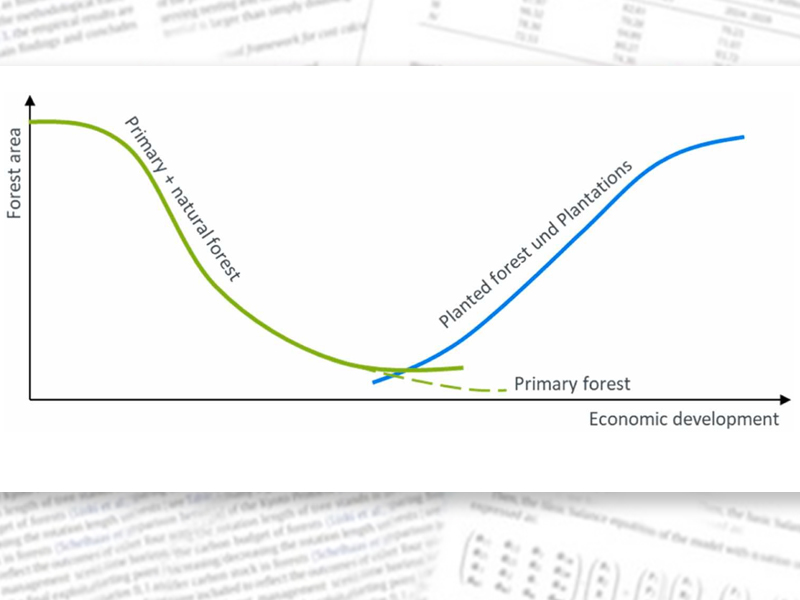
A new study, based on data from 190 countries, sheds light on the key factors that shape changes in forest area worldwide. The analysis distinguishes between natural and planted forests – and reveals that they respond differently to social, economic, political, and environmental drivers.
Some key findings are:
- Population matters: High population density is linked to natural forest loss, while overall population growth tends to support the expansion of planted forests.
- Clear negative signal: Net-forest depletion (unit resource rents times the roundwood harvest over natural growth) stands out as consistent driver of deforestation for both forest types.
- Energy use plays a central role: access to electricity and clean fuels for cooking positively foster planted forest area growth.
- Roundwood trade shows mostly positive effects: Rising imports consistently support the expansion of both natural and planted forests, while the effect of exports is more mixed and not uniformly positive.
These insights are vital for designing more effective forest and land-use policies on a global scale.
The article was published in the journal Land Use Policy and can be freely accessed here:
Tandetzki J, Morland C, Schier F (2025) Beyond the forest transition hypothesis: Uncovering the drivers influencing natural, planted and plantation forest area development using regression-based machine learning approaches. Land Use Pol 158:107762, DOI:10.1016/j.landusepol.2025.107762
https://literatur.thuenen.de/digbib_extern/dn070148.pdfProjectsite
Modelling of the global roundwood supply