
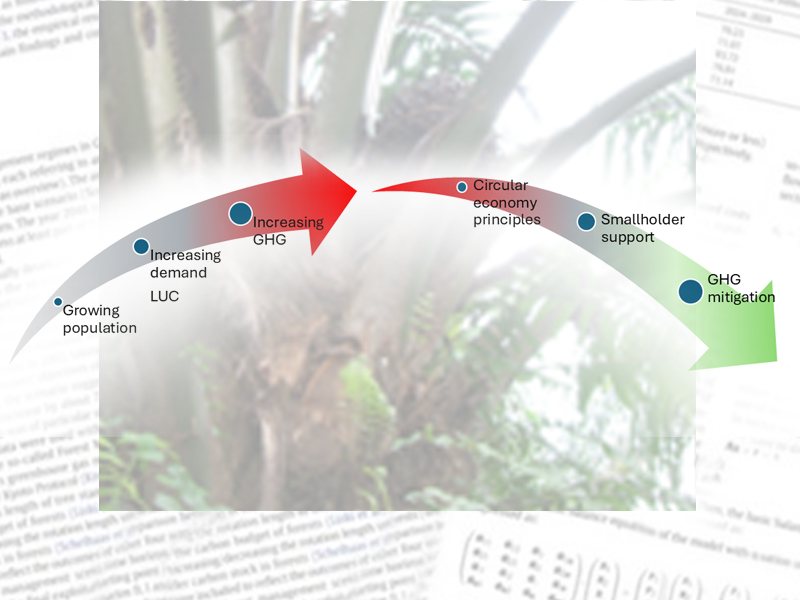
While the expansion of Indonesian oil palm improves local living standards, it simultaneously triggers substantial emissions through LUC. Understanding the carbon footprint of palm oil, particularly from LUC and through rigorous Life cycle modeling, is paramount for providing sound advice on greenhouse gas mitigation. Peatland conversion is the most carbon-intensive development pathway.
To move toward a more sustainable economy, it is essential to demonstrate the consequences of these modeling choices to stakeholders in policy and industry. Significant potential exists through the application of circular economy principles, such as improved residue management through co-composting empty fruit bunches with palm oil mill effluent to reduce methane emissions.
In 2021, smallholders manage approximately 40% of the 17 million hectares of oil palm plantations in Indonesia. Increasing smallholder yields from 11 t to 20 t of fresh fruit bunches per hectare would generate an additional 14 million tons of crude palm oil without further LUC - effectively sparing 3 million ha of land.
Consequently, providing smallholders with essential agricultural inputs and tailored technical training represents a vital opportunity to maximize yields and enhance rural incomes while minimizing the environmental footprint.
Stichnothe H, Schweinle J (2026) Carbon footprint estimation of palm oil production systems - impact of land use change and consequences of modeling choices. Carbon Footprints 5:11, DOI:10.20517/cf.2025.90
https://literatur.thuenen.de/digbib_extern/dn070937.pdf