![[Translate to English:]](/media/_processed_/2/9/csm_Embryo-Exp_Gelege_9F_dpf5-200513111619_c8534a8199.jpg "[Translate to English:]")
![[Translate to English:]](/media/_processed_/2/9/csm_Embryo-Exp_Gelege_9F_dpf5-200513111619_9027994d44.jpg "[Translate to English:]")
Project
CONMAR-2-Fish marine munition legacies and fish
Effects of marine dumped munition on fish in the North and Baltic Sea
Marine dumped munition is a global problem. In German waters of the North and Baltic Sea about 1.6 million metric tons of munition were dumped after World war two. The munitions shells are corroding and environmentally toxic substances are released to the marine environment.
Background and Objective
The CONMAR-2 project consortium will investigate in more detail locations and conditions of marine dumped munition in German waters, as well as their possible impact on the environment. CONMAR-Fish investigates potential impacts of marine dumped munition on fish, as fundamental part of marine ecosystems and important source for human nutrition. Research of the last years revealed that fish take up harmful substances from marine munitions, particularly explosives. These detections were clearly above detection limits but have not yet reached alarming levels. However, not all contaminated areas were sampled yet and it has to be expected that amounts of leaking toxins increase with ongoing corrosion of munition shells.
Up to date, fish were mainly investigated from munition dump sites in the Baltic Sea. With the present project, range of investigated sites will be extended, particularly to the North Sea. Strategies to monitor intoxication of fish by munition compounds will be developed for marine habitats in the North and Baltic Sea.
A further core area of the present initiative comprises of laboratory studies to investigate effects of munition compounds on fish. There is no doubt that explosives (such as TNT) in dumped munitions are carcinogenic and toxic. However, toxic effects of explosives are concentration depended and leaking substances are diluted in marine environments. With laboratory experiments, we therefore want to test how environmentally relevant concentrations of explosives influence vital parameters of fish.
Approach
CONMAR-2-Fish will significantly contribute to a better understanding of effects of marine dumped munition on fish. It will be investigated to which extend fish in their ecosystem and as source for human nutrition are altered by munition contaminants. Fish will be sampled at marine munition dump sites and their tissues tested for munition compounds, alongside, their health status will be monitored. With laboratory experiments fish and cell cultures will be tested with environmentally relevant concentrations of munition compounds.
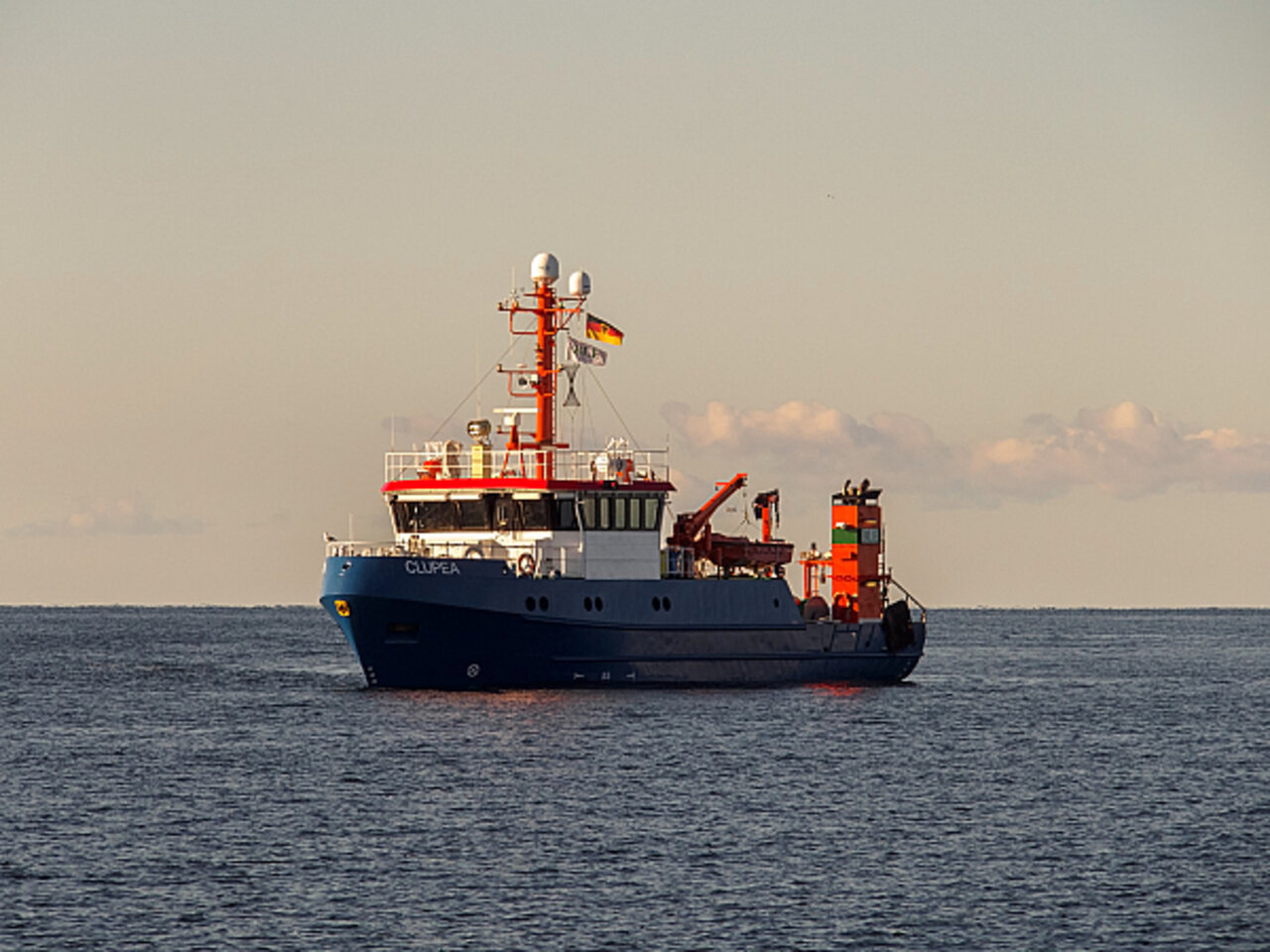
With the CONMAR-2-Fish project, further sampling is carried out at sea with research ships from the Thünen Institute and other project partners. The aim of the field studies is to consolidate the data on ammunition contamination of fish in the Baltic and North Sea and to develop strategies for future monitoring of fish in the context of marine ammunition contamination. The fish are measured on board and examined externally, and organ samples are taken for toxicology.
Another important question that will be addressed with the present initiative is to which extend explosives are accumulating in food chains. Therefore, invertebrates and fish will be sampled along food chains and investigated for residual munition compounds. The expected results will enable the assessment of effects of marine dumped munition on fish stocks in the Baltic and North Sea.
Thünen-Contact

Involved Thünen-Partners
Involved external Thünen-Partners
- GEOMAR - Helmholtz Zentrum für Ozeanforschung Kiel
(Kiel, Deutschland) - Alfred Wegener Institut (AWI) - Helmholtz -Zentrum für Polar und Meeresforschung
(Bremerhaven, List (Sylt), Deutschland) - Umweltbundesamt (UBA)
(Dessau-Roßlau, Deutschland) -
Senckenberg Gesellschaft für Naturforschung
(Frankfurt, Wilhelmshaven, Görlitz, Deutschland)
Funding Body
-
Federal Ministry of Research, Technology and Space (BMFTR)
(national, öffentlich)
Duration
12.2024 - 11.2027
More Information
Project status:
ongoing
Publications
- 0
Kammann UKR, Scharsack JP (2025) Kontamination durch versenkte Munition : TNT-Metaboliten in Fischen aus Nord- und Ostsee. Mitt Umweltchem Ökotox 31(1):8-11
- 1
Kammann UKR, Töpker V, Scharsack JP (2025) Tracking explosive contaminants from dumped munition in the western Baltic Sea via urine and bile analysis of three flatfish species. Environ Sci Europe 37:32, DOI:10.1186/s12302-025-01074-0