
![[Translate to English:]](/media/_processed_/6/4/csm_titel_CO2Kampagne8_afeea2273e.png "[Translate to English:]")
![[Translate to English:]](/media/_processed_/4/1/csm_titel_93px_CO2Kampagne8_9b0f3354d4.png "[Translate to English:]")
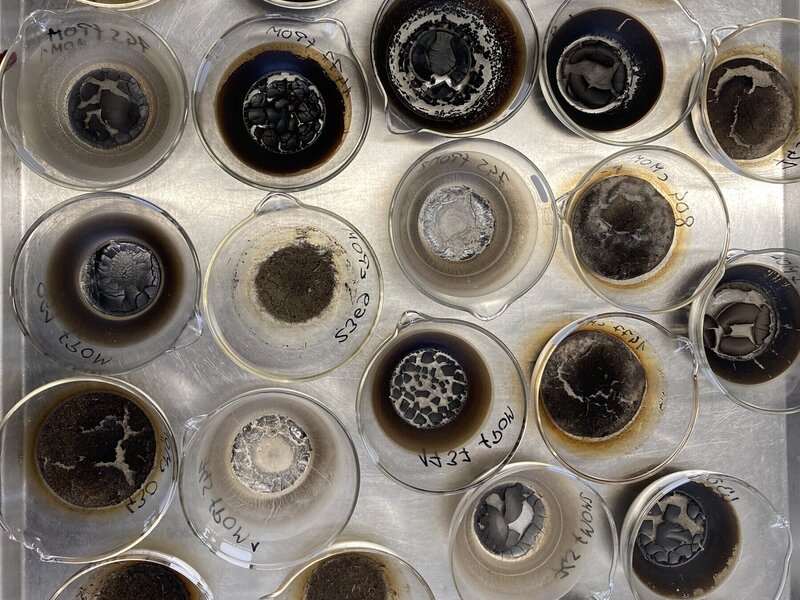
We have long been using physical fractionation of organic soil matter to distinguish between easily degradable (particulate) and more stable (mineral-associated) carbon. This can be done either by size fractionation (assumption: the fine fraction contains only mineral-bound C and the coarse fraction contains essentially C-free sand grains and plant residues) or by density fractionation (assumption: plant residues are light and are thus separated from all mineral particles). There is criticism that size fractionation carries the risk of small particulate, i.e. supposedly labile particles ‘contaminating’ the fine fraction, thereby (significantly) overestimating the proportion of mineral-associated C. This is important to know because this fraction is attributed with the longer-term storage of C in the soil.
Therefore we carried out two different tests:
- We selected 40 BZE samples along texture and C gradients and first fractionated them by size and then fractionated the fine fraction again by density. In the vast majority of samples, the proportion of fine, particulate C was negligible and, incidentally, also full of mineral-associated C. The situation was different for C-rich sands: here, there were huge amounts of fine particulate C.
- We fractionated 140 samples, which Cora Vos had already density-fractionated in her doctoral thesis, again by size. Here, too, the results show that for the vast majority of soils, the results are quite similar, regardless of whether density or size is used. On average across ‘normal’ soils, the values were even practically identical. However, here too, it was the C-rich sands for which this did not work well. We conclude that with >80% sand and >2% C, size fractionation alone should not be used and that every method causes certain contamination.