![[Translate to English:]](/media/_processed_/d/7/csm_Startseite-OF_03_c0dfd6e750.png "[Translate to English:]")
![[Translate to English:]](/media/_processed_/a/3/csm_20181116-151457-Stella-Jerome-Fischfalle-Warnem%C3%BCnde-Dorsche-im-Netzk%C3%A4fig-5691_heller_3050c72fa2.png "[Translate to English:]")
Project
Innovation Programme for Brown Shrimp Fisheries
Innovation Programme for Brown Shrimp Fisheries
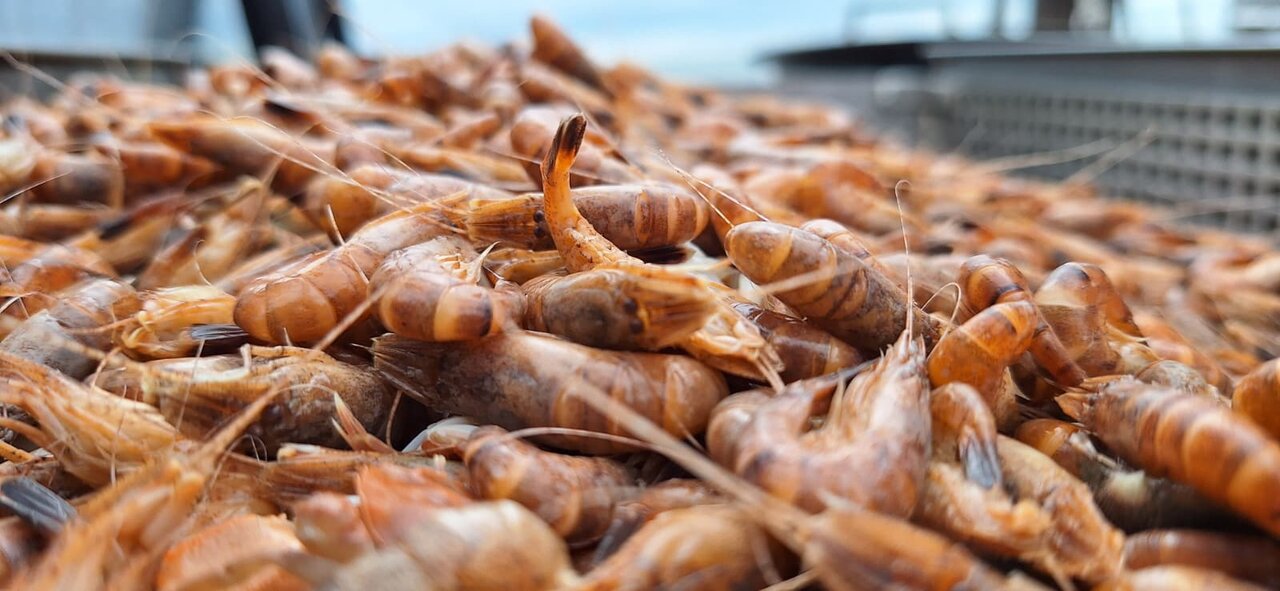
German fishing for North Sea shrimp (Crangon crangon) faces major ecological and technical challenges. Innovative ideas put forward by shrimp fishermen themselves aim to reduce bycatch, energy consumption and environmental impact in the long term.
Background and Objective
The shrimp fishery in Schleswig-Holstein (Federal State of Germany) is a traditional industry whose roots extend back more than a century. Over several generations, fishers in the Wadden Sea ecosystem harvested North Sea brown shrimp (Crangon crangon), contributing not only to the regional economy but also to the cultural identity of the coastal communities. To this day, the beam trawl remains the central fishing gear in the fishery targeting the brown shrimp. this system uses a horizontal beam to keep the net open while its movement close to the seabed flushes out the shrimp, which are then collected in the net towed behind.
The shrimp fishery is confronted with a number of complex ecological and technical challenges that make further development urgently necessary. One major issue is the comparatively high energy and fuel consumption which not only poses economic burdens for the fishing operations but also places additional strain in the ecosystem. At the same time, the beam trawls equipped with particularly small-meshed nets create challenges for the protection of marine organisms. Although selection devices used in shrimp nets can exclude larger bycatch such as fish or benthic invertebrates - like starfish or mussels - smaller organisms and juvenile individuals of many species still end up in the codend. Once inside they have little chance of escape due to the small mesh size which can lead to increased stress and reduced survival rates.
These factors clearly demonstrate thet improvements to fishing gear and fishing techniques are necessary to make the shrimp fishery more environmentally sustainable in the long term and to better protect marine communities. Beyond ecological concerns, the economic resilience of the fishery also depends on continuous innovation aimed at increasing energy efficiency and making fishing operations more sustainable.
To support this transition in a practical and realistic manner, the Krabbenfischereibeirat Schleswig-Holstein (committee that advices the Ministry for Energy Transition, Climate Protection, Environment and Nature) has launched the Innovation Programme for Brown Shrimp Fisheries. The project specifically draws on the expertise and creativity of those who work at sea ecery day: the fishermen themselves. They know the challenges of their profession firsthand and understand where improvements are needed. The programme provides an opportunity for fishers to contribute their own ideas and test them within a research-supported frame work by the Thünen isntitute of Baltic Sea Fisheries. Financial support from the Krabbenfischereibeirat creates room for experimentation that is often lacking in day-to-day fishing operations, enabling the testing of innovative approaches that would otherwise not be economically feasible.
Overall, the Innovation Programme aims to develop sustainable, practical and and directly applicable solutions that can be integrated into everyday fishing activities. These solutions are intended to reduce ecological impact of the shrimp fishery while safeguarding the economic future of this long-standing profession. In this way, the programme helps bridge the gap between centuries-old fishing tradition and modern, responsible resource management.
Approach
Shrimp fishers in Schleswig-Holstein have the opportunity to actively contribute their own ideas to improve the fishery. By submitting an application to the management of the Krabbenfischereibeirat, they can propose projects for the Innovation Programme. During the development of the experimental set up and throughout the application process, they receive extensive scientific support from the Thünen institute of Baltic Sea Fisheries. This support includes assistance with applying for financial funding as well as technical guidance throughout the idea development and implementation. In addition, fishers receive thorough training in onboard data collection to ensure robust evaluation of their projects.
The Innovation Programme is divided into two consecutive work packages: Pilot Projects and In-Depth Projects.
1. Pilot Projects
In this first work package the fishers' ideas are tested in practice for the first time. The proposed approaches may involve a wide range of technical modifications - such as adjustments to nets, sorting devices, or ground gear including the beam trawl. The primary goal is always to make the shrimp fishery more sustainable and to reduce ecological impacts. For each pilot project, an individually tailored strategy for trials and data collection is developed where necessary. Particular attention is paid to ensure that data collection can be carried out by the crew with as little effort as possible, enabling straightforward and practical evaluation.
The key purpose of this pilot projects is to gain an initial assessment of the improvement potential of a technical innovation using manageable resources. If early results indicate that the idea is feasible and promising, it may proceed to a subsequent in-depth project (work package 2), where it can be further developed, optimized and more comprehensively tested.
2. In-Depths Projects
The in-depths phase builds on successfull pilot projects that show high innovation potential. The objective is to develop the technical ideas in greater detail and to examine their effectiveness under a wide range of conditions. To achieve this multiple iterative steps can be carried out between commercial vessels and a research vessel. This close cooperation enables a braod data basis and ensures that different practical application scenarios are taken into account.
A particular focus is placed on testing the innovation across different seasons to account for ecological variability changing environmental conditions, and seasonal patterns in the fishery. The concepts selected for in-depth study are intentionally still in an early development stage and have not yet been fully explored - providing sufficient space for targeted improvements.
At the beginning of the in-depth phase, the specific task is precisely defined: Where does the concept currently encounter difficulties? Which aspects are already working well? Where is there unused potential? Based on this questions, the necessary technical modifications and actions are identified. Clear objectives for further development are then formulated, and the specifications to be tested are defined.
The practical trials at sea can be supplemented by extensive tests in a flume tank. These controlled model experiments provide valuable insights into the performance of the innovation and allow for even more accurate assessments.
Overall the in-depth phase is geared towards developing a practical, sustainable solution that can be successfully implemented in real fishing operations.
Fact sheets
Below you will find fact sheets on ideas from the shrimp fishery that have already been tested or implemented. (only available in german)
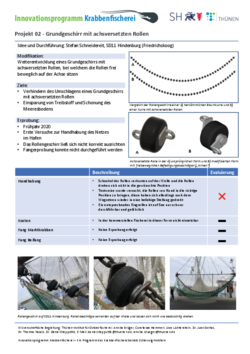 Projekt 02 - Grundgeschirr mit achsversetzten RollenModifikation: Weiterentwicklung eines Grundgeschirrs mit achsversetzten Rollen, bei welchem die Rollen frei beweglich auf der Achse sitzen
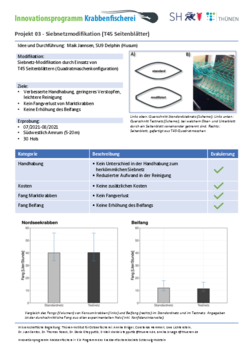 Projekt 03 Siebnetzmodifikation (T45 Seitenblätter)Modifikation: Siebnetz-Modifikation durch Einsatz von T45 Seitenblättern (Quadratmaschenkonfiguration)
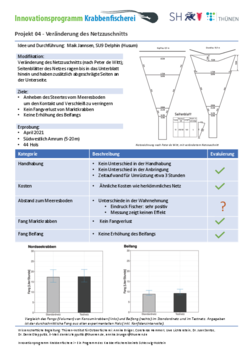 Projekt 04 - Veränderung des NetzzuschnittsModifikation: Veränderung des Netzzuschnitts (nach Peter de Witt); Seitenblätter des Netzes ragen bis in das Unterblatt hinein und haben zusätzlich abgeschrägte Seiten an der Unterseite.
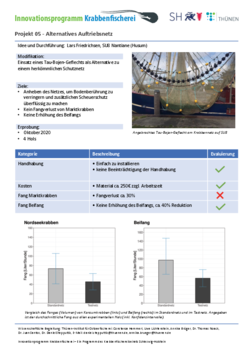 Projekt 05 - Alternatives AuftriebsnetzModifikation: Einsatz eines Tau-Bojen-Geflechts als Alternative zu einem herkömmlichen Schutznetz
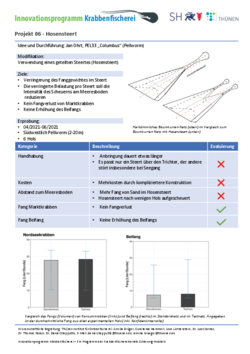 Projekt 06 - HosensteertModifikation: Verwendung eines geteilten Steertes (Hosensteert)
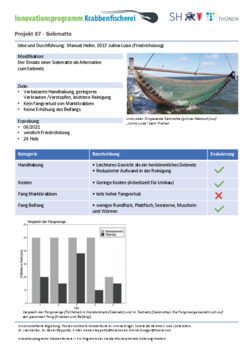 Projekt 07 - SiebmatteModifikation: Der Einsatz einer Siebmatte als Alternative zum Siebnetz
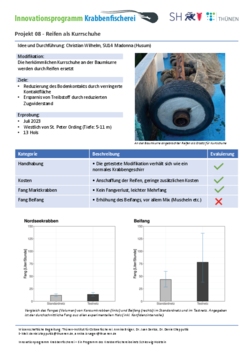 Projekt 08 - Reifen als KurrschuheModifikation: Die herkömmlichen Kurrschuhe an der Baumkurre werden durch Reifen ersetzt
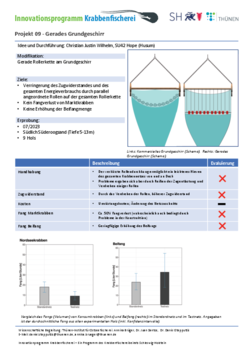 Projekt 09 - Gerades GrundgeschirrModifikation: Gerade Rollerkette am Grundgeschirr
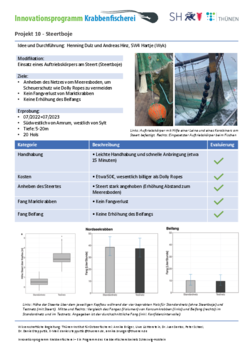 Projekt 10 - SteertbojeModifikation: Einsatz eines Auftriebskörpers am Steert (Steertboje)
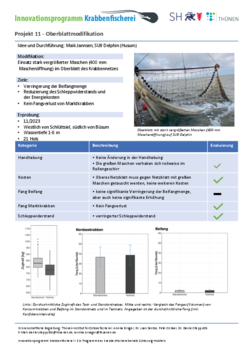 Projekt 11 - OberblattmodifikationModifikation: Einsatz stark vergrößerter Maschen (400 mm Maschenöffnung) im Oberblatt des Krabbennetzes
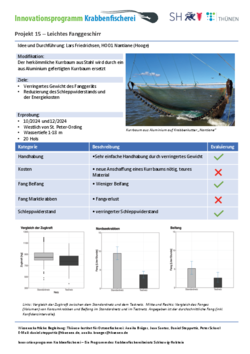 Projekt 15 – Leichtes FanggeschirrModifikation: Der herkömmliche Kurrbaum aus Stahl wird durch ein aus Aluminium gefertigten Kurrbaum ersetzt
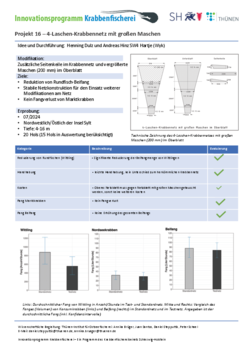 Projekt 16 – 4-Laschen-Krabbennetz mit großen MaschenModifikation: Zusätzliche Seitenkeile im Krabbennetz und vergrößerte Maschen (200 mm) im Oberblatt
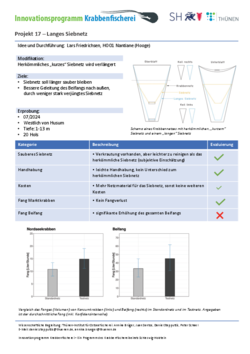 Projekt 17 – Langes SiebnetzModifikation: Herkömmliches „kurzes“ Siebnetz wird verlängert
Thünen-Contact

Involved Thünen-Partners
Funding Body
-
Bundesland Schleswig-Holstein
(national, öffentlich)
Duration
8.2024 - 2.2026
More Information
Project status:
ongoing