Funding of Thünen fisheries research by the European Maritime, Fisheries and Aquaculture Fund (EMFAF) of the EU
Fisheries research at the Thünen Institute in Bremerhaven and Rostock is funded by the European Maritime, Fisheries and Aquaculture Fund (EMFAF) of the European Union (EU Regulation 2021/1139).
 

The projects currently being funded are:

Research surveys

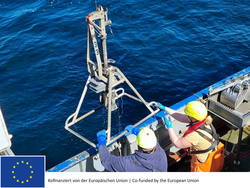
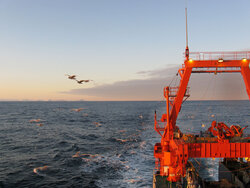
For our work at sea, we use three fisheries research vessels, which differ in design and size depending on the area in which they operate. On the majority of our research surveys, we collect data for Germany as part of the EU Data Collection Framework (DCF).

More
Research surveys

Studies on fish eggs and larvae

Knowledge on the strength of the recruiting year class of a fish stock is of tremendous importance for sustainable mangement. Successful reproduction and foraging of fry are of essential importance for the further development of the stock.

More
Studies on fish eggs and larvae

Fisheries economics in numbers

As part of the EU Data Collection Framework (DCF), each Member State is obliged to collect economic data of its fishing fleet.

More
Fisheries economics in numbers

Analyses of fishery effort in German fishing fleets

The project aims at a better understanding of the relationship between fisheries and population dynamics of fish stocks in order to better predict and justify the necessity of fleet capacity adjustment measures

More
Analyses of fishery effort in German fishing fleets

Enhancement of multi-species assessment models

This research activity will enhance multi-species models (improved diet selection models and recruitment models) to enable best possible projections of stocks developments. This will contribute to a sustainable harvest of fish stocks inside an ecosystem approach. Not only fisheries influence fish stocks but also predation and other environmental factors.

More
Enhancement of multi-species assessment models

Fish & fisheries in numbers - the Data Collection Framework

The Data Collection Framework (DCF), co-funded by the EU, allows Member States to collect fisheries data relevant for the sustainable management of fish stocks.

More
Fish & fisheries in numbers - the Data Collection Framework

The demography of fishes

Age composition data for fish stocks are essential input parameters for stock assessment. It is therefore necessary to permanently develop age determination methodology further.

More
The demography of fishes

Youngfish in German coastal waters

The shallow waters of the German Bight and Wadden Sea serve as nursery grounds for several commercially important fish species. Annual abundance and growth assessments of youngfish allow for a first indication of the level of incoming catches in future years.

More
Youngfish in German coastal waters

Sufficient offspring for brown shrimp?

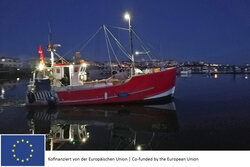
Brown shrimp fishery is from the economic point of view the most important fishery in Germany. Our research aims to develop a sustainable and ecologically sound fishery.

More
Sufficient offspring for brown shrimp?

Collection of economic data of the fish processing industry

As part of the EU Data Collection Framework (DCF), we collect economic data of the German aquaculture.

More
Collection of economic data of the fish processing industry

Reduction of plastic waste from the brown shrimp fishery through gear modifications (DRopS)

Um das Durchscheuern der Unterblätter von Baumkurrennetzen am Meeresboden zu verringern, werden dort häufig Polyethylenseile angebracht. Diese so genannten Dolly Ropes werden nach kürzester Zeit auf See als Plastikmüll freigesetzt.

More
Reduction of plastic waste from the brown shrimp fishery through gear modifications (DRopS)

MigFish

Wandernde Fischarten sind durch anthropogene Einflüsse in Meeres-, Küsten- und Binnengewässern besonders gefährdet. Viele dieser Arten zeigen abnehmende Populationstrends, sind gemäß FFH-Richtlinie geschützt und/oder gelten gemäß Roter Liste als gefährdet und besonders schützenswert. Bemühungen, die Arten in früheren Habitaten wieder anzusiedeln oder Restbestände wieder aufzubauen, waren bisher nicht in jedem Fall erfolgreich.

More
MigFish

Sampling and assessment of benthic species and seabed in the German EEZ (MOBEEZ)

The project will supplement the ongoing monitoring in the German Exclusive Economic Zone (EEZ) of the North Sea, as required by Section 6 of the Federal Nature Conservation Act (BNatSchG), with a temporally and spatially extended sampling and analysis of benthic communities in the German EEZ of the southern North Sea, incorporating alternative, minimally invasive methods.

More
Sampling and assessment of benthic species and seabed in the German EEZ (MOBEEZ)

Passive Shrimp fishing (TRAPS)

Traditional shrimp fishing in the North Sea is currently conducted almost exclusively with bottom trawls (beam trawls), which are criticized for their high energy consumption and potential ecological impacts. Given rising fuel prices and increasing environmental regulations, there is a growing need for alternative and sustainable fishing methods.

More
Passive Shrimp fishing (TRAPS)

Research on ecosystem-friendly fishing gear in the North Sea and Baltic Sea (EMFAF)

The impact of fisheries on the ecosystem and its components largely depends on the type of fishing gear used. This also means that the systematic further development or redesign of fishing gear is a key factor in advancing an ecosystem-friendly fishery in the North Sea and Baltic Sea.

More
Research on ecosystem-friendly fishing gear in the North Sea and Baltic Sea (EMFAF)

Scroll to top