Expertise
Every drop counts
Jacob Jeff Bernhardt, Nataliya Stupak | 04.02.2026
Whether sprinkler systems or drip irrigation – many crops need additional water in summer. Where irrigation takes place and where the water comes from has only been recorded sporadically to date. We are pooling the data to create a more solid basis for new developments and models.
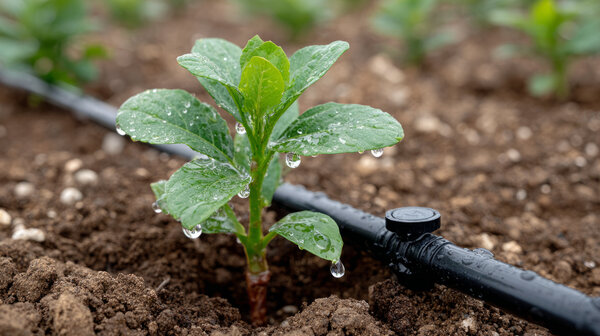
Increasing drought poses challenges for agriculture and horticulture in the context of climate change: the drought years between 2018 and 2022 led to crop failures in many regions of Germany. Forward-looking and needs-based irrigation can help to avoid such losses in the future. However, there is a lack of reliable and comparable irrigation data to make targeted decisions regarding water use. Researchers at the Thünen Institute are investigating the state of irrigation in Germany and how the data basis can be improved.
Data serves as a basis for decision-making
Depending on weather conditions, agriculture accounts for around two percent of total water consumption in Germany – and this figure is rising. However, there is currently insufficient data on how water is used in this sector. In the context of the National Water Strategy and the German Adaptation Strategy, the availability and quality of real data on actual water use is also becoming increasingly important. In order to better identify changes, irrigation data with the highest possible spatial and temporal resolution is required. Such data provides the necessary basis for decision-making to address future water use conflicts, strengthen food security, and protect water resources in a sustainable manner.
In 2025, scientists at the Thünen Institute presented irrigation data for Germany for the first time on a comprehensive basis and at the district level. Data from agricultural censuses and agricultural structure surveys from the past 15 years were included. In some cases, data from farms on irrigated areas or irrigation techniques used is available, but for data protection reasons, it is summarized and only published at the federal state level. The Thünen researchers therefore use a so-called cluster analysis to improve the spatial resolution of the data.
The area and intensity of irrigation is increasing
The results show that both the extent and intensity of irrigation and the agricultural area equipped with irrigation technology have increased. Between 2009 and 2022, the irrigable area grew by almost 24 percent: while 639,030 hectares could be irrigated across Germany in 2009, this figure had risen to 791,800 hectares by 2022. This corresponds to around five percent of the agricultural land in Germany in 2022. This means that in large parts of the country, irrigation is not possible or only possible to a limited extent.
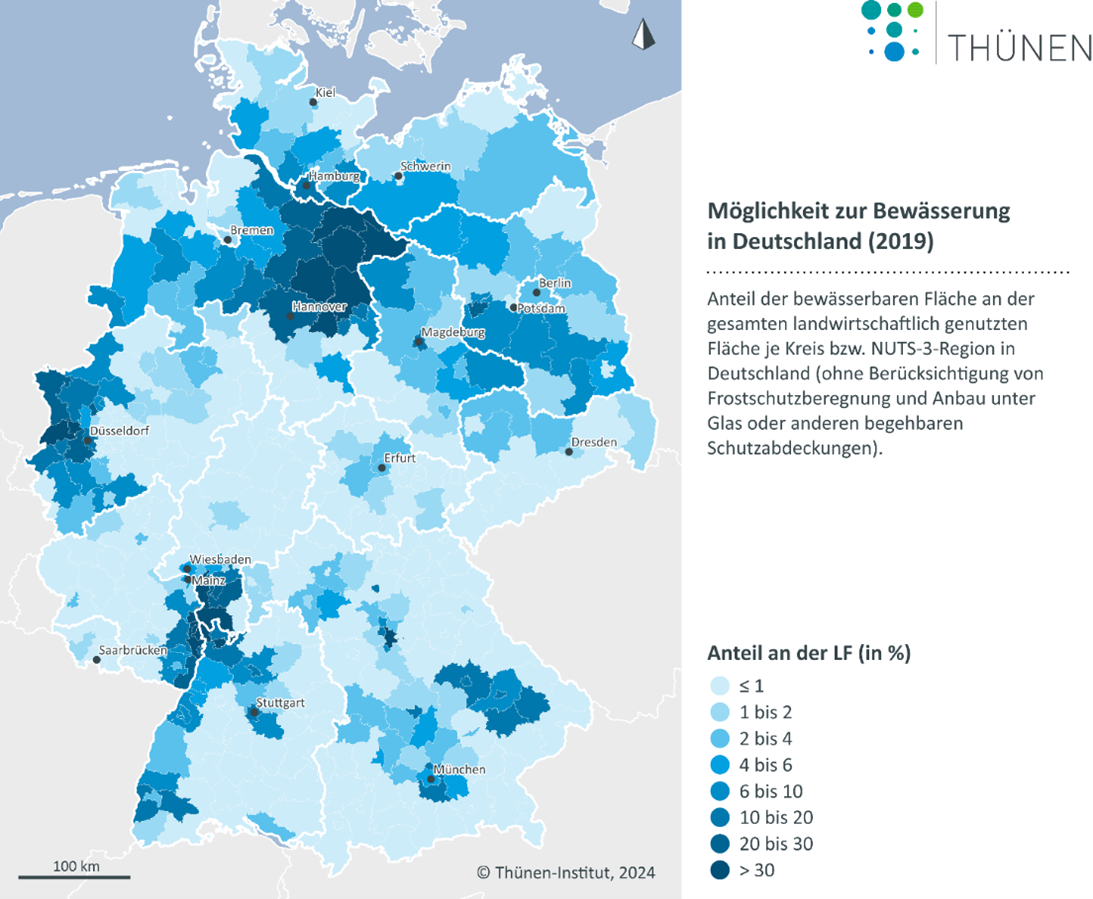
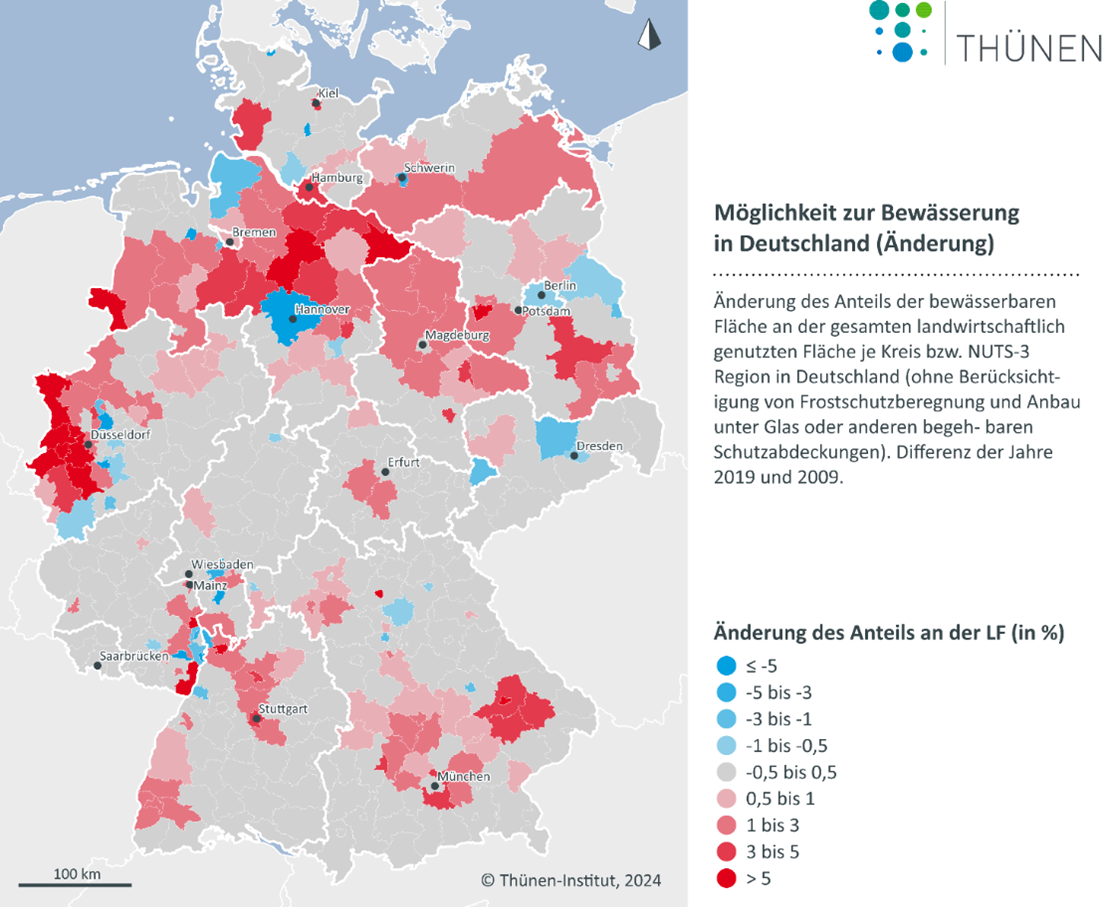
Most irrigation takes place in regions stretching from the northwestern German lowlands to the northeastern German lowlands. These include western North Rhine-Westphalia, large parts of Lower Saxony, Schleswig-Holstein, Mecklenburg-Western Pomerania, and Brandenburg, as well as areas of northern and eastern Saxony-Anhalt and northern Saxony. In southern Germany, irrigation is concentrated along the major rivers Rhine, Main, Neckar, Danube, and Isar. Further concentration can be observed in the eastern part of Rhineland-Palatinate, southern Hesse, and part of the Upper Rhine Graben in Baden-Württemberg and the adjacent Stuttgart region. In Bavaria, irrigation areas can be identified in specific locations and are concentrated primarily along the Danube and Isar rivers and in Lower and Middle Franconia.
How irrigation is carried out: quantities, sources, and irrigated crops
According to the 2023 agricultural structure survey, grain accounted for the largest share of irrigated land in 2022, at just under 26 percent. Potatoes followed with around 21 percent. Smaller shares were accounted for by outdoor vegetables, corn, and sugar beets.
However, the data on irrigated area does not provide any information on how much water was used per hectare. It is therefore to be expected that crops grown on small areas, such as vegetables or strawberries, are irrigated with significantly more water than, for example, cereals grown on large fields. According to agricultural censuses and agricultural structure surveys, water consumption for irrigation in open fields was around 431 million cubic meters in 2022, compared to around 293 million cubic meters in 2009. This corresponds to an increase of around 47 percent.
In 2022, more than two-thirds of irrigating farms used groundwater to provide additional water for their crops. Just under a third obtained their water from public or private supply networks. Surface water was used by less than a fifth of farms. However, this data is incomplete as it does not show where the water in the supply networks comes from. If a farm is part of an irrigation association, for example, it will state in the survey that it obtains its water from a private supply network. The fact that this water is often extracted from groundwater is not taken into account, which leads to a distorted picture of the water sources actually used.
Technologically, irrigation has changed significantly. Although the number of farms using sprinkler systems fell slightly by just under 2 percent between 2009 and 2022, the number of farms using drip irrigciation rose significantly: while 3,178 farms used this technology in 2009, the figure had risen to 5,660 by 2022. This shows a trend towards more effient methods such as drip irrigation. These can play a particularly important role in regions with high water costs or severe water shortages, as well as in areas where permanent crops are grown.
Recommendations for a better data basis
In order to strengthen the data basis for irrigation in Germany, the researchers propose the following improvements:
The irrigation of crops, for example in greenhouses or under protective covers, as well as frost protection sprinkling, should be recorded in future. Currently, this information is missing from both the agricultural census and the agricultural structure survey.
The data should be collected regularly and using consistent methods. This is the only way to reliably identify correlations and trends over time. To date, the status of irrigation in Germany can only be described, but not statistically evaluated.
The data should be available in the smallest possible spatial resolution. This enables local authorities to plan their water supply sustainably and make relevant water-related decisions. Currently, the available data is often limited to the state level.
The surveys conducted on farms should be clearly worded. Since a large part of the irrigation data comes from such surveys, this is necessary in order to create a reliable database.
However, with the amendment of the Agricultural Statistics Act 2025, there are currently signs of regression: irrigation data is now collected even less frequently. It is only included in the agricultural census, but no longer in the agricultural structure survey. This is one of the reasons why researchers at the Thünen Institute are developing models that can be used to estimate irrigation requirements in order to support decision-makers.
Further information
All data and further information can be found in Thünen Working Paper 258: Status Quo of Irrigation in Germany.
Researchers from the Thünen Institute, the Technical University of Braunschweig, and the Fraunhofer Institute analyze how water storage basins can support climate adaptation in crop production in Thünen Working Paper 278.
The joint project Agricultural Water Management in Germany (LAWAMAD) is coordinated by the Thünen Research Centre for Climate, Soil and Biodiversity. In a sub-project (LAWAMAD sub-project C), Thünen researchers are investigating regional irrigation requirements in the context of climate change.
In our current focus on water, we bring together the Thünen Institute's expertise on everything from rainwater storage to aquaculture.
In the Thünen podcast episode Unused Resources II – Water in Short Supply or Water in Abundance, we talk to two experts about drought and competition for water in Germany.
An explanatory video on the National Water Strategy and information on Germany's Strategy for Adaptation to Climate Change can be found on the website of the Federal Ministry for the Environment, Nuclear Safety, and Consumer Protection.
Contact

- Phone
- +49 531 2570 1487
- jacob-jeff.bernhardt@thuenen.de

- Phone
- +49 531 257 01869
- nataliya.stupak@thuenen.de