Expertise
Spring drought in Germany – What irrigation can do
Jacob Jeff Bernhardt | 23.05.2025
Germany is currently experiencing an unprecedented spring drought. This extreme drought could result in significant yield losses.
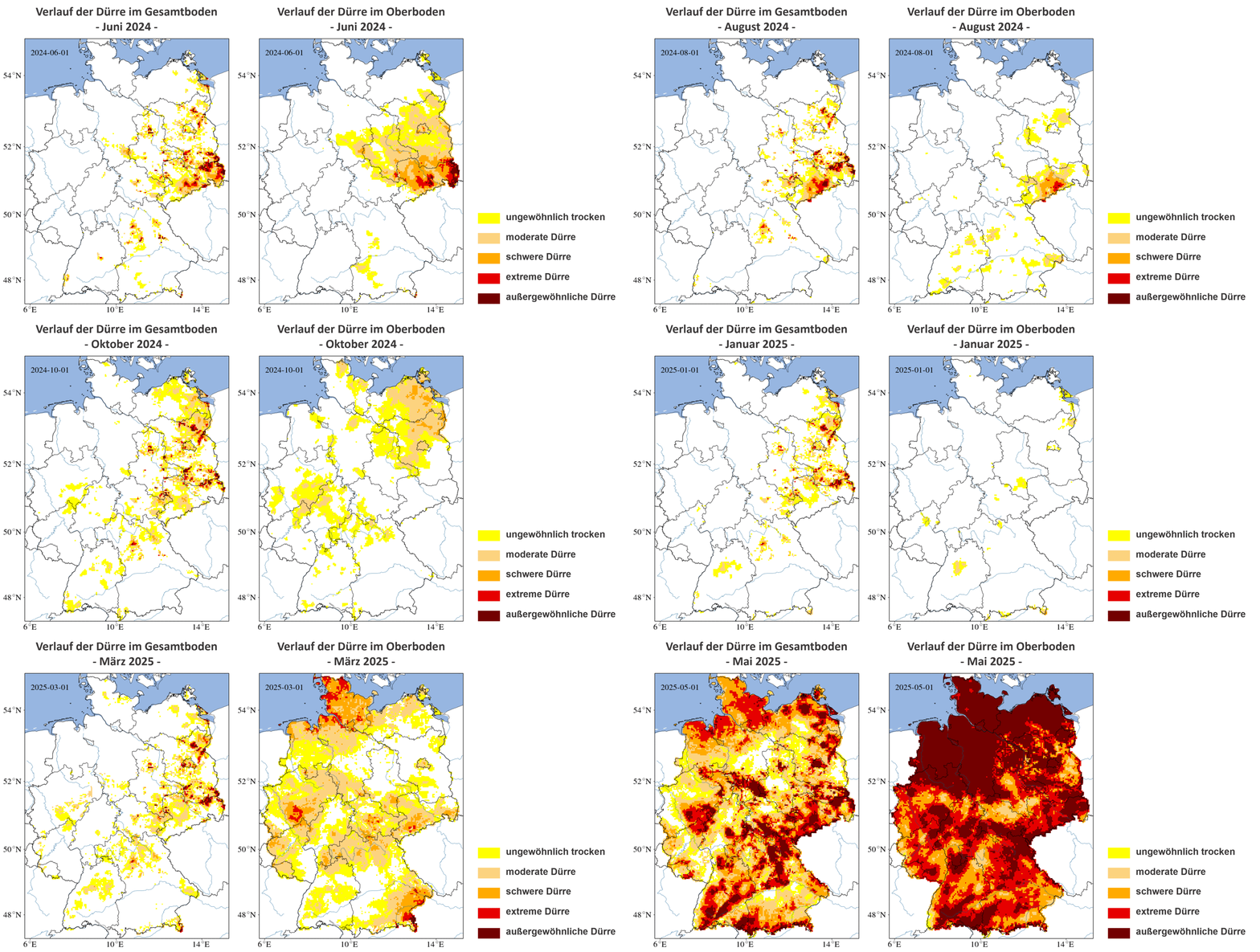
Spring 2025 threatens to become the driest since weather recording began in 1931. The Deutsche Wetterdienst (DWD) reported that between February 1st and April 13th, only around 40 millimetres of rain fell per square meter on average across Germany, 68 percent less than the long-term average for the years 1991 to 2020. The north-west was particularly affected, where less than 35 percent of the usual rainfall was measured. In the south-eastern regions, this figure was between 50 and 80 percent. The data from the Drought Monitor Germany from the Helmholtz Centre for Environmental Research (UFZ) clearly shows how the lack of precipitation since the beginning of the year has affected the drought in Germany (see Fig. 1) and how it has shaped the current drought since the beginning of March.
Consequences for crop production
The drought in spring has particularly serious consequences for crop production. The germination and development of many arable crops in spring depend on sufficient water supply. This atypical dry period inhibits growth in the current, particularly sensitive growth phases. While maize, which was sown a few weeks ago, absolutely needs water to develop, especially in light locations, wheat lacks water in the grain filling phase in May. The long-term effects of the current drought could significantly reduce the annual yield of many crops unless there is sufficient rainfall soon.
Irrigation is becoming increasingly important
Irrigation is becoming increasingly important with the increasing periods of drought. It compensates for the lack of water and maintains soil moisture. As a result, crop quantities and qualities remain stable. This makes farms which use irrigation-techniques reliable market partners.
The current irrigation situation in Germany
The recently published Thünen Working Paper “The Status Quo of Irrigation in Germany” (in German) presents the current situation of irrigated agriculture. In 2022, 6.8 percent of farms in Germany had irrigation infrastructure on 4.8 percent (791,800 hectares) of the utilized agricultural area. Although the irrigated area is thus comparatively small, it is undergoing major change: it grew by 24 percent between 2009 and 2020. This shows that irrigation is becoming increasingly important for agriculture.
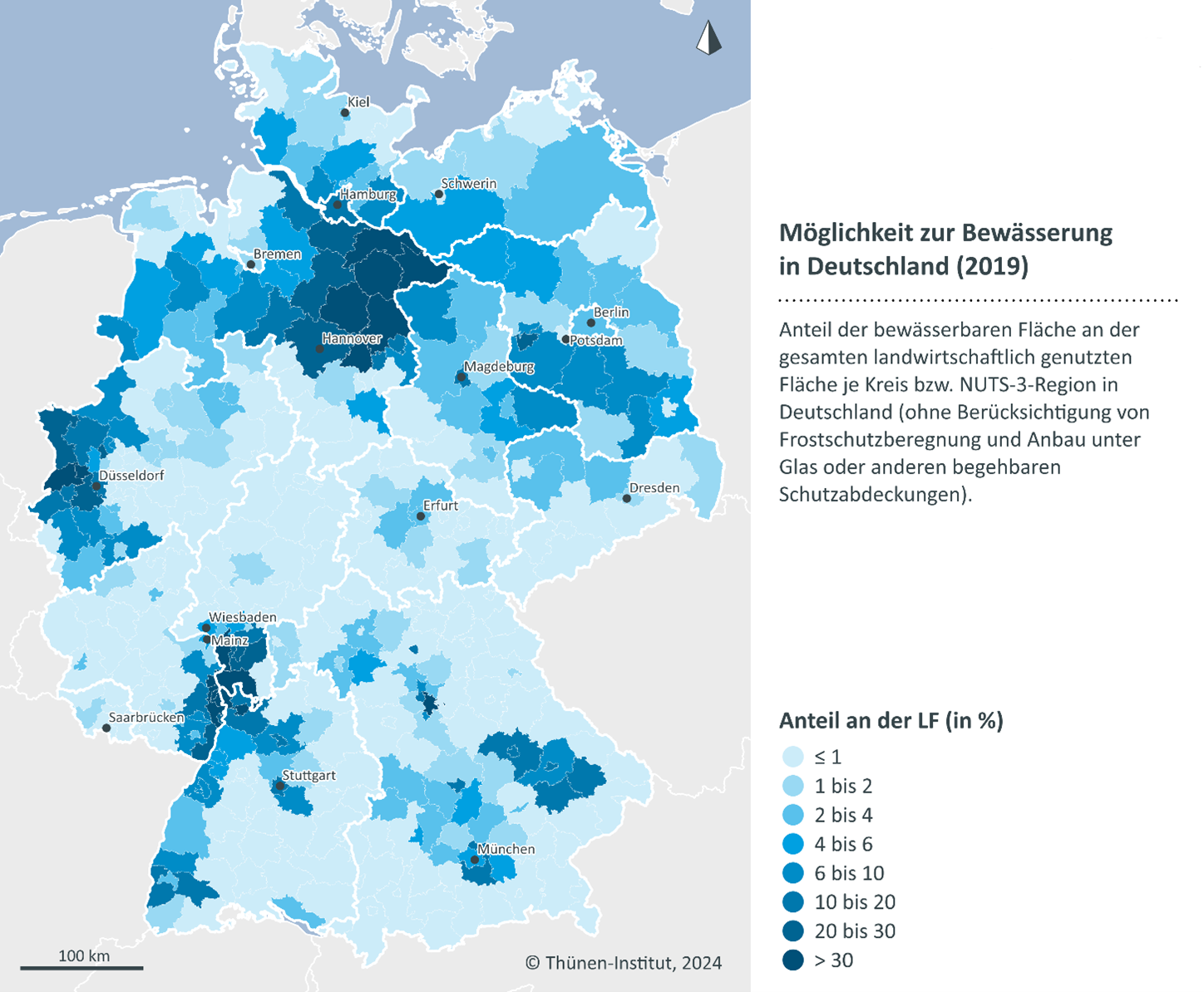
Irrigation in Germany is unevenly distributed across the country. This is due to regional conditions in terms of climate, agricultural structures and water availability. In a comparison of the federal states (Figure 2), Lower Saxony stands out in particular, where 48% of all irrigated areas were located in 2022. The other federal states have significantly less irrigated land.
Only just under five percent of agricultural land in Germany is irrigated. The most important regions with significant irrigation are in the northern German lowlands and in the Rhine plain up to the Lower Rhine. There are also the Bavarian irrigation areas along the Danube and Isar rivers.
How irrigation is implemented
Not every agricultural crop is irrigated, but only those for which it is economically viable. In north-east Lower Saxony, it is primarily potatoes, sugar beet and maize that are irrigated, whereas in the Upper and Middle Rhine region or in Knoblauchsland near Nuremberg, it is mainly vegetables.
Efficient - and expensive - drip and pipe irrigation systems are common in vegetable and speciality crop cultivation. For most arable crops, however, sprinkler cannons are more attractive as they are more flexible and can be used for large areas.
Where the water for irrigation comes from depends on the availability in the respective region and the legal framework. Groundwater is still the primary source of water for irrigation. Other sources, such as water from rivers, lakes, canals or the public supply network, are only used occasionally.
Irrigation as an adaptation to climate change
Irrigation is becoming increasingly important for yield and quality assurance due to the increasing drought caused by climate change. As a result, irrigated areas and the demand for water for irrigation are also increasing.
At the same time, declining groundwater recharge rates and falling groundwater levels in some regions of Germany show that water can develop into a scarce commodity. Various approaches are therefore required to ensure the sustainable use of water as a resource. At farm and inter-farm level, these include water-efficient irrigation techniques, newly created water storage basins, and the creation of humus to increase the water storage capacity of the soil. This also includes tapping into alternative water resources and ensuring largely closed water cycles. However, measures are also necessary at landscape level in order to maintain the functionality of the landscape water balance in the long term. The National Water Strategy of the Federal Ministry for the Environment, Climate Action, Nature Conservation and Nuclear Safety (BMUKN) therefore emphasises the urgent need to protect, restore, and permanently secure the near-natural water supply in order to counteract water scarcity and the associated conflicts of interest at an early stage. Agriculture faces the challenge of ensuring its production despite increasing periods of drought. This requires a combination of efficient irrigation and sustainable water management strategies. It is crucial that farmers work together with water managers and politicians on solutions that strengthen sustainable food production and future-oriented management of water resources.
Current research on irrigation in Germany
The current drought situation in Germany emphasises how important efficient and sustainable irrigation can be. The Thünen Institute of Rural Studies has been researching water management with a focus on irrigation for more than 15 years. In the joint project ‘Agricultural water management in Germany’ (LAWAMAD for short), researchers are analysing the current irrigation situation in Germany, determining regional irrigation requirements and forecasting how these will develop in the future. In addition, the scientists are investigating how water management in Germany's agricultural landscapes can be improved.
Research projects on irrigation requirements have been and are being carried out in close co-operation with environmental and agricultural ministries in North Rhine-Westphalia, Bavaria, Hesse and Baden-Württemberg.
Contact

- Phone
- +49 531 2570 1487
- jacob-jeff.bernhardt@thuenen.de
Further links
- Bernhardt JJ, Stupak N, Neuenfeldt S, Potts F (2025) Status quo der Bewässerung in Deutschland. Braunschweig: Johann Heinrich von Thünen-Institut, 113 p, Thünen Working Paper 258, DOI:10.3220/WP1736495260000 (in German)
- Dürregebiet Deutschland – Was tun gegen die Trockenheit. Ein Informationsvideo des Bundesinformationszentrum Landwirtschaft. (in German)