Expertise
Single parents in rural areas
Sylvia Keim-Klärner | 07.03.2025
Balancing work and family life, single parents are more often at risk of poverty. In rural areas, a lack of infrastructure is an additional challenge for them. A survey by the Thünen Institute sheds light on their situation.
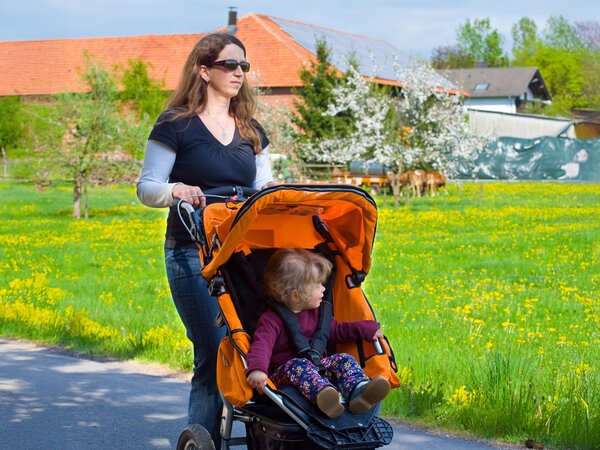
Single parents with their children are a widespread form of family in Germany, also in rural areas. The majority of these single parents are women. They organize everyday family life and often work part-time, in mini-jobs or are not employed. This increases their risk of poverty. What does it mean for single parents to live in rural areas? Are the challenges exacerbated when access to public transport, doctors and supermarkets, for example, is restricted? Are rural areas thus becoming a space and poverty trap? Researchers at the Thünen Institute of Rural Studies have surveyed single parents in structurally weak rural areas in eastern Germany.
It is important for single parents to be mobile
The respondents of the survey experience numerous spatial restrictions in everyday life, especially in terms of career opportunities. Many of them struggle to find a family-friendly job, as jobs offered often require working hours that clash with childcare. Long journeys make it difficult to reconcile work and family. In addition, there is often a lack of nearby shopping facilities, leisure facilities, schools and childcare. Especially the lack of paediatric care is viewed critically. Many pediatricians retire without a successor. In order to successfully cope with their everyday lives, single parents have to travel long distances. For this, owning a car is usually unavoidable, but for many it is financially difficult to afford. The high level of mobility is often perceived as time-consuming, expensive and stressful.
„We actually always have driving on our minds. And when I don't have to drive, I try to calm down by getting some sleep, because then I'm just (sighs) exhausted.“
Stephanie Mohn*, 2 children (12 and 18 years) , *anonymised
Proximity to nature and social networks are valuable resources
Despite the structural weaknesses of the rural region, most of the single parents surveyed are satisfied with their lives. They appreciate nature, peace, freedom and their garden – factors that relieve them in stressful everyday family life and offer cost-effective opportunities for leisure and self-sufficiency. Especially during the Covid 19 pandemic, one's own garden and quick access to nature were experienced as valuable resources
In addition, the rural environment is perceived as safe for the children, be it in terms of traffic, crime or general trust in the neighbourhood. Many single parents can rely on a strong social network of relatives, friends and acquaintances to support them in their daily challenges. They have found ways to deal with spatial restrictions, for example through online shopping, carpooling or combining errands. For them, living in a structurally weak rural region does not mean a space and poverty trap per se, but rather it also offers opportunities to get along well with little money.
„Wages are still lower here. It would be nice if there was a little more cultural stuff here. But I think at the end of the day everything is actually fine here in the area. I can send my children to the lake in the dark without having to worry.“
Katrin Schmitt*, 3 children (8, 15 and 17 years). *anonymised
More Informations:
Keim-Klärner S, Bernard J, Decker A (2025)How do single mothers evaluate and cope with living in rural peripheries? Insights into the interplay of social and spatial disadvantage. Rural Sociology: Online First, Jan 2025, DOI:10.1111/ruso.12586