
FAQ
From farm to shopping basket: how food prices are determined
Anne Margarian | 21.11.2025
Food is becoming more expensive, but agriculture is under pressure. Many therefore suspect that retailers are exploiting their market power. Thünen monitoring shows that the main drivers are rising costs in production and trade. Our FAQ explains what influences food prices.
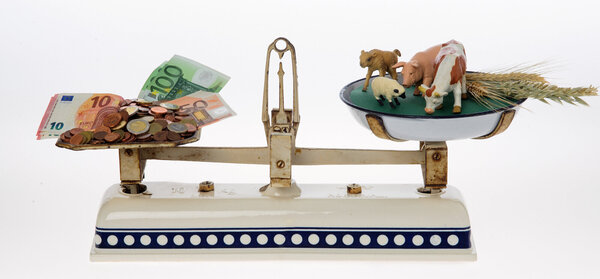
In recent years, food has become noticeably more expensive – at the same time, agriculture is under strong competitive pressure. Many therefore suspect that retailers are exploiting their market power to drive up prices. The results of Thünen Monitoring show that price increases are driven less by rising retail margins than by higher production and purchasing costs.
Using Thünen Monitoring to observe prices, costs and margins in agricultural value chains Researchers at the Thünen Institute of Market Analysis are observing how prices develop along agricultural value chains – and why. To do this, they analyse prices, costs and margins and identify recurring patterns. The aim is to promote a fact-based discussion about food prices. The updated monitoring figures have been published annually since 2024.
In our FAQ, we explain how food prices are determined and what impact growing retail companies have on consumers and farmers.
Until the early 2000s, food prices rose only slowly. Prices for agricultural products even tended to fall. It is only in the last 20 years or so that food prices have been rising faster than other consumer expenditures. Price developments in agriculture are subject to major fluctuations. The sharp rise after 2021 is not only related to wars, new trade barriers and disrupted supply chains. Climate change and the increasing deterioration of soils are also contributing factors. This is reducing productivity in the regions affected – and making agricultural raw materials scarcer worldwide.
Companies can only increase their profits by influencing supply and demand – but even the largest companies have only limited influence on this. Margins in food processing and trade are comparatively narrow overall. Changes in margins therefore have little impact on food prices. Changes in the cost of raw materials and commodities are much more effective.
Large retailers do not automatically have a lot of market power, as they often compete fiercely with each other. Large companies are often very efficient and can therefore offer their products at low prices – an advantage for consumers. And farmers also benefit from having stable supply relationships with large buyers. The extent to which the advantages of larger companies outweigh the disadvantages depends on the priorities of consumers. Some people, for example, value the baker around the corner more than the low prices at the supermarket.
Many assume that large food companies disadvantage farmers and consumers in order to generate high profits. That is why the Monopolies Commission has investigated whether companies in the food chain are abusing their market power. It was commissioned by the German government. The special report will be published on 21 November 2025. Back in February 2024, the Commission had already published an initial assessment of the competitive situation in the food supply chain.
Further information:
- All facts and figures from the Thünen Monitoring Prices, Costs and Margins in Agricultural Value Chains can be found on the website of the Thünen Institute of Market Analysis.(in German)
- The special report is available for download on the Monopolies Commission website. (in German)
- An initial assessment by the Monopolies Commission on the competitive situation in the food supply chain was published in February 2024. (in German)