Facts & Figures
Emissions of greenhouse gases from agriculture
Roland Fuß, Cora Vos, Claus Rösemann | 14.03.2026
In 2024, German agriculture was responsible for the emission of about 53.3 million tons of carbon dioxide equivalents. This corresponds to 8.2 percent of the greenhouse gas emissions in Germany. Main sources are emissions of methane from animal husbandry and nitrous oxide from agricultural soils.
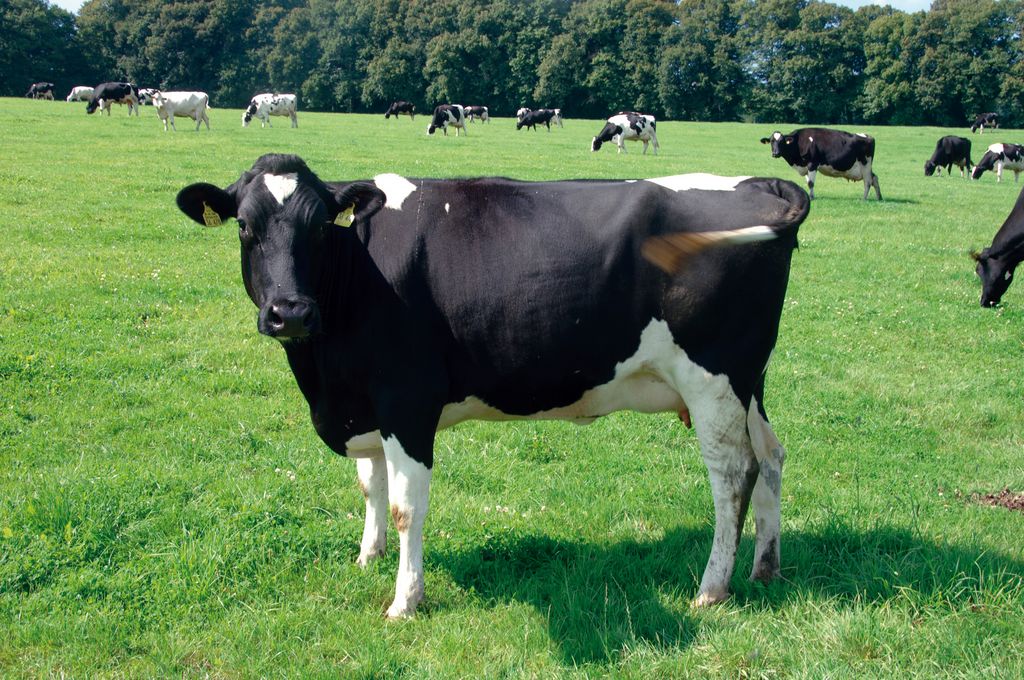
The share of nitrous oxide (N2O) from soils (including emissions due to spreading of digestate from energy crops) was 27.2 percent, whereas the share of methane (CH4) from enteric fermentation was 48.5 percent. The remaining 24.4 percent of the emissions from agriculture came from manure management, storage of digestate from energy crops, liming and the application of urea.
Emissions of nitrous oxide from manure management as well as emissions of methane from enteric fermentation and manure management have decreased significantly since 1990. In 2024, the emissions of nitrous oxide were lower than those in 1990 by about 36.6 percent, and the methane emissions by about 30.4 percent.
92 to 93 percent of the overall emissions of methane and nitrous oxide from livestock originate from enteric fermentation and manure management (stable, storage) of cattle and pigs, 4 to 5.5 percent from other animals (mainly horses, poultry, sheep and goats). These figures are largely constant over the years (2024: dairy cows 51.4 percent, other cattle 32.7 percent, pigs 8.0 percent, other animals 5.5 percent). The remainder of the overall emissions (2024: 2.4 percent) are nitrous oxide emissions resulting from soil after deposition of nitrogen previously emitted as ammonia (NH3) and nitric oxide (NO) from stables and manure stores.
The decline in emissions compared to 1990 results mainly from the structural change at the beginning of the 1990s, which led to a decrease in cattle numbers until the mid-2000s. Since the 2010s, a further decline in livestock numbers and, since 2015, a decline in the amount of synthetic fertiliser applied have also led to a further reduction in emissions.
Other reasons for the decline in emissions are the increasing importance of anaerobic digestion of manure in biogas plants and the partially gas-tight storage of digestion residues. The use of renewable raw materials in biogas plants, on the other hand, leads to additional methane emissions from the plant and the storage of digestion residues.
Since a low in 2006, greenhouse gas emissions in the agriculture sector have initially increased again, only to fall again from 2015 and reach new lows from 2018. Compared to the previous year 2023, emissions in 2024 have fallen by around 3.4 percent. This is primarily due to the further decline in cattle numbers and the reduction in the quantities of synthetic fertilisers applied.
The Climate Action Act defines a reduction path for greenhouse gas emissions for each emission sector, the exceeding of which results in immediate measures in the respective sector. The law stipulates that only 56 million tonnes of carbon dioxide (CO2) equivalents may be emitted in the agricultural sector by 2030. The reduction path was adjusted (due to credits from previous undercutting of the reduction path) and the target value for 2030 is currently 60.05 million tonnes of carbon dioxide equivalents.
The sector "agriculture" of the Climate change Act is not completely congruent with the sector of the same name in the emissions reporting: Emissions from fuel use in agriculture, forestry and fisheries, which are calculated by the Umweltbundesamt (Federal Environment Agency), are added. The remaining agricultural emissions are determined by the Thünen Institute using the methods of emissions reporting.
Compliance with the reduction pathway is assessed using the so-called previous-year estimate, which is partly based on provisional data. This year’s previous year’s estimate for 2025 indicates total agricultural greenhouse gas emissions of 60.8 million tonnes of CO₂ equivalents: 53.3 million tonnes from agriculture in the narrower sense plus 7.5 million tonnes from fuels. The estimate for 2025 is below the 66.0 million tonnes of CO₂ equivalents that would be permitted under the adjusted reduction pathway. Compared with 2024, emissions have remained roughly the same. The effects of higher sales of synthetic fertilisers and increased pig numbers were largely offset by the influence of the weather.
Compliance with the reduction path will become a considerable challenge in the coming years, which must be met with the measures of the climate change programme.
In contrast to ammonia emissions, there are so far few technical options for mitigation measures for methane and nitrous oxide emissions beyond restricting agricultural production. The greatest reduction potential is:
- low-emission fertilisation geared to plant requirements, which avoids nitrogen surpluses and thus nitrous oxide emissions from agriculturally used soils,
- feeding animals in a way that is optimised in terms of crude protein use and methane formation,
- the digestion of animal excrement in biogas plants and the subsequent gas-tight storage of the digestion residues.
Carbon dioxide emissions from fuel consumption can be reduced by improving energy efficiency and switching to renewable energy.
As a result of enhanced performance, emissions per animal increase. For example, in recent years, despite the decreasing number of dairy cows, there has often been an increase in total emissions from dairy cows. This is due to the constant increase in average milk yield.
In terms of products, however, the increasing milk yield leads to a decrease in emissions per kilogram of milk. This is due to the fact that the maintenance energy requirement of a dairy cow is independent of milk yield and therefore does not increase with rising milk yields. A basically similar picture emerges for the performance-related greenhouse gas emissions from fattening pig farming.
However, an absolute greenhouse gas reduction results from these intensification effects only if absolute production does not increase, meaning if the number of animals decreases.
The agricultural sector will meet its climate change targets by 2030
Projected greenhouse gas emissions in the agriculture sector are set to fall to 58.2 million tonnes of CO₂ equivalents by 2030, to 55.6 million tonnes of CO₂ equivalents by 2040, and to 54.4 million tonnes of CO₂ -equivalents. Overall, the sector is expected to exceed the cumulative annual emission limit set out in the Climate Action Act (KSG) by 14.5 million tonnes of CO₂-equivalents in the period from 2021 to 2030. This trend is based both on actual reductions and on methodological adjustments, such as the first-time inclusion of weather influences in nitrous oxide emissions, which can cause an annual fluctuation range of +/- 2 million tonnes of CO₂ equivalents.
The most effective measures for reducing emissions lie in reducing nitrogen surpluses and improving nitrogen efficiency, which leads to an annual reduction of around 1.9 million tonnes of CO₂ equivalents. Key factors here are the Fertiliser Ordinance and rising prices for mineral fertilisers due to the European Carbon Border Adjustment Mechanism (CBAM). The expansion of organic farming to 15% of the total area by 2030, on the other hand, makes only a minor contribution to reduction, amounting to 0.13 million tonnes of CO₂ equivalents. In the area of agricultural energy consumption, savings of 0.7 million tonnes of CO₂ equivalents are expected by 2030. Around half of this reduction is attributable to the federal programme for energy efficiency in agriculture. Another important factor, which cannot be attributed to any single measure, is the decline in cattle and pig herds, which is due, among other things, to changing meat consumption habits and higher environmental and animal welfare standards.
As has been seen in the past, existing instruments will have only a limited impact on emission reductions after 2030. By 2045, only a slight decline in emissions is foreseeable in the agricultural sector. Achieving future, more ambitious emission targets therefore requires additional efforts. There is particular potential in addressing areas that have so far been insufficiently considered, such as livestock farming (particularly cattle), for example through feed additives, and the storage of manure. New measures must be developed for this purpose. Furthermore, existing approaches to nitrogen fertilisation and energy efficiency must be continued and strengthened. Given the long implementation periods, prompt action is necessary to achieve further emission reductions in good time.
More information:
- Calculations of gaseous and particular emissions from German agriculture 1990–2024: Report on methods and data (RMD) Berichterstattung 2026.
- The file belonging to the report with input data and emission results.
- Emissions at district level.
Everything can be found at https://www.eminv-agriculture.de/.