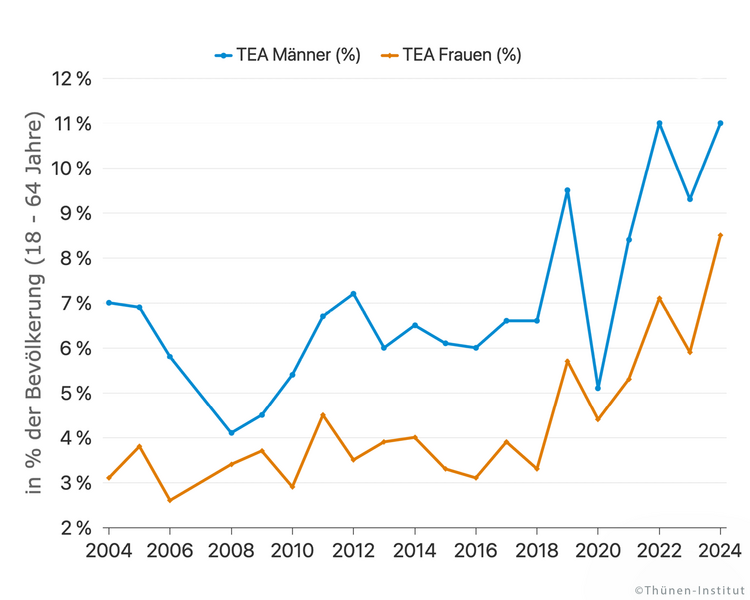
Women are underrepresented in the German start-up scene, but the number of female founders is rising significantly. In Germany, the gender gap in business start-ups is actually relatively small compared to the rest of the labor market. In addition, women were more likely than male founders to implement environmentally friendly measures in their businesses last year. This is shown in the special report “Women Entrepreneurship Monitor” by the RKW Competence Center, which was published on December 9, 2025.
Gesine Tuitjer and Christian Bergholz from the Thünen Institute of Rural Economics are co-authors of the special report and have analyzed the urban-rural differences in women's start-up behavior. Their conclusion: Women in rural areas start businesses less often than women in cities. Last year, 4.3 percent of women surveyed in rural areas decided to start their own business. In cities, it was 5.4 percent.
For all women surveyed, prosperity and high income were the most important motives for starting a business. However, significantly more female founders in cities (51 percent) rated this motive as very important than in rural areas (38 percent). Other motives for starting a business surveyed for the Global Entrepreneurship Monitor (GEM) were also significantly less important for women in rural areas than for women in urban areas. This suggests that the motives of women in rural areas could not be adequately captured in the survey. “The GEM report shows that we need to know more about the specific motives for starting a business and the support needs of female entrepreneurs in rural areas. Only then can we give women equal opportunities in the start-up process and strengthen economic momentum,” explains Gesine Tuitjer, Thünen researcher and co-author of the special report.
According to the start-up experts surveyed, men still have easier access to start-up financing than women. In addition, the GEM results suggest that a greater need for security may inhibit women from starting their own businesses. Role models that shape girls' attitudes while they are still at school may also play a role.
The special report is part of the world's largest start-up study: the Global Entrepreneurship Monitor (GEM). For the GEM, more than 3,000 people across Germany are regularly surveyed on start-up topics. Among other things, the survey records the proportion of people who have started a business in the past three years, are involved in an ongoing start-up, or are planning to start a business. In addition, a survey of experts is conducted.