Humus in arable soils promotes soil health and, as a natural carbon sink, also benefits climate protection. Alois Rainer, Federal Minister of Agriculture, Food and Regional Identity, was able to see this for himself during a field visit on 6 October 2025 to the HumusKlimaNetz demonstration farm AG Groß Machnow eG in Brandenburg. ‘The HumusKlimaNetz is a great example of what we can achieve when practice, research and politics work closely together,’ emphasised Alois Rainer during the tour.
The minister was briefed on humus and the Humus Climate Network by representatives of the project partners: Tina Andres, chairwoman of the German Organic Food Industry Association (BÖL), and Joachim Rukwied, president of the German Farmers' Association (DBV). Prof. Dr Birgit Kleinschmit, President of the Thünen Institute, was on site to represent the Thünen Institute, which provides scientific support for the HumusClimateNetwork. ‘Living labs and exchange formats with agricultural practitioners are very important to us at the Thünen Institute. We contribute our extensive scientific expertise, which is based on a wide range of data and models. At the same time, we learn a lot from the practical experience of farmers,’ explained the President in Groß Machnow.
During the subsequent field visit, those present were able to get an idea of the project measures that had been implemented – and see how they affect humus formation and conservation. On the demonstration farm, cover crops, the most frequently implemented measure in the project, and cup plant as a perennial energy crop are being tested. On a demonstration area, participants were also able to examine partial crumb deepening – a process that loosens compacted soils, improves root penetration and thus strengthens humus build-up.
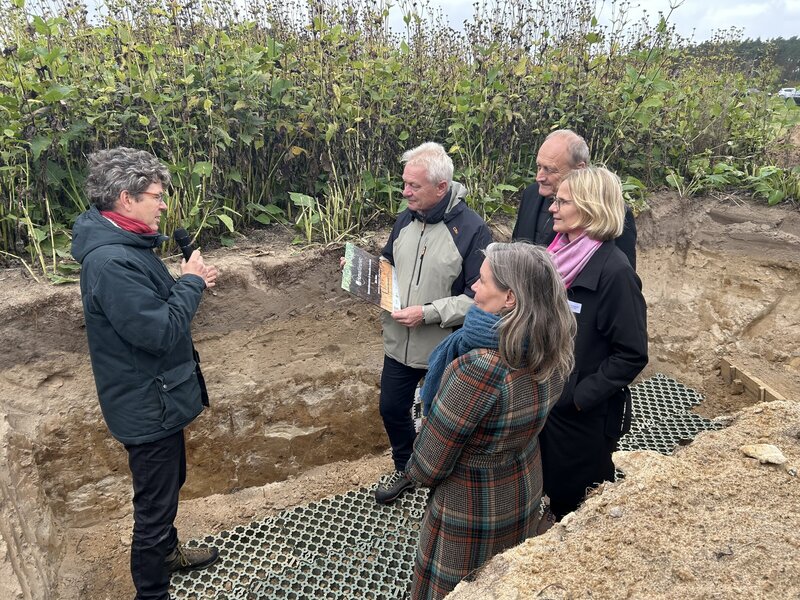
Prof. Dr. Axel Don, deputy director of the Thünen Institute of Climate-Smart Agriculture, concluded by taking the participants to a soil profile pit and showing them what humus means for the soil, using roots, earthworms and other organisms as examples.
In the model and demonstration project HumusKlimaNetz, approaches to humus build-up and conservation as a contribution to climate protection are being tested and evaluated on 150 farms across Germany and incorporated into broad agricultural practice. Half of the farms operate conventionally and half organically.