
Project
The scent of wood
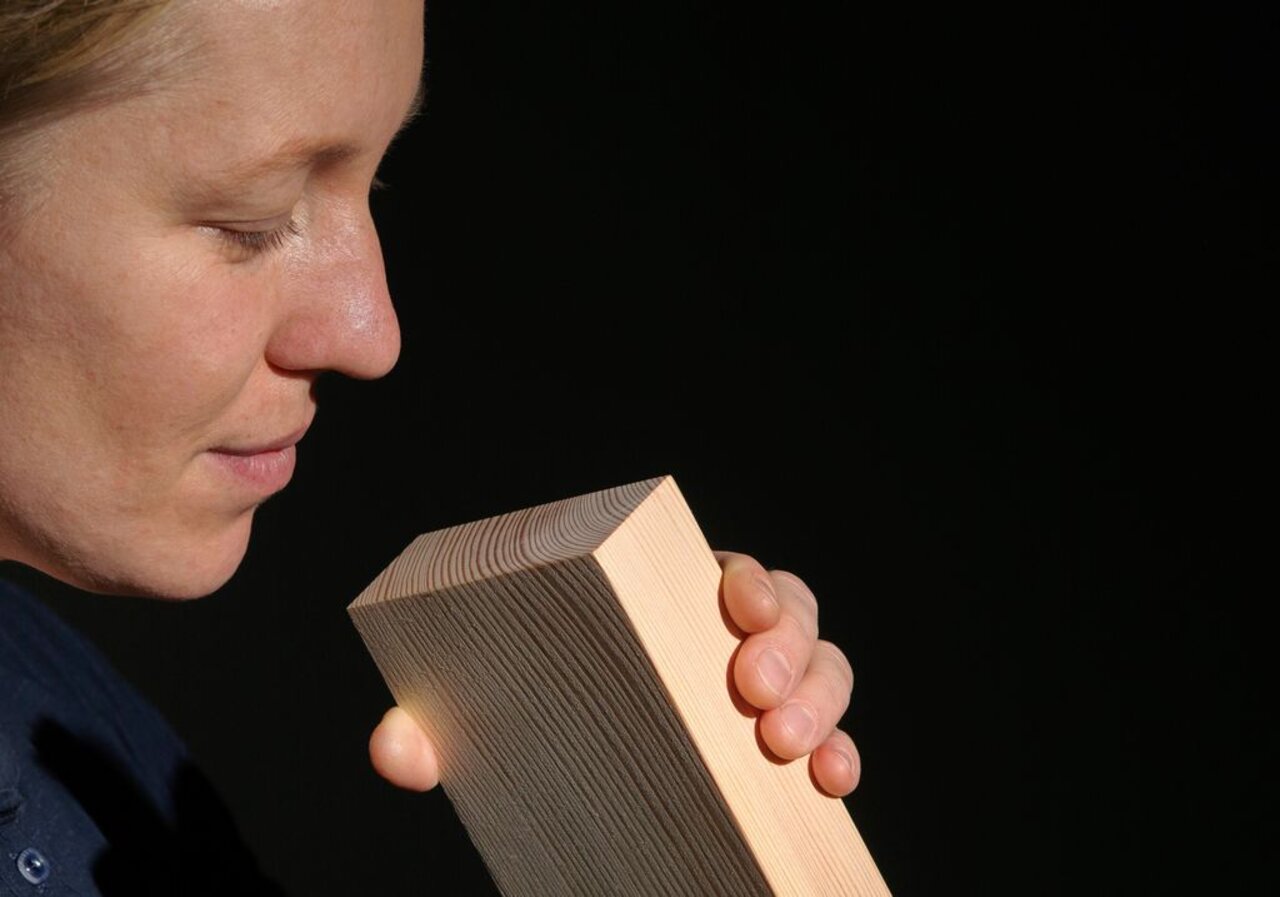
Wood for Good – Context-related, mixture- and concentration-dependent effects of volatile organic compounds from different wood species on human neurophysiology and chemosensory processing
Strong odours are a frequent reason for investigations of indoor air quality. Odours are caused, inter alia, by volatile organic compounds emitted by various materials (e.g., wood products) into the ambient air.
Background and Objective
Wood-based products emit a variety of odorous volatile organic compounds (VOC). In particular softwoods can have an intensive odour. However, also hardwoods and engineered woods can have their own distinctive scent. Due to their broad application as construction material and furniture, therefore, wood products can contribute considerably to the indoor odours.
For certain VOCs, including some that are emitted from wood products, guideline values exist that should not be exceeded indoors. These limits are intended primarily to protect vulnerable groups such as children, elderly people, and those with health conditions. Currently, however, there are efforts to introduce additional regulations for indoor spaces and for building products such as wood, specifically with regard to their odour. The project investigated to what extent such measures are purposeful.
Target Group
- Actors in the field of construction (architects, designers, wood construction companies, wood processing industries, decision makers in in the municipalities and public authorities).
- Consumers
Approach
The essential VOC emitted from wooden products are well-known due to emission tests. But the human nose is more sensitive than the analytical measuring method for some substances. This means that the human sense of smell can detect odour-active components even below the analytical detection limit. It is important to note that the olfactory impression follows the signal processing in the brain. Therefore, the mere analytical emission measurement does not necessarily allow conclusions on how a product odour is perceived.
Therefore, sensory testing of different wooden products was carried out by a panel according to ISO 16000-28. Contrary to the standard test, the influence of visual and psychological context was examined.
Our Research Questions
- How is the odour of various wooden products evaluated?
- Do visual cues of wooden materials vary the olfactory impression?
- Does the odour perception differ under laboratory conditions in comparison to real indoor conditions?
- Can the odour perception be manipulated by additional product information?
Results
Odours are perceived very individually, and their evaluation depends strongly on context. Terpene-rich scents, such as that of pine wood, were rated by participants as the most familiar and pleasant. The studies further showed that wood odours are processed multisensorially: simply viewing a matching material image or knowing the source of the odour made it seem more familiar and pleasant. This effect was observed primarily with solid wood, while the odour ratings of wood-based products such as OSB remained unchanged or even declined.
Against this background, it is questionable whether building products should be evaluated or regulated based on odour. Likewise, the concentration of individual VOCs is hardly suitable as a measure of potential odour nuisance. As long as the established guideline values for VOCs indoors are met, odours themselves do not pose a health risk. Therefore, additional regulation of odours from building products or indoor air cannot be justified as a measure to protect health.
Project brief: Butter K, Gallus V, Hucke CI, van Thriel C, Ohlmeyer M (2025) Follow your nose? : olfactory evaluation of wood products. Hamburg: Thünen Institute of Wood Research, 2 p, Project Brief Thünen Inst 2025/26a, DOI:10.3220/253-2025-179
Thünen-Contact

Involved Thünen-Partners
Involved external Thünen-Partners
-
Leibniz-Institut für Arbeitsforschung
(Dortmund, Deutschland)
Funding Body
-
Federal Ministry of Agriculture, Food and Regional Identity (BMLEH)
(national, öffentlich)
Duration
7.2020 - 8.2025
More Information
Project funding number: 22011115
Funding program: FNR
Project status:
finished