![[Translate to English:]](/media/_processed_/2/0/csm_LV_Bei_Hornburg_Quelle_Johanna_Fick_neu_da89674833.jpg "[Translate to English:]")
![[Translate to English:]](/media/_processed_/2/0/csm_LV_Bei_Hornburg_Quelle_Johanna_Fick_neu_3aae309567.jpg "[Translate to English:]")
Project
Valorisation of farm-specific fertiliser application data in Schleswig-Holstein
Valorisation of farm-specific fertiliser application data in Schleswig-Holstein
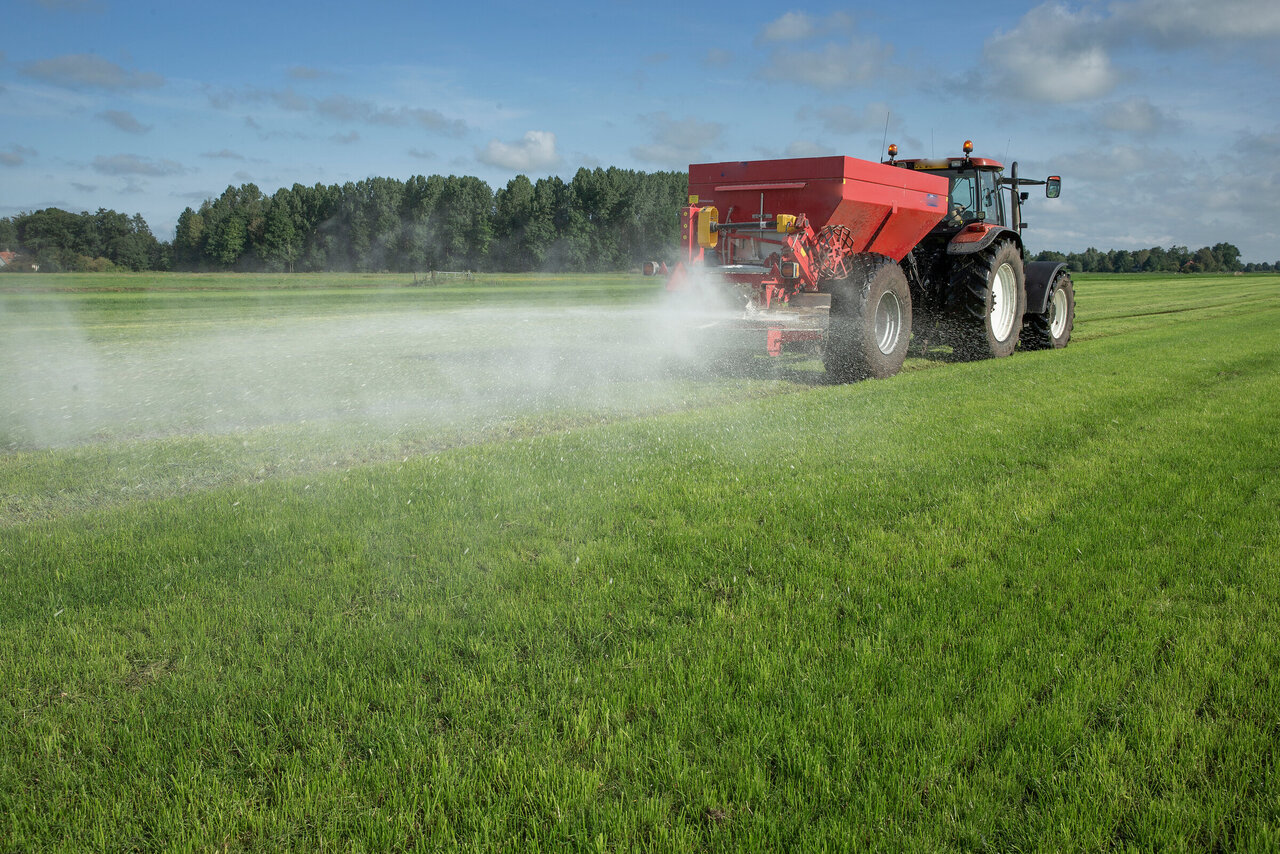
For the first time, farm-level data from official fertiliser documentation are available for quantifying spatially differentiated nutrient balances in Schleswig-Holstein. Analysis and application of these data will provide valuable insights for optimising fertiliser management and agricultural water protection.
Background and Objective
Excessive nutrient inputs from agriculture pose a threat to ground and surface water, potentially causing ecological damage and impacting drinking water quality.
Depending on the nitrate content in groundwater, Germany has designated with nitrate polluted areas, where stricter fertiliser regulations apply. These so-called "red areas" cover 9.5% of the agricultural land in Schleswig-Holstein.
Optimised fertiliser management is a key to protecting water bodies from agricultural nutrient inputs. To develop and evaluate water protection strategies, it is essential to quantify and analyse agricultural nutrient balances spatially. However, nutrient balances vary significantly between farm types, management systems, and individual farms. For the first time, a federal state is making its farm-level data from fertiliser documentation available for research. This enables in-depth small-scale analyses and spatially differentiated nutrient balances.
The INDUS project seeks to achieve three main objectives:
- Development and application of a method for regional nutrient balancing (nitrogen and phosphorus) using farm-level fertiliser data from Schleswig-Holstein.
- Comparative analysis of the balance results with the nutrient balances from the RELAS project
- Derivation of recommendations for regional fertiliser data management in Schleswig-Holstein and implementation of the impact monitoring for the Fertiliser Application Ordinance.
The project will also contribute to the further implementation of impact monitoring, which is being developed at the Thünen Institute, among others, with the RELAS project.
Target Group
Policy makers, agricultural and water management authorities, farm managers, environmental organisations, farmers' associations, interested members of the public and researchers
Approach
- Establishing the data foundation: Acquisition and preparation of farm-level data, as well as integration with additional data and plausibility checks.
- Exploratory data analysis: Identification of potentials and limitations of the dataset, as well as analysis of regional and farm-level patterns in fertilisation practices.
- Regionalization of agricultural statistics: Utilisation of farm-level fertiliser data to regionalise other agricultural statistics, such as crop yields.
- Modelling: Modelling of nutrient balances using farm-level fertiliser data and established modelling approaches (RAUMIS) at the federal level.
- Comparison and analysis: Comparison of balances using farm-level data with results from the RELAS project, including analysis of potential differences.
- Derivation of recommendations for regional fertiliser data management in Schleswig-Holstein and implementation of impact monitoring for the Fertiliser Application Ordinance.
Data and Methods
The project will be based on farm-level data from the Schleswig-Holstein State Agricultural Administration for the years 2022 to 2025, supplemented by additional agricultural statistics.
Our Research Questions
The INDUS project seeks to address the following research questions:
- Suitability of farm-level fertiliser data: Are farm-level fertiliser data suitable for nutrient balancing? Are there spatial and temporal gaps?
- Regionalisation of data: To what extent can data from fertiliser requirement determination and documentation contribute to the regionalisation of statistical data?
- Advantages of farm-level data: Do farm-level data show advantages in nutrient balancing compared to other approaches, and can they contribute to an improved water protection strategy?
- Insights into fertiliser data management: What insights into fertiliser data management can be gained, and what recommendations can be derived from this?
Thünen-Contact

Involved Thünen-Partners
Funding Body
-
Bundesland Schleswig-Holstein
(national, öffentlich)
Duration
1.2025 - 12.2027
More Information
Project status:
ongoing