
![[Translate to English:]](/media/_processed_/6/1/csm_AdobeStock_543466681_9df3d40718.jpeg "[Translate to English:]")
![[Translate to English:]](/media/_processed_/6/1/csm_AdobeStock_543466681_6eab1c26f9.jpeg "[Translate to English:]")
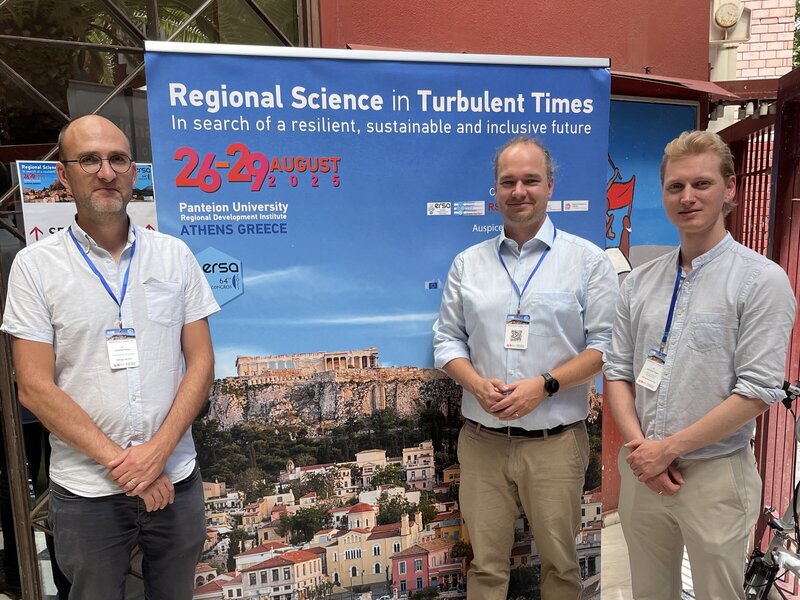
“Regional Science in Turbulent Times” was discussed among other topics at the ERSA Congress 2025, which took place from August 26 to 29 at Panteion University in Athens. The Thünen Institute of Rural Economics contributed three paper presentations and participated in the organization of a special session on agglomeration (dis-)economics.
Alexander Kopka presented joint work with Nils Grashof (University of Jena) and Johannes Dahlke (University of Twente), which is part of the project “Artificial intelligence and regional economic development”. The study examines the innovation pathway from AI research to the implementation and use of AI in firms. In a second step, the influence of both dimensions on company productivity is also examined. AI research activity is measured using patent data, while AI application and usage are assessed through web scraping of firm websites. Preliminary findings suggest a clear linkage between firms engaged in AI research and those implementing it; however, the effect on productivity remains inconclusive.
Disruptive transformation processes are also at the center of a project by Damiaan Persyn and Alexander Kopka on “The regional ripple effects of industrial transformation”. At the ERSA conference, Damiaan Persyn presented results from their study “Tracing the Effect of Sectoral Transformation Through Space: The Case of German Car Manufacturing in Turbulent Times.” The study investigates the effects of structural change in the German car manufacturing sector across different regions and industries. To assess the potential effects, it compares two widely-used model approaches. The first model is based on a traditional input-output (IO) analysis, which captures the short-term effects of shocks. Using highly detailed data on trade in intermediate and final products, the analysis shows that the effects are strongly limited locally and largely follow existing value chains. The second model is a quantitative spatial framework that incorporates adjustment mechanisms through prices for goods, labor, and housing, as well as commuting, migration, and trade. This approach shows that the effects are distributed more evenly across space. This suggests that the adjustment channels embedded in the spatial model help regions to better absorb and adapt to demand shocks.
Finally, the spatial consequences of structural change were also the focus of a special session organized, among others, by Jan Cornelius Peters on the topic “New insights into agglomeration (dis)economies: effects and underlying mechanisms” (co-organizers: Lina Bjerke (Jönköping University, Sweden), Annekatrin Niebuhr and Duncan Roth (Institute for Employment Research, Nuremberg)).
Within the framework of this special session, Jan Cornelius Peters presented results from his project “Economic effects of the spatial uneven distribution of workers as well as firms”. His presentation examined how (regional) structural change since 1975 has affected the accumulation of valuable work experience and individual wage growth over the course of working lives. Over the entire observation period, employees receive a lower wage premium for work experience if it is accumulated in a rural area rather than in a highly densely populated region. This disadvantage in rural, as well as its changes over time, are related to the fact that workers in rural areas are employed in different types of jobs than employees in highly densely populated regions. Jobs associated with high wage premiums for accumulated experience are less frequently found in rural areas. In addition, wage premiums for certain types of experience have changed over time. This also contributed to changes over time in the (relative) premium for work experience in rural areas. However, there is no clear trend over the past 50 years.
Contact: Dr. Jan Cornelius Peters