
![[Translate to English:]](/media/_processed_/6/1/csm_AdobeStock_543466681_9df3d40718.jpeg "[Translate to English:]")
![[Translate to English:]](/media/_processed_/6/1/csm_AdobeStock_543466681_6eab1c26f9.jpeg "[Translate to English:]")
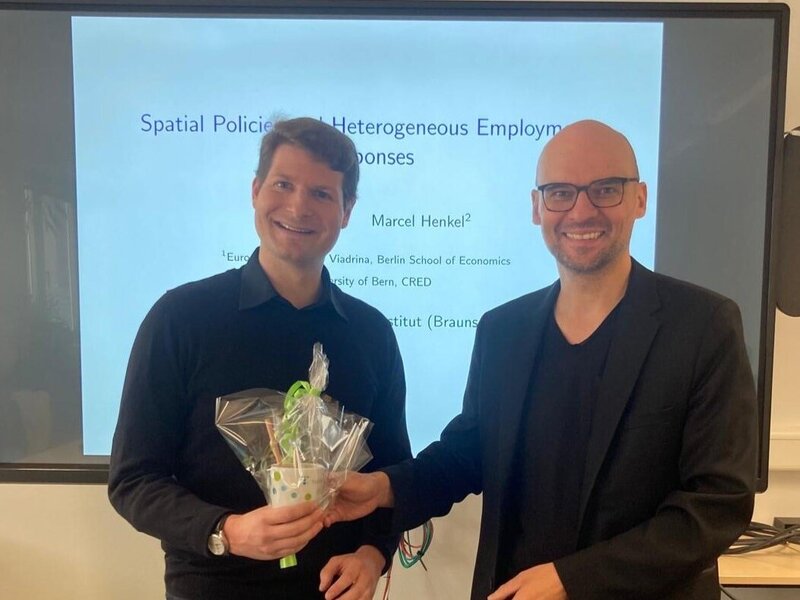
The impact of spatial redistribution on economic outcomes and employment has long been a central concern in regional economics. In their recent paper, Fabian Bald (European University Viadrina) and Marcel Henkel (University of Bern) show that spatial fiscal policies can enhance economic outcomes by reducing barriers to local labour force participation, with different effects across demographic groups and locations. Within a quantitative spatial model, the authors emphasize a new mechanism by which spatial policies affect economic activity: Place-based transfers enable the provision of public goods and services, such as childcare and transportation, in regions with high employment potential but limited fiscal capacity. This redistribution reduces employment barriers for workers, especially for women. Providing empirical evidence German labour markets, the analysis shows that when labour market frictions vary across space and demographic groups, well-designed spatial policies can address market failures and improve efficiency.
On May 21, 2025, Prof. Dr. Fabian Bald presented the results of his paper in the seminar series at the Thünen Institute of Rural Economics.
The Working Paper is online available here: https://drive.google.com/file/d/1E2EpyRsAIM7Hm_S34Nn78AzIar67MC6i/view
Contact: Dr. Lena Gerling