![[Translate to English:]](/media/_processed_/6/1/csm_AdobeStock_543466681_9df3d40718.jpeg "[Translate to English:]")
![[Translate to English:]](/media/_processed_/6/1/csm_AdobeStock_543466681_6eab1c26f9.jpeg "[Translate to English:]")
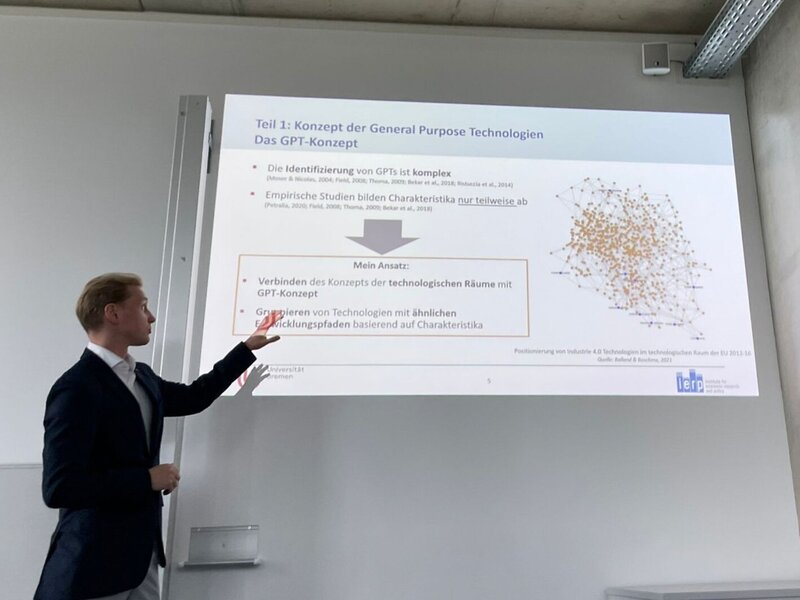
In his cumulative dissertation entitled “Artificial Intelligence in Technological Spaces – The Influence of AI on Economic and Technological Development in Organizations and Regions”, Alexander Kopka examines how artificial intelligence (AI) shapes economic and technological systems as a general-purpose technology (GPT) and as an “invention of a method of inventing (IMI)”. He shows that AI does not automatically lead to productivity gains, but can have very different – and sometimes contradictory – effects depending on the type of technology, company size, and regional context.
Methodologically, the work combines network, time series, and regional analyses based on more than a hundred years of patent data, among other sources. This makes it possible to identify the life cycles of GPTs in the technological space and to reveal the networked structure of knowledge and innovation.
The results show that knowledge in AI application areas promotes radical innovation, especially in larger companies, while smaller businesses benefit primarily from AI technical knowledge. At the regional level, AI can support both growth and sustainability, but it can also reinforce unequal development trajectories if existing knowledge gaps are widened.
With this work, Alexander Kopka makes an important contribution to understanding the so-called “AI productivity paradox” and provides concrete implications for politics, economics and businesses in order to shape technological change in a targeted and regionally balanced manner.
Alexander Kopka would like to thank his supervisor, Prof. Dirk Fornahl, for his expert guidance, and his examiners, Prof. Martin G. Möhrle, Prof. Uwe Cantner, and Prof. Christian Cordes, for the inspiring discussion during the defense.
Contact: Alexander Kopka