![[Translate to English:]](/media/_processed_/6/1/csm_AdobeStock_543466681_9df3d40718.jpeg "[Translate to English:]")
![[Translate to English:]](/media/_processed_/6/1/csm_AdobeStock_543466681_6eab1c26f9.jpeg "[Translate to English:]")
Project
Sustainability effects and crisis resilience of short food supply chains
„Short Food Supply Chains (SFSC)“ are generally associated with positive effects for producers, consumers, and the regional environment and economy. However, a challenge for the scientific assessment of the potential effects of short food supply chains is the heterogeneity of their manifestations.
Background and Objective
The strengthening of short food supply chains is identified in various strategies at the European and international level (EU Farm-to-Fork, UN Agenda 2030 for Sustainable Development, FAO Urban Food Agenda, etc.) as a building block for transforming the agricultural and food system towards more sustainable production and supply structures. However, for a scientific evaluation of potential sustainability effects, an initial problem is that the term "Short Food Supply Chains" is not clearly defined. Rather, it's an umbrella term for many different forms of food production, distribution, and consumption that are fundamentally based on spatial and socio-emotional "proximity" between producers and consumers.
Typical forms include, for example, the direct marketing of agricultural products (farmers' markets, vegetable box schemes, farm shops, etc.) in so-called "short chains" (SFSC). Additionally, "alternative" food networks (AFN) like Community Supported Agriculture (CSA) and "Local Food Systems" (LFS) represent forms of short food supply chains that pursue broader social, ecological, and political goals beyond just food supply.
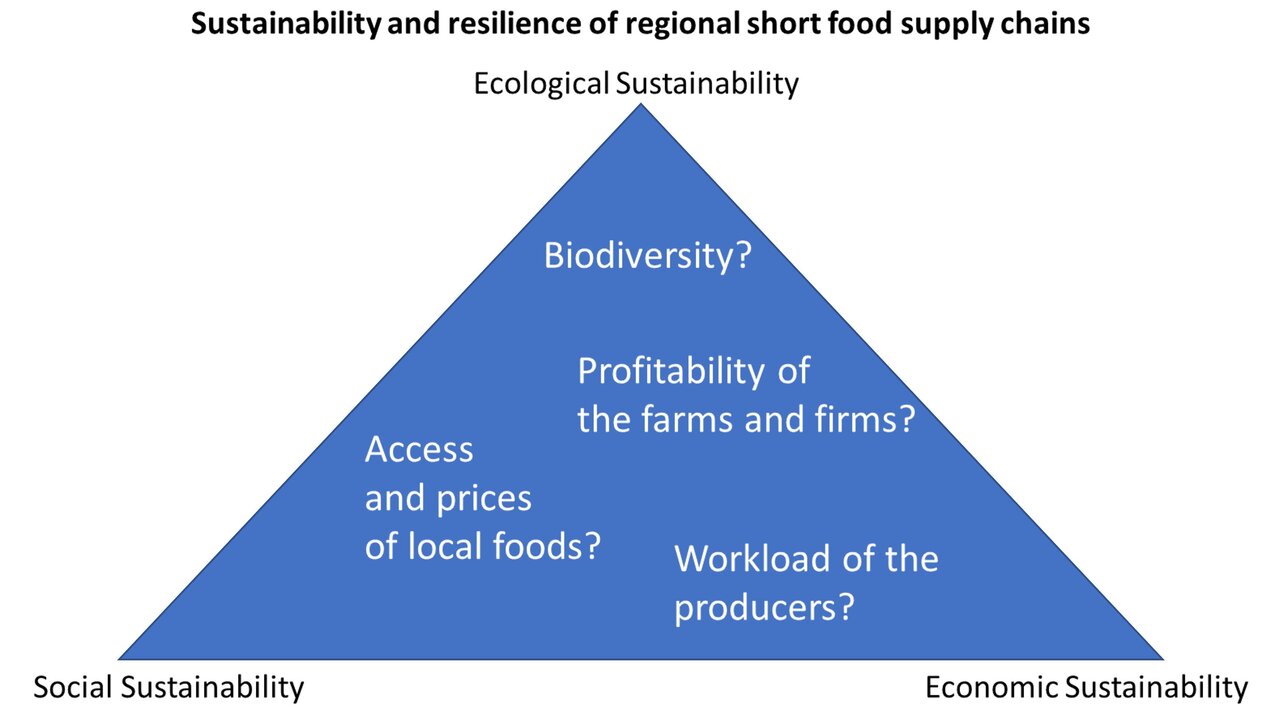
Our project pursues three goals: First, we aim to trace the development of the umbrella term "Short Food Supply Chain" and differentiate between various forms of them. Second, we want to better understand the potential influence of these different forms of short food supply chains on the development of rural areas, particularly with a focus on the three dimensions of sustainability: ecology, economy, and social aspects. Third, we would like to shed light on the extent to which and under what conditions short food supply chains prove to be resilient (or not) in the face of crises.
Approach
Our methodological approach is a systematic literature review, to first trace the development of the umbrella term "Short Food Supply Chain" and its differentiation into various forms in academic literature. Subsequently, we will analyze which aspects of the three sustainability dimensions (ecology, economy, social) are associated with the different forms (SFSC, AFN, LFS) in the literature. After completing the systematic literature review, we will use semi-structured interviews to investigate how producers in short food supply chains in Germany have reacted to crises.
Our Research Questions
- How has the concept of "Short Food Supply Chain" evolved from a concept for the (economic) development of rural areas into a building block of global sustainability strategies?
- Which aspects of economic, ecological, and social sustainability are associated with which forms of short food supply chains or what sustainability effects can they unfold?
- How are potential trade-offs between the three sustainability dimensions discussed in the academic literature on short food supply chains?
- How have individual producers in short food supply chains in Germany reacted to crises?
Thünen-Contact

Involved Thünen-Partners
Duration
10.2024 - 2.2026
More Information
Project status:
finished