![[Translate to English:]](/media/_processed_/6/1/csm_AdobeStock_543466681_9df3d40718.jpeg "[Translate to English:]")
![[Translate to English:]](/media/_processed_/6/1/csm_AdobeStock_543466681_6eab1c26f9.jpeg "[Translate to English:]")
Project
Innovation and Knowledge Transfer in Agriculture and the Food Industry
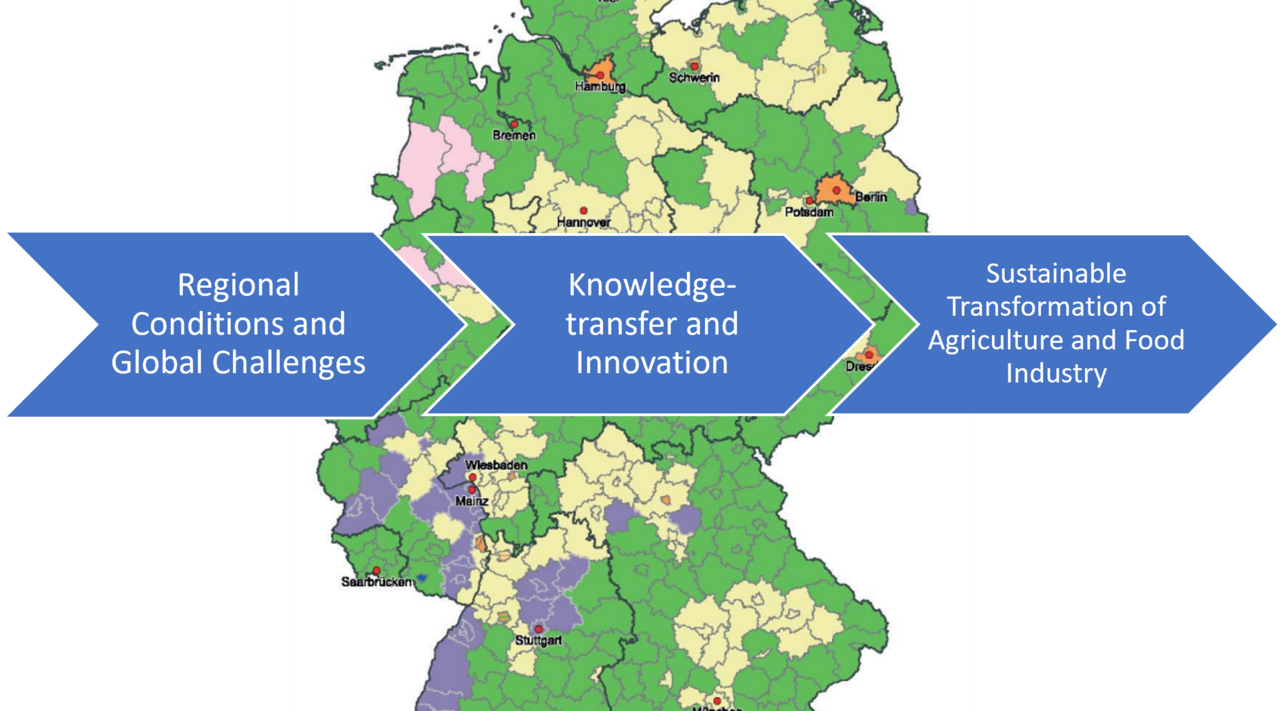
Competing sustainability objectives in the agriculture and food industry determine the social discourse. Different objectives lead to a variety of practices being labeled as sustainable. From a scientific point of view, there are solutions that reconcile economic and ecological goals. These are innovations that enable a sustainable transformation of the agriculture and food industry. In this project, we investigate what kind of innovations characterize the agriculture and food industry and what promotes or hinders the adoption of sustainability innovations and helps to explain regional differences in dissemination.
Background and Objective
Globally, the agricultural and food industries are facing major challenges: Scarcity of agricultural land due to land use competition on the one hand and degradation of land and fluctuations in yields due to climate change on the other. Although the need for a transformation of agriculture is undisputed, the answers to this challenge vary. While in the Global South, particularly in Asia and South America, but also in Africa, the focus is on increasing productivity, in Europe there is a much stronger focus on resource conservation. In addition to the European Union's Common Agricultural Policy (CAP), the BMEL's strategy to increase the proportion of land used for organic farming to 30% can also be seen as an expression of this focus on aspects of sustainability and climate and resource protection.
From a scientific point of view, solutions that reconcile economic and ecological goals are available. These are innovations that enable a sustainable transformation of the agriculture and food industry, i.e. that reconcile economic, ecological and social goals and also address the challenges of climate change (droughts, etc.). These include agroecological approaches in particular. Although such approaches promise that it is possible to increase yields while simultaneously reducing resources, thus also reducing emissions, the adoption and dissemination of these technologies fall far short of expectations and vary greatly from region to region.
Against the background of current challenges, the aim of the project is to gain new insights into the importance of innovation and knowledge transfer for the sustainable transformation of the agriculture and food sector in rural areas.
Approach
We explore which objectives guide possible innovation processes in agriculture and the food industry. While at a global level the focus is on principles of agroecology that aim to increase yields through ecologically sustainable practices, in rural areas of Germany ‘organic farming’ in particular is being promoted. Different objectives compete within the ‘organic farming’ spectrum. This is accompanied by a broad and inconsistent repertoire of practices. Some of these practices are productivity-oriented and aim to be ecologically and economically sustainable. Other practices, on the other hand, refer to objectives in which efficiency or yield increases play a subordinate role compared to, for example, variety preservation, seed diversity or internal farm cycle processes etc. (e.g. biodynamic agriculture). These objectives are certified by labels such as the EU organic label and/or are identified by membership of farming associations such as Demeter.
We first assess the large variety of objectives and then strive to categorize these objectives in a (simplified) way, for example in “scale” (yield increase through ecologically sustainable measures and specialization) vs. “scope” strategies (combination of different value-added branches in the farm) or growth vs. post-growth target orientations. We analyse the regional distribution of these objectives via membership of farming associations.
Patent data gives us an insight into the various areas in which agricultural innovations are gaining acceptance (for example in the area of soil and fertilizer management or precision agriculture). This allows us to classify the extent to which innovations are developing towards sustainability.
Building on this, we investigate which factors favour or hinder the adoption and diffusion of agricultural innovations and what role local context factors play. We pay particular attention to regional differences.
Data and Methods
We organize our work in two steps: first, we analyze the existing literature to obtain an overview of the available knowledge:
1. We examine classical theories on the diffusion of innovation and critically question whether they are suitable for the processes in the agricultural and food sector. In this way, we contribute to a conceptual understanding of the special features of the agricultural and food sector.
2. we then use a systematic literature review to examine the existing literature on the diffusion of agroecological innovations. In particular, we look at factors that promote or hinder the adoption and diffusion of agricultural innovations. The respective contextual factors are also important. In addition to agroecological conditions, these include market conditions and institutional factors as well as behavioral aspects of farmers.
3. we evaluate the existing state of knowledge on various objectives declared as sustainable in agricultural production. In particular, we examine the regional distribution of different objectives.
In addition, we use patent data and collect our own qualitative data to investigate the regional distribution of innovation activities in agriculture:
4. Based on patent data, we analyze what kind of innovations are patented in the field of agricultural production. In this way, we can show in which areas of agricultural production patents are registered and classify the role played by sustainability.
5. We collect own data in the form of expert interviews with farmers. In doing so, we examine what kind of innovations are currently important for farmers. We select different regional and farm contexts as case study regions. We then conduct interviews with farmers. On the one hand, this enables an assessment of the actual distribution of agricultural innovations and an overview of regional differences. Furthermore, qualitative approaches enable a comprehensive assessment of barriers and facilitating factors as well as the importance of (local) context factors.
Our Research Questions
- What are the different objectives for the “sustainable” transformation of the agricultural and food sector in rural areas, and what is the regional distribution?
- In which areas are agricultural innovations patented? Can a trend towards sustainability be identified?
- What helps or hinders the adoption and dissemination of agricultural innovations in rural areas? What regional differences are there and what role do (local) context factors play?
Thünen-Contact

Involved Thünen-Partners
Duration
2.2025 - 1.2030
More Information
Project status:
ongoing