![[Translate to English:]](/media/_processed_/8/e/csm_Bildschirmfoto_2021-03-03_bearb_fc48ac88bf.jpeg "[Translate to English:]")
![[Translate to English:]](/media/_processed_/8/e/csm_Bildschirmfoto_2021-03-03_bearb_ba3ec0e9d7.jpeg "[Translate to English:]")
Project
On-farm research network for organic dairy farms in Germany
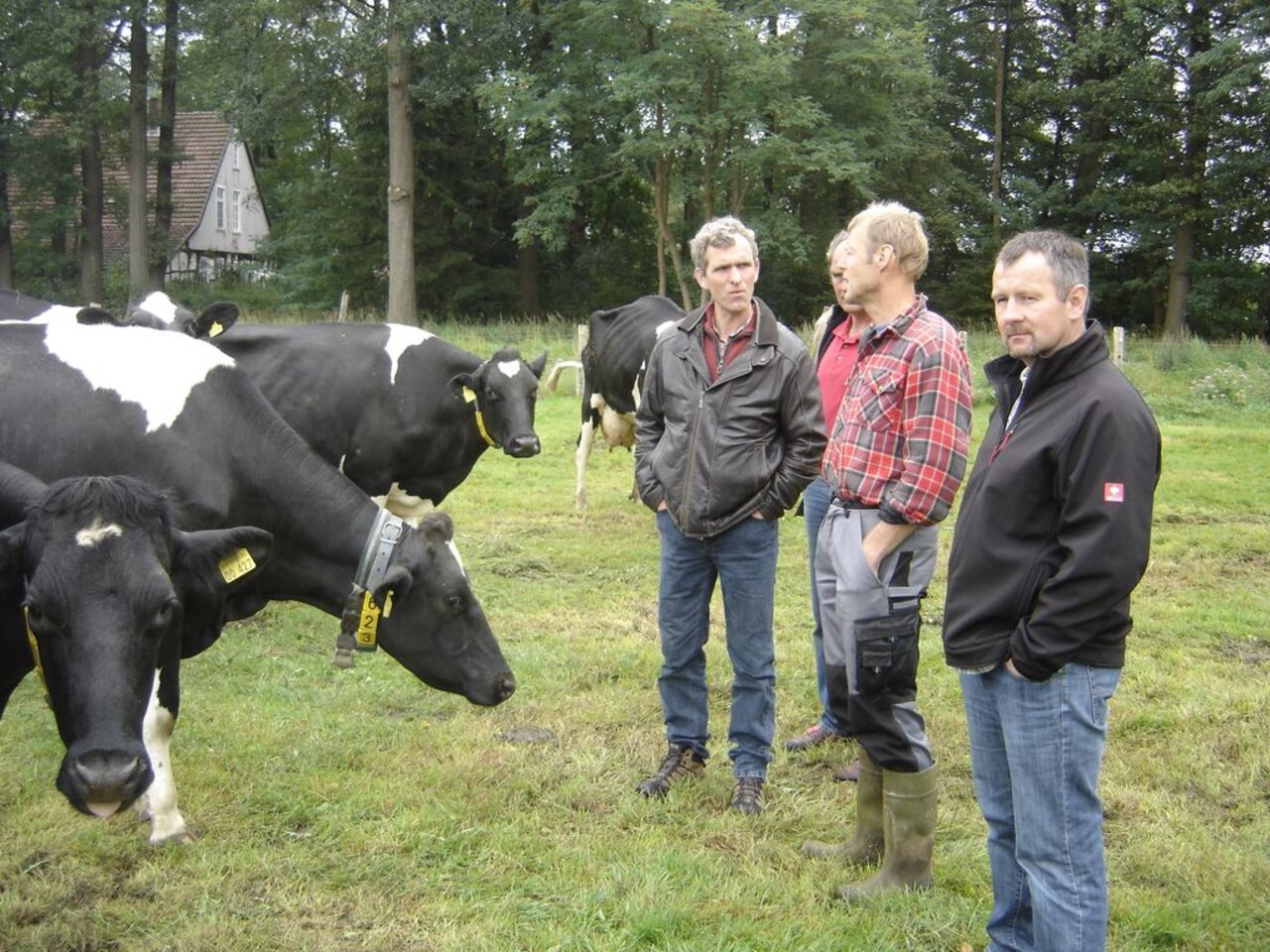
Establishment of an on-farm-research network for organic dairy farms
On-farm research with a continuous exchange between practice and research enables the sustainable transfer of findings into practice. Conversely, science receives impulses from practice for relevant research questions.
What are the trends and developments in production systems? Through the establishment of a reference network comprising organic dairy farms, we seek to monitor and analyze ongoing practical advancements to ensure our insights remain current and relevant
Background and Objective
Organic managed farms are characterized by an extraordinary diversity. They are also constantly evolving, affected by structural change, continuously developing their production methods, professionalizing, adopting new production sectors, or ceasing others. We aim to document, monitor, and investigate these changes and developments within organic farms. A permanently established and continuously supervised reference network enables the long-term tracking of the evolution of farms and their structures. This allows for the efficient and timely conduction of ad hoc studies addressing current questions and developmental processes, including policy advice. The transfer of knowledge between research and practice is facilitated through this collaboration, enabling innovative solutions from practice to be integrated or jointly developed by science and practice. Comprehensive data knowledge and monitoring of the developments within the farms are very important for policy advising. Through a reference network of organic farms, which is maintained on a long-term basis, these data foundations can be established. Ruminants are integral to organic agriculture, and milk production possesses substantial economic significance within the context of organic food systems. Consequently, the primary focus in the development of the practice research network is on farm systems of organic dairy cattle operations. The objective is to establish a comprehensive, nationwide reference network with a particular focus on organic dairy cattle farms. In this network, we aim to advance practice-oriented research in collaboration with dairy farmers to facilitate practical development and continuous feedback between practice and science. At the same time, the establishment of a reference network allows us to efficiently address current issues and developmental processes through ad hoc investigations, including policy advisory, without significant time delays. i.e. we are able to: • Validate and further develop insights from scientific studies under real conditions on practical farms, i.e., verify theories or experimental results from "exact experiments" in practical settings, • Monitor interventions across various areas of practical farms over an extended period, • Analyse the impacts of policy measures or changes in the market environment, • Practically represent the diversity of common production methods in organic farming and their development (monitoring), • Investigate and address current issues in the short to medium term based on a comprehensive and up-to-date data basis — for example, within the scope of policy advisory. In long term, the objective of such a reference network could also involve integrating production-related data with socio-economic information. This integration is essential because, in order to implement agricultural policy measures effectively and efficiently to achieve political and societal goals, both advisory scientists and policymakers require access to comprehensive data encompassing both production and socio-economic aspects.
Approach
Through the establishment of a nationwide, permanent practice-based research network with long-term engagement of participating farms, we aim to build trust through long-term collaboration. For the participating farms, involvement should inherently provide additional benefits: in addition to offering various exchange format (such as topic-specific discussions among the farms) different methods of processing the collected data and providing feedback are conceivable. Examples include benchmarking or horizontal and vertical operational comparisons over time, which are highly meaningful and motivating for practitioners to engage in a network. Simultaneously, standardized routines can be developed to facilitate data collection and the transmission of data from the companies to researchers, potentially through digitalization, thereby streamlining the process and enhancing efficiency. The close monitoring of the reference network's participating farms, combined with regular data collection on the development of production processes, animal performance and yields, and potentially additional economic indicators, is essential. This support plays a key role, as it is the only way to ensure that practice-based farms remain engaged in the long term and can derive benefits from their participation. From a scientific perspective, as well as from the standpoint of policy advisory, this long-term collaboration can generate significant value: baseline and comparative data can be continuously collected and analyzed across the entire farm operation over an extended period. This serves to capture the current status quo and the long-term development (monitoring), thereby enabling the assessment of various issues and nationwide trends, as well as the formulation of new research questions. Policy advisory and impact assessment would be enhanced, allowing for the derivation of both policy and operational recommendations.
Data and Methods
To establish a reference network capable of generating generalizable and broadly applicable results across practical farming operations, it is essential to identify typical farms characterized by specific intensities and operational structures. In selecting these farms, particular attention must be paid to the extreme agri-structural differences across various regions of Germany. Only through this approach can universally valid, practice-relevant findings be obtained that accurately represent the diversity of farm types throughout Germany. Based on preliminary work, we are currently in the process of recruiting long-term participants for a practice-based research network of organic dairy farms, utilizing existing larger farm data sets from previous projects focused on dairy cattle operations. Additionally, we aim to maintain and strengthen collaborations with other existing networks that operate regionally or thematically, in order to leverage synergies and enhance the overall research impact.
Our Research Questions
• Practice-oriented and current depiction of production methods in (typical) organic managed dairy farms nationwide. • Participatory practice-based research for the development and feedback loop between practice and science, and vice versa, ensuring continuous knowledge transfer between practice and research: ‒ Sustainable transfer of findings into practice: development of concepts for practical implementation and establishment, as well as identification of barriers. ‒ Impulses from practice to generate relevant research questions. • "Monitoring": How do production systems evolve over time? • Addressing long-term questions and developmental processes efficiently through continuous and comprehensive farm-level data collection, for example: ‒ Interventions in farm management practices, ‒ Impacts of policy measures, ‒ Changes in market environment. • Evaluate and further develop insights derived from scientific investigations conducted under real-world conditions within operational settings: ensuring the complexity of the interrelationships among various influencing factors in practical contexts is adequately addressed. • To address ad hoc questions related to policy advisory: investigate short- to medium-term production-technical issues based on a comprehensive data foundation. • To monitor the progression of organic farms development in practice and to document its evolution.
Preliminary Results
The current status of the development of the Practice Research Network (January 2026) is as follows: we have received over 70 positive responses regarding participation from approximately 260 farms involved in previous practice projects conducted between 2002 and 2019. After feedback on the so-called "master data sheet" with an overview of characteristics of dairy farming for the respective farm, the first farm visits took place in 2025. Around 65 farms were visited. In addition to a basic survey with animal welfare assessments in the dairy herds, this initial on-site contact served primarily as an opportunity for personal exchange. In particular, suggestions for research topics by the farm managers were also taken up.
Kontakt: praxisforschung@thuenen.de